Sayre Gomez at David Kordansky Maps Los Angeles as a Ruin in Real Time
Precious Moments is Gomez’s most expansive exhibition to date, using painting, sculpture, and video to show how spectacle, neglect, and private memory are.
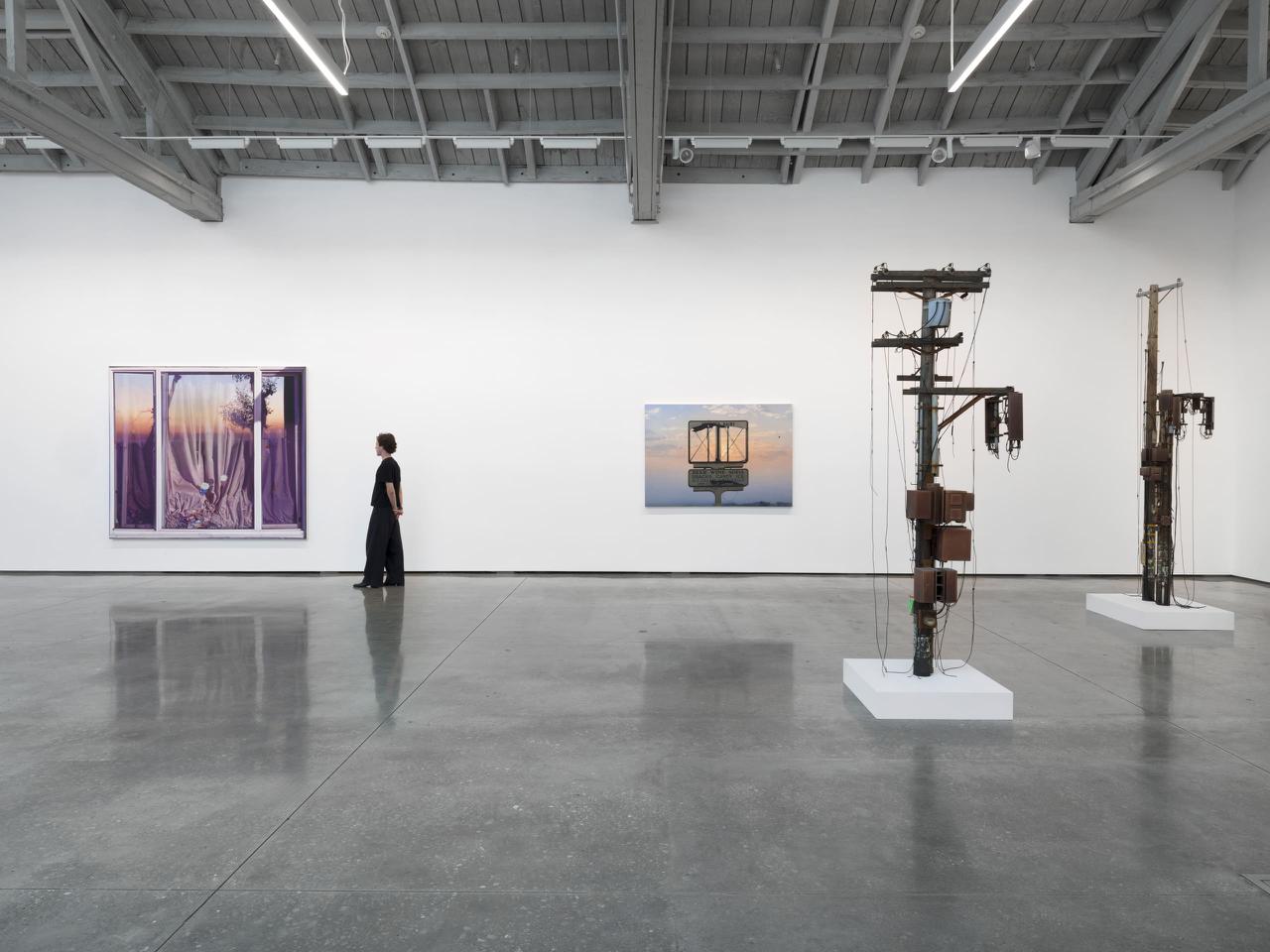
Sayre Gomez’s Precious Moments at David Kordansky Gallery occupies all three Los Angeles spaces and feels calibrated to that scale. The exhibition is ambitious in medium and tone, moving between large-format photorealist paintings, meticulously engineered sculptures, and video works that extend rather than duplicate the painterly argument. What emerges is not simply a survey of urban motifs, but a tightly edited study of how contemporary Los Angeles organizes attention through signage, architecture, fantasy, and neglect.
Gomez has long been associated with a hyper-attentive rendering of the city’s visual systems, billboards, utility poles, strip mall signage, facades, and over-coded commercial surfaces, yet this exhibition pushes his practice into a more integrated and, at points, more intimate register. The title invokes the sentimental figurine brand, and the show uses that reference as both lure and critique. Underneath the language of innocence, Gomez assembles an image-world where childhood iconography, consumer aspiration, and infrastructural failure are inseparable.
His paintings remain the exhibition’s anchor. Technically, they demonstrate the composite method he has refined over years: source materials from phone images, found photographs, and stock references are merged, translated, and re-authored through painting. The result is a paradox that has become central to his work: images that feel documentary in clarity but are structurally constructed propositions. He is not giving us neutral city views. He is staging how the city is seen, and by whom.
Gomez’s sharpest move is to treat Los Angeles not as backdrop but as evidence, every sign, tower, window, and banner becomes a record of who gets visibility and who absorbs the cost of it.
Vertigo (2025) crystallizes this method. A giant fast-fashion billboard crowns an Art Deco building while a makeshift domestic vehicle sits below, collapsing glamour marketing and housing precarity into one visual field. The work could have settled for obvious social contrast. It does not. Gomez’s compositional discipline, light control, and spatial calibration keep the painting from becoming didactic illustration. The contradiction is not told to us; it is embedded in the way the picture holds together.
Several other canvases deepen this argument by using damaged or fading public graphics as emotional index. In works such as Vaccine Flag and Ice Cream Groceries, torn banners and broken sign structures are placed against luminous skies that might otherwise read as cinematic consolation. Gomez repeatedly interrupts that pleasure. Beauty arrives, then catches on evidence of exhaustion. This push-pull is where the paintings are most convincing: they neither celebrate urban decay nor flatten it into morality play.
Window paintings, including Apartment Window and Bay Window, are among the strongest works in the show because they literalize layered visibility. Sticker residues, blinds, interior clutter, pharmaceutical traces, and reflected sunsets occupy the same pane. These pictures are less about domestic interiors than about visual thresholds, what is screened, what leaks, what gets seen accidentally. In an era where interfaces mediate most forms of attention, Gomez’s windows read as analog counterparts to stacked digital feeds.
The sculptural program is equally significant and arguably where Precious Moments becomes a full exhibition rather than a painting show with objects. Totem 4 and Totem 5, utility-pole accumulations rendered with extraordinary material fidelity, demonstrate Gomez’s interest in communication as physical sediment: cables, notices, flyers, ad fragments, and weathering marks compose a vertical history of use. These are not neutral infrastructure studies. They are social archives in compressed form.
Playground and Annelid extend this logic into childhood architecture. By extracting familiar play structures from lived scale and relocating them into sculptural attention, Gomez exposes how nostalgia itself is built, coded, and maintained. The miniaturization is not merely cute inversion. It is a way of making viewers confront their own habits of selective memory, what gets retained as softness, what gets excluded as structural context.
The exhibition’s most discussed object, and rightly so, is Oceanwide Plaza (2025–26). Gomez’s model of the unfinished downtown Los Angeles megadevelopment is technically staggering and conceptually pointed. By reproducing the abandoned towers, including graffitied surfaces and construction residue, he transforms a citywide symbol of speculative collapse into a concentrated sculptural argument. The work functions simultaneously as portrait, memorial, and forensic model of a development regime that promises futurity while externalizing failure.
What makes Oceanwide Plaza especially effective is that it resists the familiar critical binary of condemnation versus romanticization. Gomez does not sanitize the structure into formalist abstraction, and he does not instrumentalize it as one-note anti-capitalist emblem. Instead, he keeps contradictory temporalities visible at once: corporate ambition, financial breakdown, unauthorized artistic occupation, and pending redevelopment. The sculpture holds this unstable sequence without forcing closure.
The video components, including ¡ACCIDENTES! and the longer title work Precious Moments (2026), contribute to the exhibition’s concern with looped time and ambient crisis. Rather than delivering narrative explanation, they operate as rhythmic counterpoints to the objects and paintings, reinforcing the sense that urban life is experienced as recursive incident, image repetition, and interrupted attention. Gomez uses duration sparingly but intelligently.
A notable achievement of the show is tonal control. Political art about cities often collapses into either detached cynicism or affective overstatement. Gomez avoids both. His mood is cooler, observational, and materially exact, yet never indifferent. There is care in the handling of surfaces and details that reads as ethical, not merely technical. He seems less interested in declaring what Los Angeles means than in showing how meaning is manufactured through ordinary visual systems.
If there is a vulnerability in Precious Moments, it lies in legibility economics. The paintings are so highly resolved and visually seductive that some viewers may consume them as virtuoso image-making and move on before their structural critique registers. This risk is real, especially in market contexts where technical accomplishment is easily detached from social argument. Yet Gomez appears aware of this tension and actively stages it. Seduction is part of the mechanism he is examining.
The personal turn in this exhibition, particularly references to his children and to child-coded visual culture, adds depth to that mechanism. It shifts the work from broad civic diagnosis to intergenerational question: what kind of image environment do we hand forward, and what kinds of social reality does that environment normalize? In this sense, the show is less about nostalgia as sentiment than nostalgia as governance of perception.
For Los Angeles, the exhibition lands with particular force because it does not treat the city as exceptional mythology. Gomez’s LA is specific in texture and iconography, but the systems he tracks, speculative real estate, degraded public trust, spectacle economies, stratified visibility, are widely legible across global cities. The show therefore works both as local portrait and as transferable method for reading contemporary urban images.
For curators and critics, Precious Moments offers a strong case for medium hybridity without dilution. Painting, sculpture, and video are not present to satisfy format diversity. They each carry distinct analytic burdens and sharpen one another in sequence. The exhibition demonstrates that Gomez’s practice has moved beyond isolated iconic canvases toward a fuller installation intelligence.
By the end, the title becomes clearer. The "precious moment" here is not innocence preserved; it is contradiction made visible before it is smoothed into branding, policy language, or nostalgia product. Gomez captures Los Angeles at that unstable threshold. Precious Moments is his most coherent and compelling statement so far, a rigorous exhibition that turns familiar urban surfaces into durable forms of civic memory. It confirms him as one of the most exacting chroniclers of American urban image culture working today.