At the DIA, Reimagining African American Art Corrects the Museum's Center
Detroit's new installation does more than add visibility, it reorganizes the museum's internal narrative by placing African American art beside its most.
At the Detroit Institute of Arts, Reimagine African American Art makes its argument before the first label is read. The galleries are placed beside Rivera’s Detroit Industry Murals, one of the museum’s symbolic centers, and that adjacency is not neutral architecture. It is curatorial speech. The installation proposes that African American art is not a supplemental lane inside an encyclopedic museum. It is one of the central routes through which American art can be understood at all.
The reinstallation is the first major reset of these holdings since 2007, and its strength lies in refusing a token-correction model. Instead of a representational add-on or a short-term institutional gesture, the curatorial team structures a long historical continuum from nineteenth-century artists working under active exclusion to twentieth-century and contemporary practitioners who transformed both form and discourse. The story is not framed as delayed inclusion into a stable canon. The canon itself is shown to be contingent, edited, and open to reordering.
This is where Valerie Mercer’s leadership is especially visible. The installation translates scholarship into visitor movement. Rather than presenting Black artistic production as a separate chapter that can be visited and exited, the show builds historical linkage across periods, media, and aesthetic positions. The effect is cumulative. Harlem Renaissance sensibilities, Civil Rights-era urgencies, and Black Arts movement energies are read as related but not collapsed into one style or one political script.
The decisive curatorial move is spatial: this history is no longer asked to justify itself from the margins, it now speaks from the museum’s core circulation.
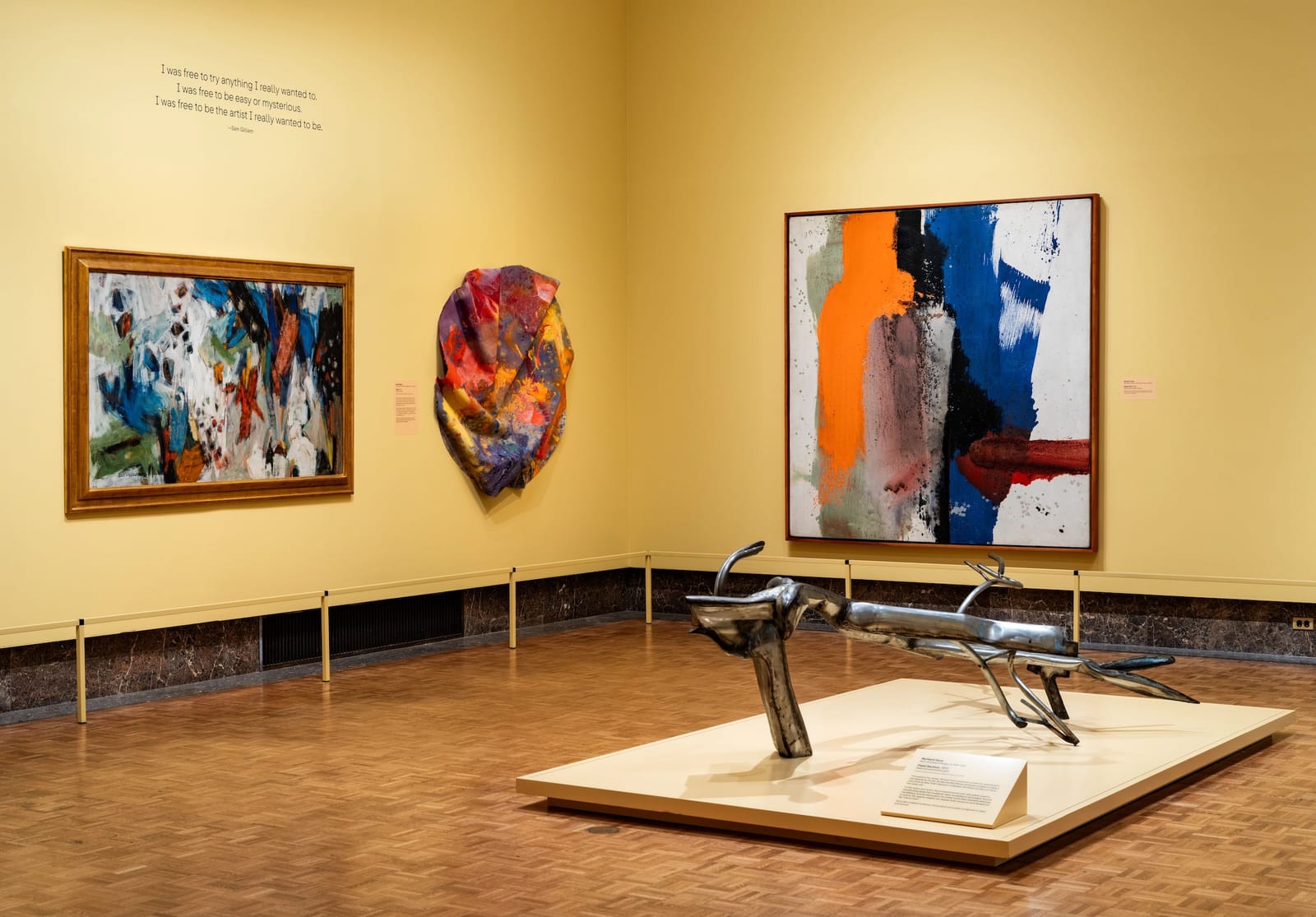
The roster, including Robert S. Duncanson, Mary Edmonia Lewis, Aaron Douglas, Sam Gilliam, Charles McGee, and Alvin Loving, is handled with productive tension. These artists are not arranged to perform a single narrative of linear progress. Instead, the installation keeps formal divergence in view. You move between figuration and abstraction, between sculptural volume and graphic economy, between explicit social address and more oblique material inquiry. That refusal of simplification is one of the show’s major achievements.
The Duncanson and Lewis presence is particularly important for the nineteenth-century groundwork. Their inclusion does not operate as genealogical decoration. It establishes that Black participation in American art institutions and markets was never absent, only systematically under-recognized and under-preserved in mainstream pedagogies. By positioning those works within a living sequence rather than a historical preface, the installation counters a common curatorial habit where nineteenth-century Black artists are acknowledged as exceptions rather than structural actors.
The twentieth-century material deepens this argument. Douglas’s compositional intelligence and Gilliam’s chromatic and structural experimentation are not treated as separate lanes of social modernity and formal modernity. The installation lets them speak within one expanded frame where abstraction is not apolitical retreat and figuration is not the only valid register of historical testimony. This matters because museums still too often force Black artists into representational duties that white peers are not asked to perform.
Charles McGee and Alvin Loving are especially effective in this configuration because they expose how much institutional memory has depended on narrow viewing protocols. McGee’s line and rhythm, Loving’s built surfaces and compositional pressure, both demand a reading practice that is materially alert rather than iconographically reductive. The installation’s best rooms reward that attention. They allow works to be seen as works, not as evidence files for prewritten narratives about identity and visibility.
One of the show’s strongest curatorial decisions is pacing. Rather than driving visitors through a triumphalist arc, the sequence allows friction and unresolved intervals. That rhythm is historically honest. Recognition has been uneven, acquisition practices inconsistent, and interpretive frameworks frequently late. The installation acknowledges those institutional facts without turning the galleries into a didactic report. It keeps aesthetic experience alive while retaining structural critique.
Several room-to-room transitions are especially effective because they treat chronology as elastic rather than rigid. Earlier works are not locked behind a period wall that neutralizes their present force, and later works are not framed as inevitable culmination. Instead, visitors are prompted to notice recurring strategies, compression of pictorial space, chromatic daring, structural play, and to see how those strategies reappear under changing social conditions. This approach produces stronger looking than a textbook progression ever could.
The installation also succeeds at scale management. Smaller works are not swallowed by adjacent monumental pieces because the hang gives each object enough visual air to register as an argument, not an illustration. In encyclopedic settings, this is often where curatorial claims collapse: major works are over-amplified while quieter pieces become historical punctuation. Here, many of those quieter works carry serious analytic weight. They reveal methods and decisions that larger signature pieces alone cannot show.
For educators, the exhibition has immediate pedagogical value. It can be used to teach that art history is a constructed sequence, not a naturally ordered one. The galleries demonstrate how institutional choices, what sits next to what, what receives wall-space priority, what is described with depth, shape public memory as powerfully as acquisition itself. Students walking this installation can see curation not as neutral display labor but as interpretive authorship with political consequences.
This balance between formal rigor and institutional self-revision is where the DIA distinguishes itself from many peer rehangs. Across the museum sector, collection reinstallations often succeed rhetorically but fail spatially. Here, placement and narrative are aligned. The adjacency to Rivera does not merely borrow prestige. It redefines how prestige circulates. Visitors who come for a canonical mural cycle now encounter a restructured field in which African American art is neither detour nor themed annex.
The installation also has policy implications. A curatorial reset of this kind becomes credible only if acquisition, interpretation, and future programming continue the same logic. In that sense, Reimagine African American Art functions as both exhibition and institutional test. The museum has signaled that this is a baseline, not a one-off correction. The field will now watch whether that baseline is sustained across contemporary reinstallations, education strategy, and collection growth.
For scholars, critics, and curators, the value of this exhibition is methodological. It demonstrates that museums can revise internal hierarchies without resorting to symbolic overstatement or defensive messaging. It shows how to use space, sequencing, and historical density to produce structural clarity. Most importantly, it models a curatorial ethics where artworks are not burdened with proving their right to be present. Their presence is assumed. The question becomes how they reorganize the room around them.
The installation’s implications extend beyond Detroit. U.S. museums currently revising collection displays often face a false choice between historical accountability and aesthetic conviction. Reimagine African American Art shows that this is a manufactured opposition. When the work is chosen and placed with rigor, accountability becomes a formal question as much as an institutional one: where do viewers pause, which lineages become visible, and what kinds of comparison are newly possible. That framework could materially improve how encyclopedic museums approach future rehangs across departments, not only in African American art spaces.
By the end, the exhibition leaves a clear proposition: American art history cannot be repaired by attaching missing names to old frameworks. It has to be reassembled through different centers of gravity. At the DIA, that process is already underway. Reimagine African American Art is persuasive not because it is loud, but because it is architecturally and intellectually exact. It turns correction into structure, and structure into a new normal other museums should study closely.