Paulo Nazareth at Meyer Riegger Makes Language a Site of Political Struggle
In ALLEMANN, Nazareth treats naming as material, tracing how one unstable word can carry colonial residue, racial coding, and social hierarchy across Brazil.
Paulo Nazareth’s ALLEMANN at Meyer Riegger in Berlin is one of those exhibitions where the title is not a label but the first artwork. The show begins with a linguistic displacement, from alemão in Brazilian Portuguese to alle Mann in German, and uses that slippage to expose how naming systems encode power. The immediate effect is conceptual clarity: this is not a show about identity as static fact, but about identity as something produced through repetition, misrecognition, and command.
The historical trigger, Leonard Kaczmarkiewicz, the Polish immigrant in 1920s Rio who became known locally as "o Alemão", is handled with precision. Nazareth does not treat this anecdote as colorful background. He stages it as an origin point for a broader social mechanism by which terms migrate, harden, and become instruments of sorting. In contemporary usage, alemão can mark white foreignness, then mutate again inside urban conflict vocabularies. The exhibition’s intelligence lies in showing that this semantic drift is not accidental noise; it is political history in motion.
Nazareth has long worked through movement, encounter, and embodied research rather than studio enclosure, and ALLEMANN extends that method while tightening the formal frame. The exhibition is less itinerant in appearance than some earlier projects, but no less nomadic in structure. References move between Brazil and Germany, between colonial expansion and twentieth-century propaganda, between Afro-diasporic ritual objects and contemporary urban life. The connective tissue is not chronology. It is relation.
Nazareth’s central proposition is that otherness is not a fixed identity category, it is a repeated social operation carried through words, images, and institutions.
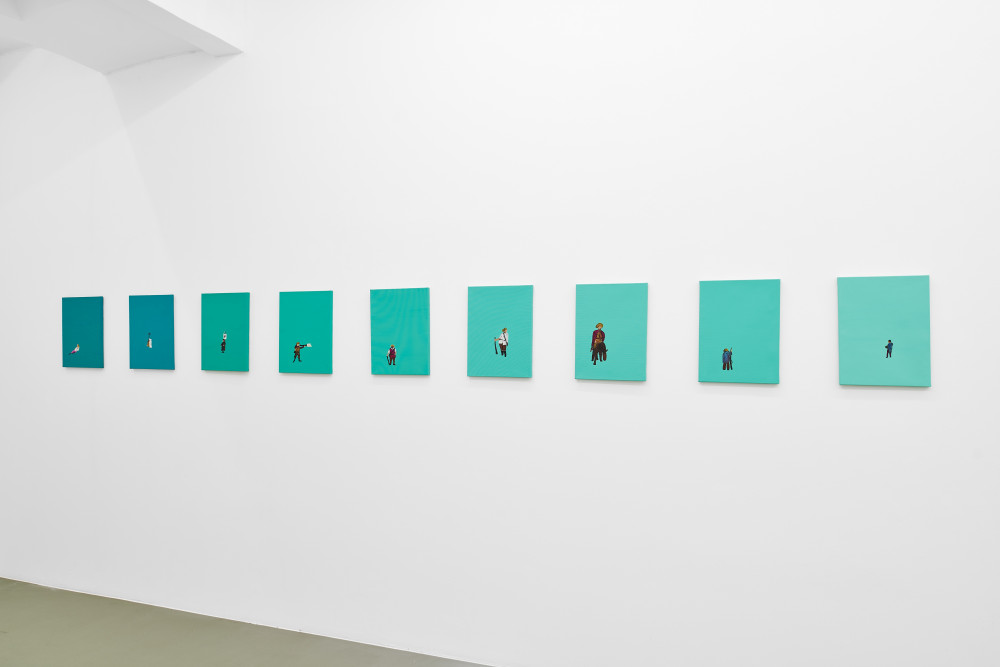
The paired painting cycles, AlemaN’o / série Amarelo-Laranja and AlemaN’o / série Verde (both 2025), are crucial to the argument. Small-scale, frontal, and chromatically concentrated, they stage ordinary contemporary figures alongside historically charged personae associated with conquest, missionization, and state violence. The yellow-orange and green grounds function as more than palette choices. They partition affective registers while refusing moral simplification. Nazareth does not offer clean binaries. He offers a field in which historical agents and present-day subjects remain entangled.
Works such as Sem título [Bermuda azul y camisa branca] and Sem título [Homem rezando] demonstrate this with deceptive economy. Their reduced scale and direct figuration could be read quickly, but the paintings resist quick consumption. They accumulate force through seriality. Seen together, they operate like a social lexicon, each image a short entry in a larger dictionary of posture, clothing, gesture, and coded belonging.
The eucalyptus-post works, including THÄLMANN and WÄHLT THÄLMANN (2025), sharpen the exhibition’s relationship to political rhetoric. Their verticality carries the memory of signage, standards, and directives, while the material itself introduces another historical layer tied to extraction and plantation geographies. Nazareth is attentive to how the support can speak before the mark does. In these pieces, text is never disembodied discourse. It is anchored in matter.
The EBOH series (2025), alguidares filled with concrete and tile, is among the strongest bodies in the show because it binds ritual form to infrastructural violence without reducing either. The vessels evoke Afro-diasporic religious practices across the Americas, including Candomblé contexts, yet they are weighted with construction debris that recalls urban hardening, occupation, and unfinished modernity. The gesture is neither nostalgic nor purely accusatory. It is diagnostic. Nazareth asks what happens when sacred receptacles are forced to hold the residues of the built world.
Spatially, the installation avoids spectacular overload. The rooms are composed to let works breathe and collide by sequence rather than by theatrical density. This matters because Nazareth’s practice depends on reading across objects, text fragments, and repeated signs. The pacing allows viewers to move from linguistic disorientation to historical recognition and then back into uncertainty. That oscillation is not a curatorial side effect. It is the structure of the work.
The return of Depósito Felicidade (2008), a short video, is a smart inclusion because it extends the show’s argument about archive and memory across media. Nazareth’s moving-image language remains dry, observational, and resistant to sentimental framing. It punctures any assumption that the new works are solely language pieces. For him, words, bodies, and landscapes are part of one choreography, each medium entering where another reaches its limit.
Likewise, MATA MANIFESTO DE ARTE EM TERRITÓRIO ANCESTRAL (2025), with its acrylic box, newsprint intervention, cotton-paper print, and 86 woodblock prints, demonstrates how Nazareth thinks seriality as social method. Multiplicity here is not decorative abundance. It is a refusal of singular authorship and singular reading. The work behaves like a distributed statement, closer to public speech than autonomous objecthood.
One of the exhibition’s clearest strengths is its treatment of Germany not as a neutral host context but as an active historical participant in the work’s semantic and political field. References to communist propaganda and failed emancipatory projects from the 1930s are not inserted as citation theater. They function as warnings about how quickly liberatory language can be co-opted, emptied, or weaponized. Nazareth is acutely alert to this cycle.
There is also a notable performative undercurrent, even in ostensibly static works. Nazareth’s objects often appear as residues of actions, gestures already enacted or still pending. This temporal ambiguity links the Berlin presentation to his broader practice of walking, encounter, and social choreography. The exhibition is full of things, but those things behave like verbs. They point to doing, naming, carrying, offering, voting, remembering.
The show’s chromatic intelligence deserves emphasis. Color is used with restraint and strategic force, especially in the small canvases, where flat grounds operate as social weather rather than scenic backdrop. Yellow-orange can feel intimate and exposed; green can tilt toward authority, camouflage, or historical eeriness depending on neighboring forms. Nazareth avoids the trap of symbolic one-to-one color coding. He treats color as unstable index, capable of shifting political valence across the sequence.
For Berlin audiences, ALLEMANN also opens a conversation about contemporary European institutions and their vocabulary of inclusion. The exhibition asks who gets named as "international" and who is still marked as "other" even when fully present in the room. Nazareth does not stage this as accusation alone. He stages it as a mirror, one that catches curatorial language, market language, and civic language in the same reflective plane.
If there is a vulnerability, it lies in legibility thresholds. Viewers seeking a single storyline may feel the exhibition withholds orientation too long. Yet that friction is integral to Nazareth’s method. A show about the manufacture of "the other" should not provide immediate comfort through stable categories. ALLEMANN makes the viewer work through ambiguity, because ambiguity is one of the mediums through which power operates.
For curators and critics, the exhibition offers a rigorous model for politically engaged practice that does not collapse into slogan or didactic didascalia. Nazareth keeps formal decisions, scale, spacing, serial logic, material contradiction, inseparable from historical argument. The result is a show that is both conceptually demanding and visually exacting.
By the end of ALLEMANN, you leave with the sense that language itself has weight, texture, and afterlife. Nazareth shows that words do not merely describe social reality; they organize it, police it, and occasionally fracture it open. In Berlin, he has built an exhibition that listens to those fractures and turns them into form. It is one of his most coherent recent statements, and a persuasive case for art as a site where naming can be contested in public. It rewards return visits because its meanings continue to shift as each work is re-read in relation to the others.