Gideon Appah at Pace Turns Coastal Ghana Into a Theater of Time
In Beneath Night and Day, Appah expands his Swimmers and Surfers cycle into a painterly study of rhythm, color, and collective memory, where beach life.
In Gideon Appah’s Beneath Night and Day at Pace, New York, you enter paintings that feel at once site-specific and out of time. Beaches, fields, surfboards, resting bodies, and long horizon lines anchor the work in familiar geographies near Appah’s studio in Ghana, yet each canvas resists documentary literalness. The scenes are recognizably lived and simultaneously transfigured, as if ordinary coastal routines had passed through memory, then through dream, before arriving as paint.
This is Appah’s first solo presentation with Pace in New York, and it reads as a confident expansion of his ongoing Swimmers and Surfers cycle rather than a market-facing introduction. The exhibition includes large multi-figure compositions, newer vertical portraits, and a film component, Beyond the Shadows (2025), that clarifies his process without reducing the paintings to illustration. The curatorial framing is strongest when it lets these elements remain in dialogue rather than hierarchy.
The key achievement across the canvases is temporal slippage. Appah moves from dusk to dawn, day to night, within and across pictures, so that time behaves as mood and rhythm rather than linear sequence. This strategy gives the works their oneiric charge. Figures appear suspended between action and pause, carrying boards, waiting by waterlines, sitting in clusters, never fully fixed into one event. The paintings do not narrate what happened. They stage how a place is remembered.
The strongest claim of this exhibition is that Appah treats color not as atmosphere but as temporal structure, a way of holding multiple moments in one image without forcing them into narrative closure.
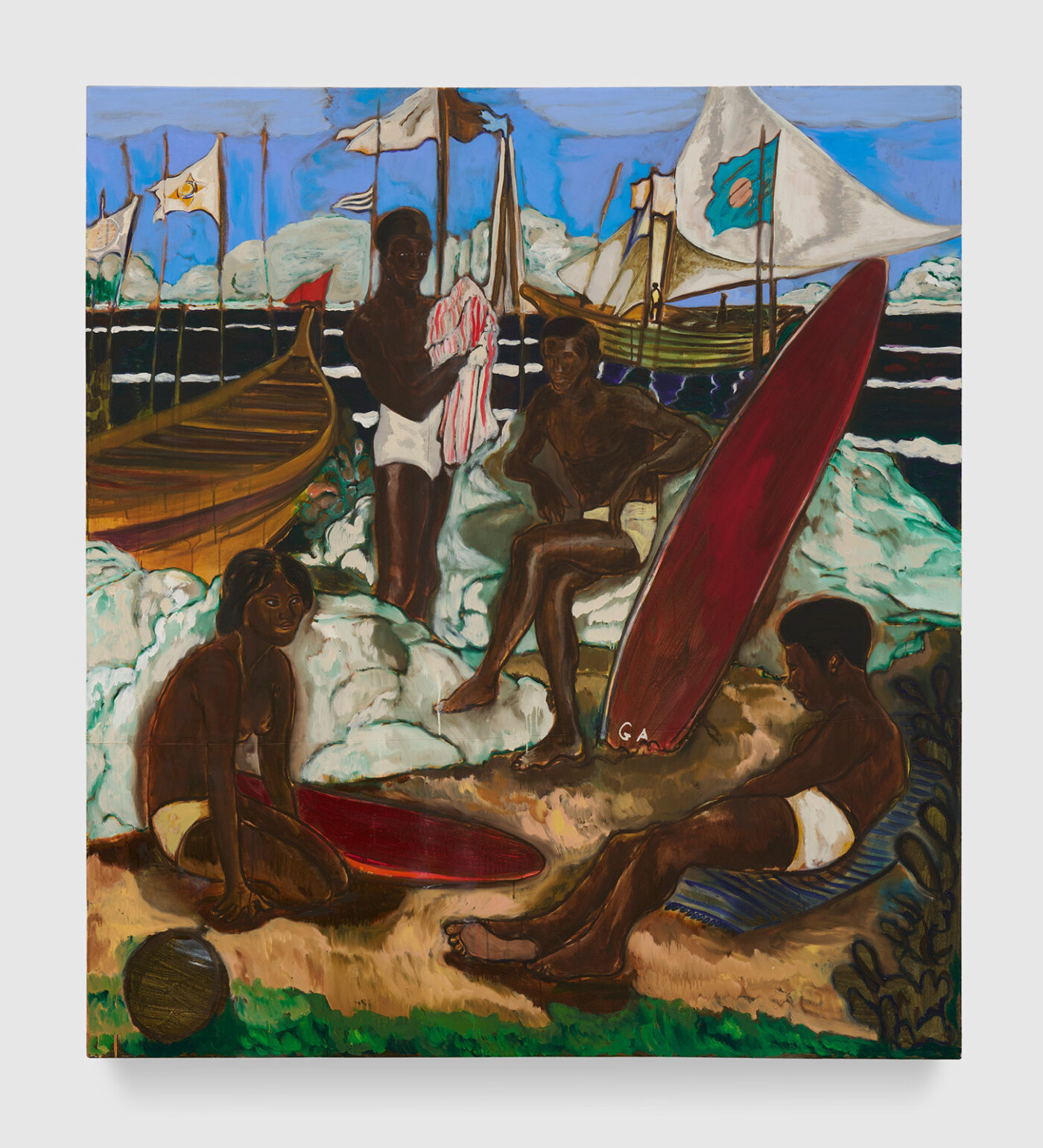
Several major works make this clear. In large beach scenes such as Bathers and Boats and related compositions from 2025, bodies are distributed like tonal intervals across wide fields of color. The pictorial space stays open, but never empty. Appah uses clustered gestures and chromatic echoes to keep the eye moving from foreground to horizon and back again. Even when figures are static, the paintings remain kinetic because color carries movement through them.
His palette in this show is notably more architectonic than in earlier presentations. Deep blues and green-black grounds are overlaid with controlled eruptions of orange, violet, pale yellow, and white, producing surfaces that feel internally lit rather than merely contrasted. These choices do more than signal atmosphere. They build structural tension between depth and flatness, warmth and coolness, repose and alertness. Appah demonstrates increasing confidence in letting chromatic conflict do conceptual work.
Material handling is equally central. Appah’s use of layered relief and alternating viscosities of acrylic and oil gives many passages a tactile push-pull, with denser regions resisting optical smoothness while thinner areas open into softer transitions. This material variation prevents the dream register from becoming decorative. The paintings remain grounded in labor and touch. You feel decisions accumulating in the surface, not just images arriving fully formed.
The vertically oriented single-figure portraits mark an important development. Compared with the ensemble scenes, these works compress the field and intensify the relation between body, garment, and background. Clothing, often carefully rendered from patterned textiles, becomes a compositional device as much as a marker of personhood. Appah treats fabric as rhythm and geometry, allowing folds and motifs to modulate the entire pictorial register. The portraits suggest he is pushing toward a new intimacy within the broader series.
The inclusion of Beyond the Shadows is a smart curatorial decision because it reveals source conditions without collapsing the paintings into reportage. Shot in Busua and linked to communities of surfers, swimmers, and fishers, the film offers moving, social, and environmental references that recur across the canvases. Yet the relationship is not one-to-one translation. The film records local life; the paintings metabolize it. Appah keeps enough distance to preserve the autonomy of each medium.
One of the exhibition’s strongest undercurrents is its treatment of collectivity. Many contemporary figurative painters working with social subjects default to emblematic central figures or symbolic protagonists. Appah moves differently. Groups are often distributed across the image plane with no single figure claiming narrative dominance. This compositional ethic aligns with the show’s broader concern: community as lived rhythm rather than spectacle, and identity as relational rather than singularly performed.
If there is a risk in this body of work, it is occasional over-enchantment. A few passages in the larger canvases flirt with pictorial seduction that can soften the harder social textures of the environments being referenced. Yet even in those moments, Appah’s structural intelligence usually reasserts itself through spatial compression, tonal drag, or abrupt figure placement. The best paintings in the exhibition carry beauty and friction together, and they are strongest when neither is sacrificed.
For painters and curators, the show offers a compelling technical proposition: figuration can remain narratively open while still being materially exacting and compositionally disciplined. Appah avoids the current tendency toward either over-coded political literalism or purely atmospheric stylization. His middle path is more demanding. It asks that viewers attend to process, color logic, and temporal ambiguity while still reading social life in the work.
The exhibition also invites comparison with wider currents in painting that engage leisure, migration, and coastal space. Appah’s difference is his refusal to treat beach imagery as postcard iconography or anthropological distance. Water and shoreline in these canvases are not scenic backdrops. They are active conditions that shape posture, tempo, and collective relation. This shifts the work away from genre depiction toward a deeper question of how environments choreograph social experience.
There is a notable intelligence in how Appah handles gaze. Many figures appear to look past one another or beyond the frame, producing a visual field that is socially connected but not theatrically performative. The paintings do not stage a viewer-centered encounter where subjects are available for immediate reading. Instead, they preserve a degree of opacity that feels ethically important. Presence is granted without being exhausted by legibility.
The exhibition’s film-painting dialogue also has implications for how we understand contemporary image ecologies. Appah works from photographs, moving images, posters, and found materials, but the canvases do not mimic digital abundance. They slow it down, redistribute attention, and transform reference into form. In this sense, the show is not only about Ghanaian beach life or memory politics, it is also about what painting can still do in a culture of constant visual capture.
The exhibition also contributes to a broader re-mapping of contemporary painting geographies. Appah’s practice is rooted in Ghanaian environments and visual references, including local photographic and cinematic sources, but his work is not framed as regional tokenism for global circulation. Instead, these paintings insist on specificity as method. They do not perform placeness for outside consumption. They operate from place as a generative condition of form.
A quieter but crucial work in this context is Wood House (2025), where human figures disappear and architectural residue takes over. The drained pool, overgrown edges, and encroaching night read like an afterimage of the social scenes elsewhere in the show. Rather than breaking the exhibition’s logic, this painting extends it. It asks what remains of collective presence once bodies leave the frame, and how memory persists in built and natural surroundings.
By the end of Beneath Night and Day, what lingers is not a single iconic motif but a painterly method of holding multiplicity. Appah binds observation to fantasy, coastal routine to mythic duration, and communal life to formal experiment without forcing synthesis. This is a mature exhibition, technically ambitious, conceptually coherent, and emotionally patient. It confirms Appah as one of the more interesting current voices in figurative painting, not because he illustrates identity, but because he structures time, place, and relation with uncommon precision.