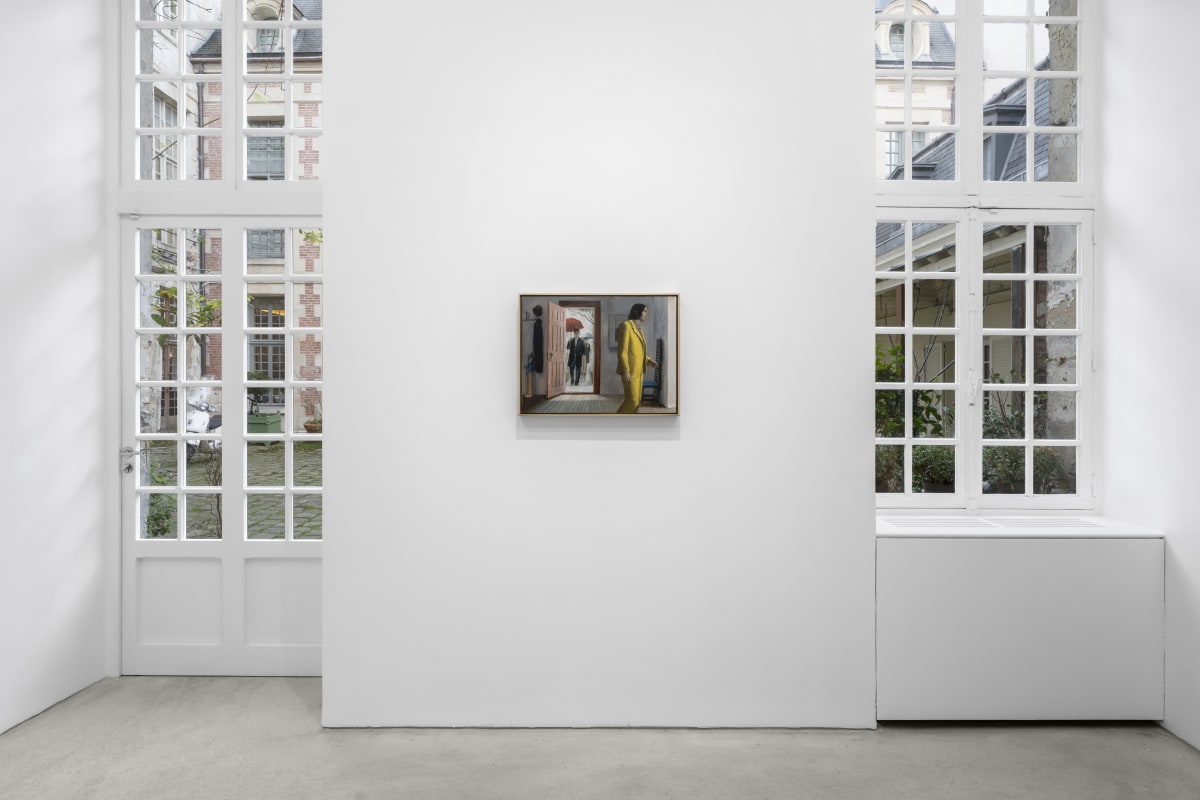
Giangiacomo Rossetti at Mendes Wood DM Paris Makes Melancholy Structurally Luminous
In Résurrectine, Rossetti stages painting as a chamber of delayed recognition, where mirrors, windows, and arsenic yellow bind art historical citation to a.
In the Mendes Wood DM Paris presentation of Résurrectine (January 24 to March 14, 2026), Giangiacomo Rossetti turns painting into a controlled atmosphere where perception arrives half a beat late. The exhibition’s governing sensation is not shock, nor overt narrative revelation, but a sustained state of suspended cognition, as if each image were waiting for the viewer to catch up to a thought it has already completed. Rossetti’s figures look through apertures, into mirrors, and across thresholds, but those devices do not stabilize perspective. They estrange it.
The show’s conceptual scaffolding is unusually precise. The title borrows from Raymond Roussel’s 1914 novel Locus Solus, where the scientist Martial Canterel reanimates bodies under the influence of invented fluids. In Rossetti’s hands, this literary reference is not decorative. It provides a working model for what these paintings do: they stage image-making as a procedure of partial return, a resurrection that never restores its subject to original coherence. In that sense, Résurrectine is less about death than about the strange afterlife of forms.
Rossetti has said and shown enough to position chance, patterning, and visual punning as core methods, and that methodological commitment is clear across the strongest works. In The Party (2025), bodies and architectural passages lock into a rhythm that feels social and funereal at once. The room implied by the painting reads as inhabited, yet curiously evacuated of ordinary social contact. Figures are proximate but psychically remote. What might have been staged as scene painting becomes instead a choreography of inwardness.
In Counting the Teeth and Here Comes the Child (both 2025), mirrors function as engines of temporal disturbance rather than symbols of narcissism. Rossetti refuses the familiar mirror trope in contemporary figurative painting, where reflection serves as psychological shortcut. Here, reflective surfaces scramble identity and duration. The viewer cannot confidently parse whether a figure is self-observing, self-erasing, or being observed by an absent third term. That ambiguity is not indecision. It is a formal choice that keeps the paintings open under pressure.
Rossetti’s real achievement is that he does not quote painting history as repertoire, he metabolizes it into a private syntax that still reads publicly.
Golden Bowl (2025) extends this logic through illumination. Light in Rossetti is never neutral atmosphere; it is structural argument. It arrives through uncertain sources and produces tonal transitions that feel chemically active, almost unstable. The recurring arsenic yellow noted in the exhibition framing becomes especially consequential here. It is seductive at first register, then faintly toxic in memory, a chromatic operation that recalls the exhibition text’s invocation of Jacques Deray’s La Piscine (1969) and Gae Aulenti’s lemon-tinted Locus Solus furniture for Poltronova (1967). Rossetti treats color as plot.
One of the show’s major strengths is its refusal to flatten citation into homage. Rossetti’s dialogue with Francesco Hayez’s Mary Magdalene as a Hermit (1833), Renoir’s The Umbrellas (1880 to 1886), and motifs linked to Domenico Fetti’s allegory of melancholy is handled with unusual discipline. He does not stage these references as virtuoso recognition games for the art historically literate viewer. Instead, he uses them as mutable components inside a larger compositional grammar organized by recurrence, fracture, and re-entry. The point is not to prove knowledge. The point is to test what inherited images can still do.
That compositional grammar is where Rossetti becomes most convincing. In many current exhibitions of historically inflected figurative painting, citation operates as insurance, a way to secure seriousness through name recognition. Rossetti avoids that trap by allowing historical material to pass through distortion, repetition, and tonal recalibration until it becomes structurally necessary to the painting’s current tense. This is why the works feel internally pressurized rather than merely referential. They are built, not curated on canvas.
The exhibition’s writing also invokes Leonardo’s late St. John the Baptist and the figure of Salaì, then folds in Freud’s biographical account of Leonardo and the problem of unfinishedness. Rossetti’s paintings benefit from this framework because incompletion in the show is not a defect but a condition. Edges do not always resolve where we expect. Spatial transitions occasionally remain metabolically active, as if a prior image state were still visible beneath the present one. This gives the surfaces a temporal depth that exceeds simple facture description.
If there is a risk in Résurrectine, it is that the hermetic intelligence of the project could narrow its public address. Rossetti’s iconographic system is dense, and the paintings often reward slow, repeated looking more than immediate legibility. Yet this risk is also one of the exhibition’s achievements. In a market environment that increasingly rewards instant readability and social-media-ready pictorial effects, Rossetti insists on the legitimacy of difficulty. He asks for duration from his viewers, and the work repays that demand.
The tonal register of melancholy across the exhibition deserves special attention. Melancholy here is not mood branding, not a fashionable affective veneer. It is a compositional principle. Forms bend toward recurrence. Figures return in altered states. Motifs migrate across paintings with slight displacements that prevent closure. Rossetti understands melancholy as a temporal technology, the way certain images continue to act on us because they cannot be finished once and for all.
This is where Résurrectine speaks to a broader contemporary condition without collapsing into topical illustration. The show recognizes a social world saturated by archival debris, inherited crisis, and unstable memory, but it refuses journalistic literalism. Rossetti’s response is to construct painterly situations where historical residue and present perception remain entangled. That choice gives the exhibition an uncommon seriousness. It trusts painting to think, not just to picture.
The most compelling curatorial decision in this presentation is scale management. The works are given enough space to breathe without being inflated into theatrical isolation. That matters for Rossetti because his imagery depends on near-repetitions, recurring gestures, and chromatic echoes that emerge across multiple canvases. Seen in sequence, the paintings accumulate like chapters in a recursive text. Seen singly, they would still hold, but they would not fully reveal their logic of return.
There is also a notable intelligence in how the exhibition negotiates intimacy and historical weight. Rossetti borrows from major lineages, Venetian and Lombard painting, French modernism, psychoanalytic biography, literary modernity, yet the works never feel crushed by precedent. The painterly touch remains personal, at times tentative in productive ways, at times assertive in its contour and tonal command. This oscillation keeps the paintings alive. It prevents historical reference from becoming stylistic costume.
What is especially praiseworthy is Rossetti’s treatment of figuration as unstable ontology rather than fixed likeness. Faces and bodies are present, but they are never reducible to portrait identity. They behave as carriers of psychic weather, narrative residue, and formal tension. In this respect, Résurrectine enters dialogue with recent figurative practices across Europe that resist clean autobiographical reading and instead stage personhood as a mutable visual event.
For curators and critics, Rossetti’s project offers a useful proposition: figurative painting can remain art historically rigorous without becoming either nostalgic reenactment or ironic quotation. Résurrectine demonstrates a third route, one where citation is active matter, color is conceptual, and image-space becomes a site of philosophical testing. The exhibition does not seek consensus. It establishes a clear, self-demanding standard and meets it with conviction.
By the end of the show, what lingers is not one emblematic image but a method, recurrence under transformation. Rossetti’s paintings hold open the difficult interval between ruin and reanimation and refuse to close it prematurely. That refusal is generous. It grants viewers the dignity of sustained thought and grants painting the dignity of unresolved life. In an attention economy that rewards immediate legibility, that generosity feels not only aesthetic but ethical.