Barkley L. Hendricks at Marian Goodman Paris Shows Portraiture as Social Thought
All is Portraiture in Paris makes a rigorous case for Hendricks as both formal innovator and acute social observer, extending beyond canonical portraits.
The Paris presentation of All is Portraiture at Marian Goodman opens with a deceptively simple proposition: Hendricks painted people as if they had already claimed the center of the image before the painter arrived. That compositional confidence is the first thing you feel moving through the show. Figures stand against distilled grounds, often monochrome, with an unapologetic frontal clarity that makes both style and personhood inseparable. In a moment when portraiture is frequently treated as biography-by-proxy, Hendricks still reads as an artist of structure.
The exhibition carries unusual weight as Hendricks’s first solo show in Europe. The curatorial framing does not reduce that milestone to institutional rhetoric. Instead, it uses the occasion to widen the account of his practice: portrait paintings, photographs, works on paper, basketball-derived compositions, and Jamaican landscapes all appear as parts of one sustained intelligence. This breadth matters because Hendricks has too often been flattened into one art-historical sentence, as the painter who restored glamour and agency to Black figuration in the United States. True, but insufficient.
The strongest portraits here confirm why his work remains so influential. In pieces like John Wayne (2015), sartorial specificity becomes compositional logic rather than accessory detail. Clothing does not merely describe a period or subculture; it calibrates the painting’s chromatic and rhythmic balance. Denim, jersey fabric, exposed skin, and shoe silhouettes are orchestrated with the same rigor as background hue and edge control. Hendricks understood that style is not decorative surface. It is social form, and in painting it can carry argument.
The most persuasive achievement of this exhibition is that it refuses to isolate Hendricks as a portrait specialist and instead shows portraiture as a method that can move across media, scale, and historical reference without losing social precision.
What distinguishes this presentation is its insistence that Hendricks’s dialogue with European painting history is not deferential citation. The references to Van Dyck, Van Eyck, Caravaggio, and Rembrandt are active tools. You see this in the way bodies are lit, in how pictorial space is compressed, and in the calibrated distinction between flesh, textile, and backdrop. The old master lesson is absorbed, then rerouted through twentieth-century American urban life and post-civil-rights visual politics. The result is not homage. It is transformation under pressure.
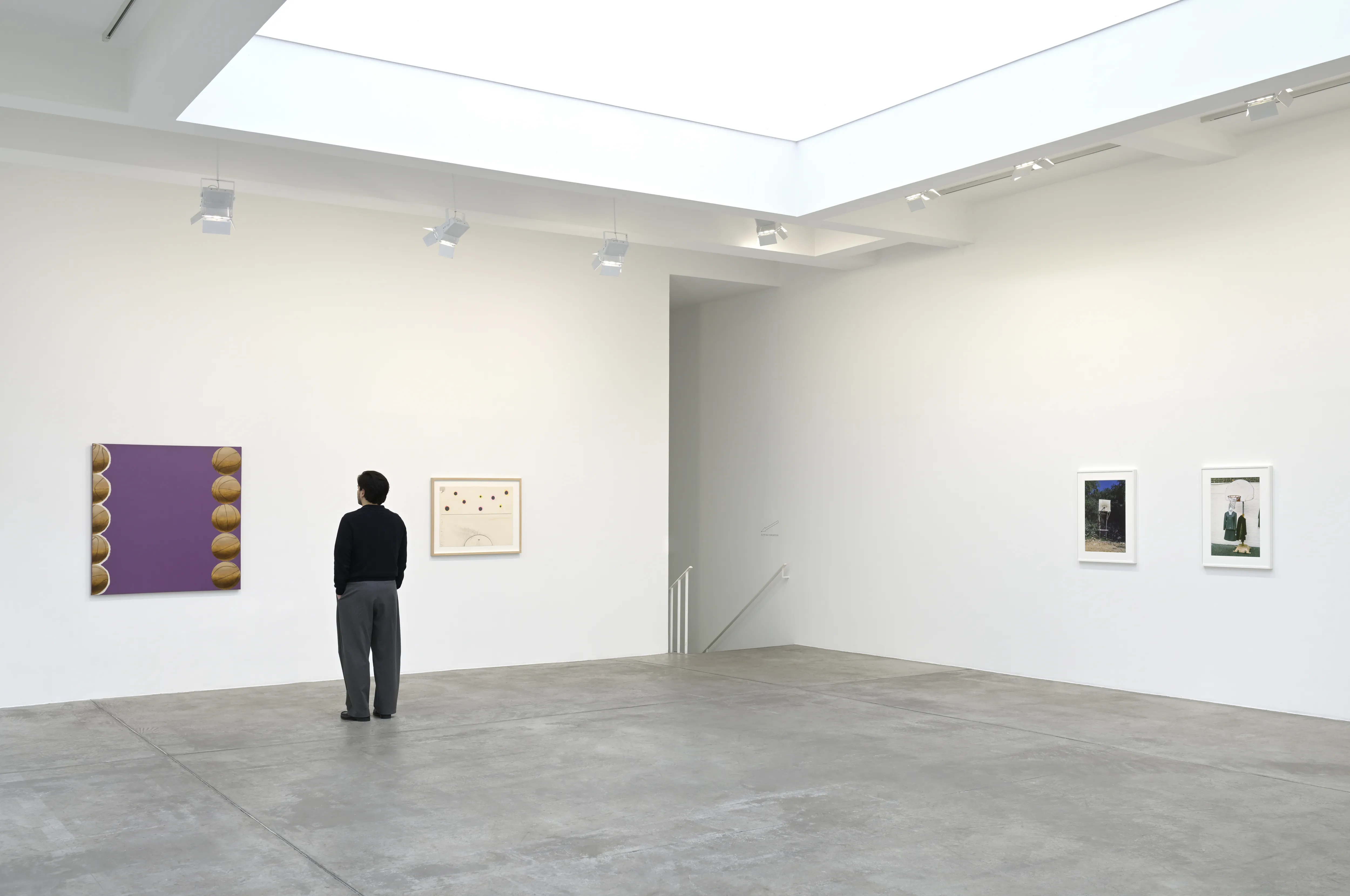
The basketball works from the late sixties and seventies are among the exhibition’s most useful surprises. Often described as side investigations, they appear here as central to his thinking about movement, repetition, and geometric reduction. In paintings such as I Want to Take You Higher (1970), circular and rectilinear motifs test how far a figurative sensibility can travel into near-abstraction without surrendering physical memory. These works retain the sport’s kinetics while stripping narrative content to a few decisive visual units. They complicate any easy split between Hendricks the portraitist and Hendricks the formal experimenter.
The Jamaican landscapes from the late nineties through 2010 introduce another crucial register: stillness as discipline. Works such as Crocodile Head at Fort Charles, Hurricane Tree at Great Bay, and The Last Sunday in Marlhole are compact in scale but expansive in conceptual effect. Their tondo and oval formats, along with frame treatments that echo Renaissance precedents, could have tipped toward nostalgia. They do not. Hendricks uses those inherited formats to stage acute studies of light and weather over specific sites, producing landscapes that feel observed rather than idealized.
Photography, long present in discussions of his practice, is treated here as foundational rather than ancillary. The show’s selection supports his own description of the camera as a mechanical sketchbook. Street portraits and place studies from Connecticut and Jamaica reveal a method built on patient attention to gesture, posture, and ambient structure. Crucially, the photographic works are not displayed as mere preparatory material for paintings. They stand as independent evidence of a humanistic documentary eye that shaped his entire practice.
The self-portraits are another high point because they clarify the artist’s relation to authorship. Images of Hendricks in studio and domestic spaces, often in proximity to works in progress, do not read as confessional introspection. They function as declarations of professional presence. In one of the most compelling through-lines of the exhibition, self-representation becomes less about personality than about labor, continuity, and place within a broader art historical lineage. Hendricks is not asking to be seen. He is showing that he was always already in the frame.
The works on paper in the final sections, including eclipse-linked pieces and the Mingus references, are perhaps the least known and therefore the most revelatory for many viewers. Here, collage elements and heterogeneous materials push his vocabulary toward speculative abstraction while maintaining ties to music, astronomy, and improvisational thought. These pieces demonstrate that his curiosity was not bounded by market expectations around portraiture. He pursued visual problems across media and thematic fields with unusual consistency over decades.
If the exhibition has a vulnerability, it lies in density. There are moments when the abundance of material invites a checklist mode of viewing, with viewers moving quickly from category to category rather than staying long enough with individual works. A slightly more generous spacing in certain rooms might have strengthened the slower perceptual rhythm Hendricks’s paintings reward. This is, however, a structural issue of installation pacing, not a conceptual weakness in the curatorial thesis.
What the show does exceptionally well is resist hero narrative simplification. Hendricks is not presented as a corrective footnote finally admitted into the canon, nor as a singular icon exempt from critical complexity. He appears as a major artist whose practice integrated portraiture, abstraction, photography, and landscape into a coherent yet restless body of work. That positioning is more accurate and more useful for scholarship than celebratory reduction.
The exhibition also arrives at a moment when debates around portraiture have narrowed into representational visibility metrics, who is pictured, how often, and by whom, at the expense of sustained formal analysis. Hendricks’s work insists that the politics of depiction and the intelligence of form are inseparable. His paintings are socially legible because they are formally exacting. Their force comes from the marriage of those two commitments.
Seen against current market trends, where portrait formats are frequently optimized for rapid recognizability, Hendricks feels almost defiantly slow. His images are immediately striking, yet their full effect depends on second and third looking: the calibrated distance between figure and ground, the exact temperature of color fields, the tension between sartorial bravura and compositional restraint. This temporal demand is part of their ethics. The works ask viewers to spend time with subjects as subjects, not visual commodities.
There is also a pedagogical dimension to this show that institutions should take seriously. Younger painters and photographers can read Hendricks here not only as a model of representation but as a model of career architecture: medium mobility without opportunism, historical literacy without citation dependency, and social attention without didactic flattening. The exhibition demonstrates how an artist can remain formally adventurous across decades while keeping a consistent human focus.
For Paris audiences in particular, this presentation performs an important historical recalibration. It places an American artist in active conversation with European traditions while refusing the old center-periphery script that treats Black American modernity as either derivative or culturally enclosed. Hendricks belongs in this transatlantic frame, not as an exception but as a protagonist.
By the end of All is Portraiture, what remains is not only the magnetism of individual canvases but a larger methodological lesson. Hendricks treated portraiture as a field of thought capable of absorbing music, sport, landscape, photography, and art history without collapse. Marian Goodman’s exhibition makes that lesson newly visible. It is an ambitious, necessary presentation, and a persuasive argument that Hendricks’s full oeuvre is still ahead of much of the discourse built around it.