Wilhelm Sasnal’s London Show Turns Feed Logic into a Curatorial Problem
A sharply divided response to Sasnal’s new Sadie Coles exhibition centers on montage, historical violence, and how social-media attention patterns now shape painting criticism.
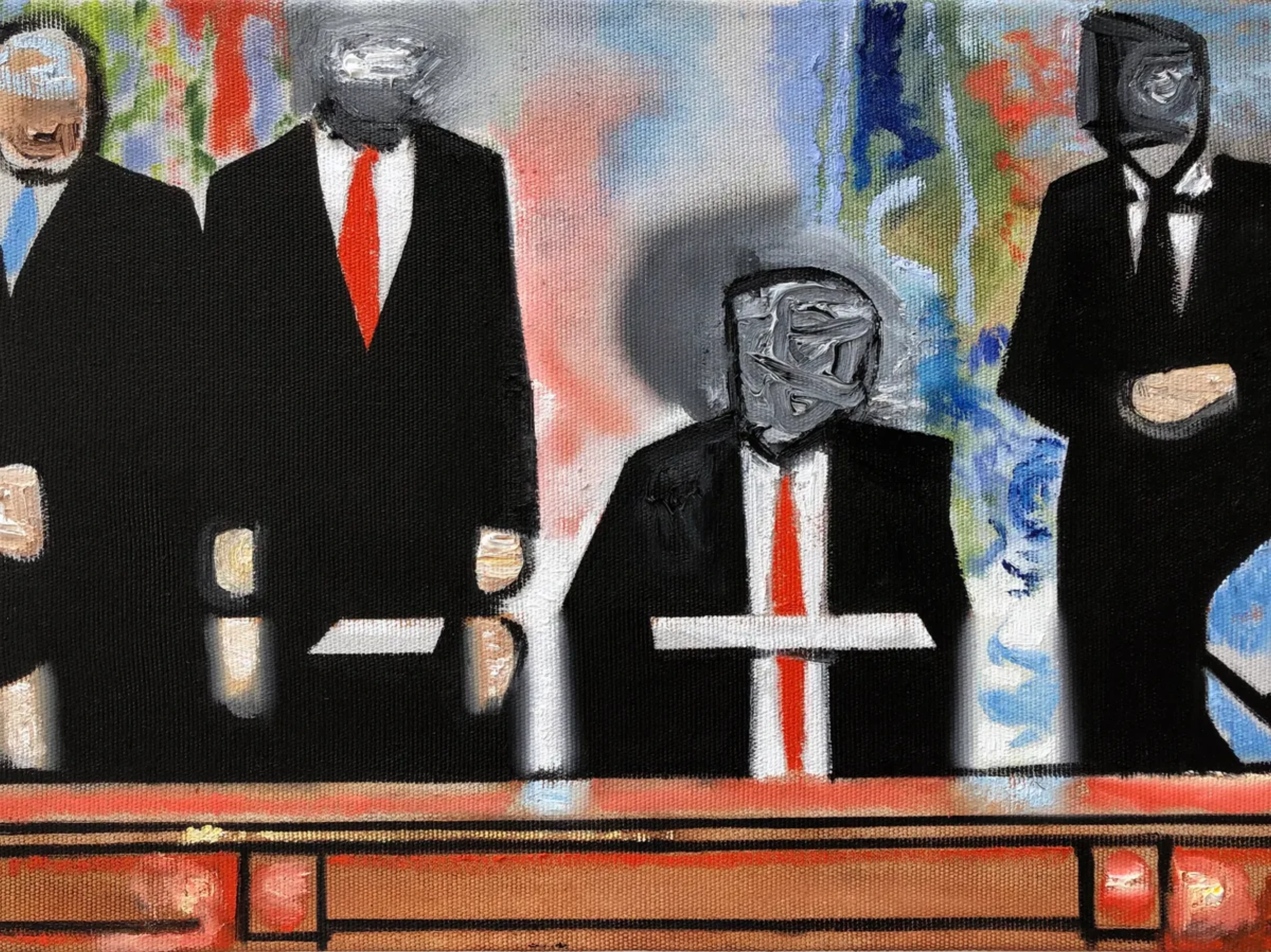
Wilhelm Sasnal’s new exhibition at Sadie Coles HQ in London is being received less as a conventional painting show and more as a test case for how contemporary attention behaves under pressure. The Guardian’s review describes a sequence of jarring juxtapositions, political interiors, family portraits, cultural references, and historical violence, that refuse a stable narrative. That instability is the point. Sasnal is not just making images about history. He is reproducing the fractured visual condition through which history is now encountered.
The exhibition, Family/History, sits inside a wider conversation about montage as method in painting. Sasnal’s use of abrupt transitions has often been discussed in relation to cinema, but here the closer analogue is feed architecture, a condition also debated in institutional discourse at Tate and by collection museums such as the Museum of Modern Art: unrelated images collapsed into one perceptual field, where domestic scenes and mass trauma compete for the same cognitive bandwidth. In that sense, the show reads as diagnosis as much as expression.
What makes the work consequential for curators is its refusal of interpretive comfort. Museums and galleries increasingly try to mediate politically charged material with smooth didactic framing. Sasnal does the reverse. He stages ethical discomfort by withholding connective tissue, forcing viewers to confront their own pattern-making impulses. This can frustrate audiences conditioned to explanatory wall text, but it also reopens a crucial function of advanced painting, making visible the mental operations through which images are ranked, ignored, and moralized.
The review’s emphasis on family imagery alongside references to fascism, corruption, and cultural nihilism touches a live curatorial question, can institutions still present unresolved contradiction without immediately converting it into a themed narrative. In many exhibitions, contradiction is quickly domesticated by education copy. Sasnal’s installation resists that closure. It asks whether viewers can hold tenderness and brutality in the same frame without pretending one explains the other.
For collectors, the strategic significance is not only critical attention. It is medium position. In recent years, painting has been repeatedly declared too slow for networked culture, then repeatedly absorbed back into market and museum centers through artists who metabolize screen logic without becoming illustrative. Sasnal belongs to that lineage. Works that carry this level of conceptual friction can perform strongly institutionally because they offer both visual immediacy and long-form interpretive return.
For institutions beyond London, the show also highlights a programming risk. If galleries and museums adopt feed-era language aesthetically but avoid feed-era critique institutionally, the result is surface relevance with weak substance. Sasnal’s exhibition works precisely because it does not flatter contemporary spectatorship. It implicates it. That distinction matters for curatorial credibility at a moment when art audiences are increasingly alert to programming that borrows urgency but avoids stakes.
The larger takeaway is that the exhibition is not an argument for pessimism. It is an argument for precision. By collapsing disparate images into one uneasy syntax, Sasnal demonstrates how contemporary visual life produces both numbness and heightened sensitivity. The task for critics and curators is to resist simplifying that contradiction. In London, this show makes the case that painting can still be one of the sharpest tools for doing exactly that.