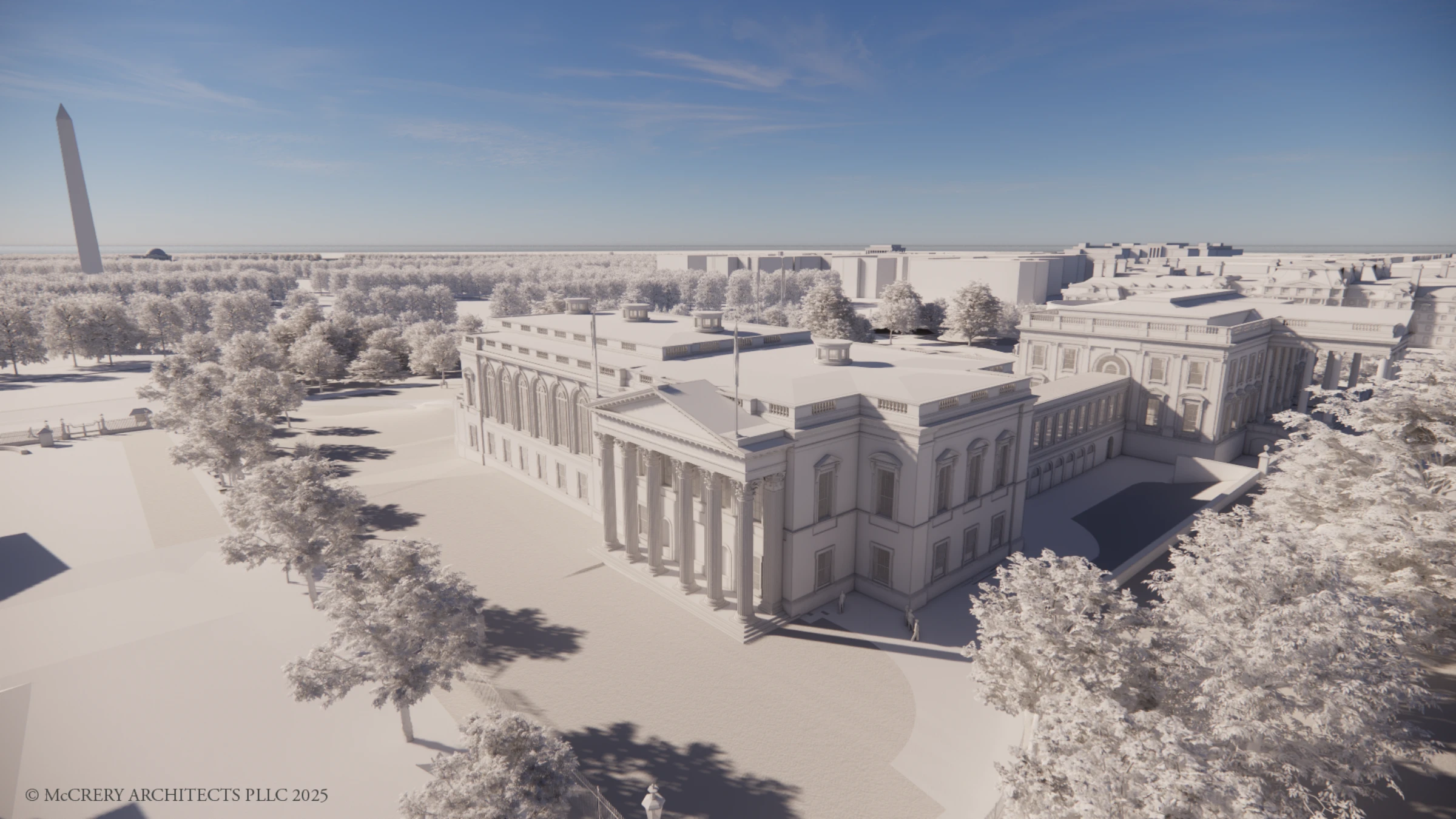
Federal Judge Halts White House Ballroom Construction, Resetting the Preservation Fight
A Washington federal judge ordered construction on the White House ballroom project to stop until Congress authorizes it, turning a design dispute into a constitutional test over federal property power.
A federal judge in Washington, DC has ordered the White House ballroom project to stop, apart from safety and security work, until Congress provides explicit authorization. The injunction interrupts one of the highest-profile architectural interventions attempted at the US executive residence in decades, and it lands days before a key planning review that had been expected to push the project toward final procedural clearance.
The decision matters because it takes the debate out of the narrow lane of taste and places it inside constitutional governance. In practical terms, the court rejected the idea that broad executive maintenance authority can be stretched to include demolition and major new construction on historically protected federal grounds. For preservation advocates, that distinction is decisive. For the administration, it is a direct limit on unilateral control over one of the most symbolically loaded sites in the country.
The legal architecture behind the ruling draws on long-settled principles about Congress’s authority over federal property and spending in the District of Columbia. It is also why procedural bodies still matter in politically charged projects. Institutions such as the National Capital Planning Commission, the US Commission of Fine Arts, and watchdog groups including the National Trust for Historic Preservation are not decorative add-ons to federal design politics, they are the system by which legitimacy is produced when executive ambition meets public heritage.
That legitimacy question is now central. The administration has already appealed, and the case could climb quickly. Even if the project ultimately proceeds, the court’s language has already reset expectations for how large interventions at the White House must be justified. It is no longer enough to argue utility, private funding, or ceremonial need. The government now has to demonstrate statutory footing for the scale of intervention it is pursuing.
For the art and architecture world, this is a precedent case in real time. Landmark governance is often discussed as if it were primarily municipal, but high-symbolism federal projects can ripple outward into museum campuses, state capitols, and civic memorial zones where administrators track what thresholds have been normalized. If a major addition can move ahead with thin legal grounding in Washington, arguments for aggressive redesigns elsewhere become easier. If courts and planning bodies enforce tighter standards here, local preservation frameworks gain political cover.
The ruling also exposes a persistent misunderstanding in cultural infrastructure debates, the belief that private money neutralizes public-law constraints. It does not. Philanthropic or donor-backed funding can accelerate projects, but it does not erase constitutional ownership questions or override statutory process. In this case, the judge treated funding source as secondary to authority. That hierarchy is likely to influence future federal cultural construction disputes, especially where donor politics and national symbolism intersect.
What comes next is a two-track fight. First is litigation over separation-of-powers and statutory interpretation. Second is the political route the court explicitly pointed to, seeking congressional authorization for the project. Either path could produce a ballroom in the long run, but they produce very different precedents for how executive architecture is governed. One route expands informal executive discretion. The other reasserts congressional primacy over federal landmarks.
For preservation professionals, curators, and trustees who work with civic heritage assets, the lesson is straightforward. Process design is not bureaucracy at the margins, it is the mechanism that decides whether symbolic architecture remains collectively governed or becomes a tool of episodic political force. The White House injunction is less about one building than about the constitutional boundaries around cultural power in built form.
<
p
>
T
h
e
a
d
d
i
t
i
o
n
a
l
p
r
e
s
s
u
r
e
p
o
i
n
t
n
o
w
i
s
p
u
b
l
i
c
i
n
t
e
r
p
r
e
t
a
t
i
o
n
.
T
h
e
W
h
i
t
e
H
o
u
s
e
i
s
b
o
t
h
a
f
u
n
c
t
i
o
n
i
n
g
g
o
v
e
r
n
m
e
n
t
c
o
m
p
l
e
x
a
n
d
a
n
a
t
i
o
n
a
l
l
y
n
a
r
r
a
t
i
v
i
z
e
d
m
u
s
e
u
m
-
l
i
k
e
s
y
m
b
o
l
,
a
t
e
n
s
i
o
n
i
n
s
t
i
t
u
t
i
o
n
s
s
u
c
h
a
s
t
h
e
<
a
h
r
e
f
=
"
h
t
t
p
s
:
/
/
w
w
w
.
w
h
i
t
e
h
o
u
s
e
h
i
s
t
o
r
y
.
o
r
g
/
"
t
a
r
g
e
t
=
"
_
b
l
a
n
k
"
r
e
l
=
"
n
o
o
p
e
n
e
r
"
>
W
h
i
t
e
H
o
u
s
e
H
i
s
t
o
r
i
c
a
l
A
s
s
o
c
i
a
t
i
o
n
<
/
a
>
h
a
v
e
l
o
n
g
d
o
c
u
m
e
n
t
e
d
t
h
r
o
u
g
h
a
r
c
h
i
t
e
c
t
u
r
e
,
i
n
t
e
r
i
o
r
s
,
a
n
d
c
i
v
i
c
m
e
m
o
r
y
.
C
o
u
r
t
-
s
u
p
e
r
v
i
s
e
d
p
r
o
c
e
s
s
w
i
l
l
s
h
a
p
e
n
o
t
o
n
l
y
c
o
n
s
t
r
u
c
t
i
o
n
o
u
t
c
o
m
e
s
,
b
u
t
a
l
s
o
h
o
w
t
h
a
t
s
y
m
b
o
l
i
c
c
o
n
t
i
n
u
i
t
y
i
s
p
u
b
l
i
c
l
y
d
e
f
e
n
d
e
d
.
<
/
p
>