Weekend Guide: Four UK Shows That Actually Reward Time
From Konrad Mägi at Dulwich to Leonora Carrington at the Freud Museum, this week’s strongest UK picks are less about checklist prestige and more about concentrated looking across modernism, language, and surrealism.
Most weekend guides are logistics dressed up as criticism: names, neighborhoods, opening hours, and a soft command to consume as much as possible. This one should be treated differently. The strongest route in the UK this week is compact and demanding, and the payoff depends on pace. Four shows are enough if you approach them as a sequence of methods instead of a checklist.
The first stop is Konrad Mägi at Dulwich. The stakes are bigger than rediscovering one painter. Exhibitions like this test whether institutions can alter canonical gravity rather than merely diversify footnotes. Mägi has long been described as a major modernist in Estonian context, but this framing asks a sharper question: what happens when a supposedly regional figure is positioned as central to European modernism’s emotional and chromatic experiments?
Do not rush to compare him with better-known names. Start by tracking his temperature shifts: where color saturates into mood, where contour resists narrative, where landscape becomes interior weather. If the show is successful, it should force a double correction, against provincial framing on one side and lazy universality on the other. You are not looking for confirmation of fame; you are looking for evidence of artistic necessity.
From there, move to Fiona Banner at The Common Guild in Glasgow. Banner’s work has always lived in a productive discomfort between language and image, and this format makes concentration non-negotiable. Her word pictures can appear austere at first encounter, but the point is duration: the text does not illustrate the image and the image does not settle the text. They compete, overlap, and withhold.
This is where most viewers either quit too early or over-theorize too fast. Better method: read slowly, then step back physically, then return to details. Notice when your attention flips from semantic decoding to visual rhythm. That switch is the work. Banner’s best pieces are not statements about representation; they are stress tests for how representation fails and reassembles in real time.
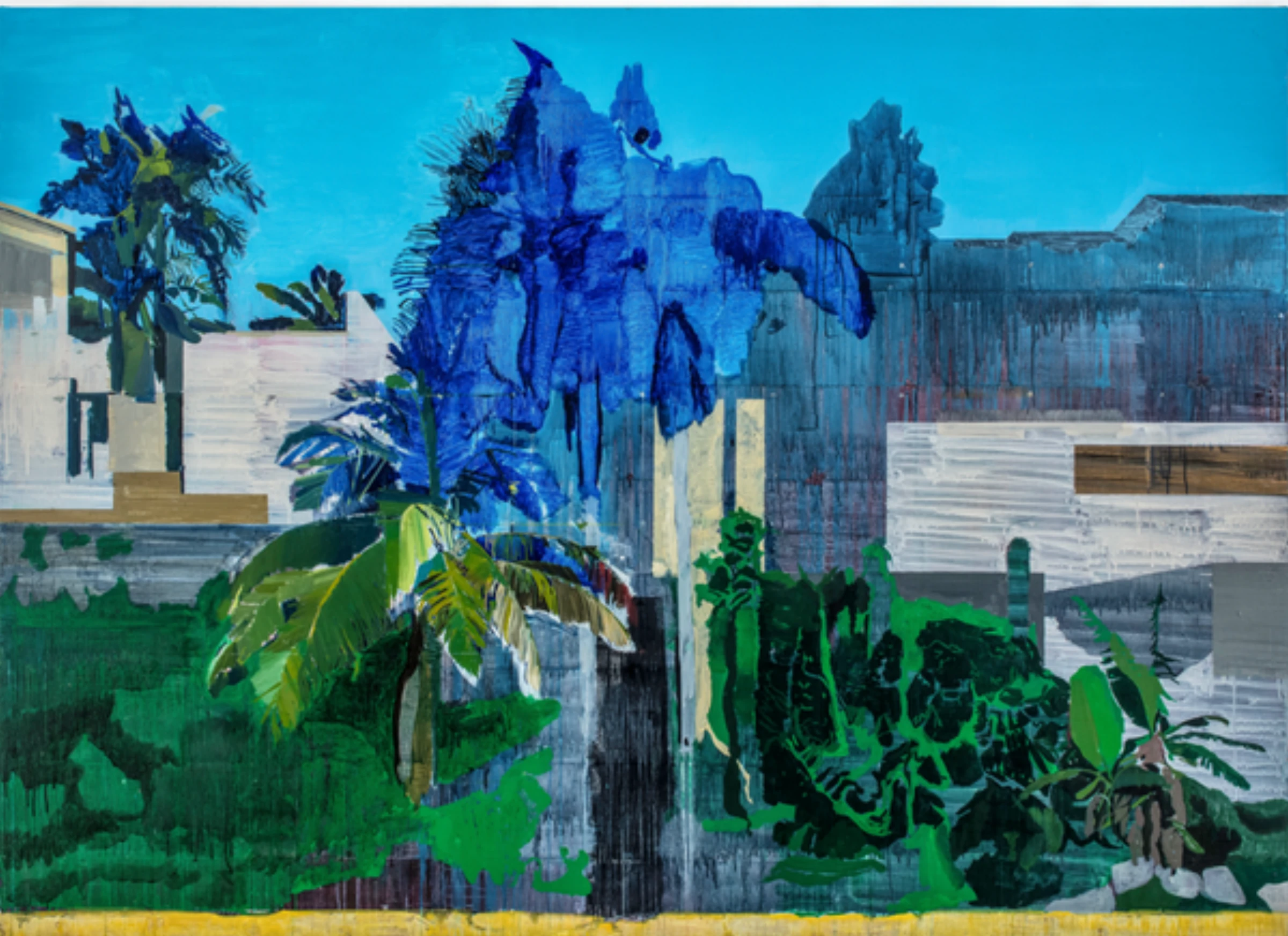
Third, give Hurvin Anderson at Tate Britain the longest block in your day. His paintings are often praised for lyricism, but that word can flatten what is actually happening. Anderson builds spaces that feel at once remembered and unstable, and that tension only emerges through repeated looking. Surface pleasure is the entry point; structural uncertainty is the architecture underneath.
You should do at least two passes in the rooms. First pass for composition and atmosphere. Second pass for decision-making: where edges hold, where they dissolve, where pattern functions as shelter versus obstruction. The retrospective context also helps locate his practice beyond market shorthand. This is not just a painter of beautiful ambiguity; it is a sustained inquiry into memory, migration, and the politics of place.
Finish with Leonora Carrington at the Freud Museum. This pairing of artist and site could have collapsed into thematic decoration, but in principle it has real bite. Surrealism has always been over-explained through psychoanalytic clichés; seeing Carrington in Freud’s last home allows a more grounded reading of psychic intensity, myth, and refusal without reducing her to biography.
Approach Carrington as an active constructor of symbolic systems, not a passive vessel of dream content. Look at how scale, creaturely form, and narrative fragmentation generate agency rather than chaos. In this setting, her work can be read not as eccentric fantasy but as a disciplined language for negotiating power, gender, and consciousness on her own terms.
Order matters across the day. Dulwich gives you historical recalibration. Glasgow sharpens conceptual attention. Tate demands sustained formal reading. Freud Museum closes with symbolic density. This sequence moves from external framing toward interior complexity. If you invert it, fatigue will likely flatten your final encounters.
For curators, students, and collectors, this route also functions as a compact diagnostic of current institutional intelligence. One venue tests canon repair. One tests text-based conceptual rigor. One tests retrospective framing without sentimentality. One tests site-specific meaning production. Taken together, they offer a rare chance to compare how different organizations build authority without relying on spectacle.
Practical discipline: cap your day at four stops, leave buffer between venues, and write short notes after each show before checking your phone. A rushed fifth exhibition will dilute memory more than it adds value. This weekend rewards selective depth over maximal throughput.
If you are advising younger viewers, assign each stop a question before arrival. At Dulwich ask what institutional framing does to canon formation. At Banner ask where language fails to stabilize an image. At Tate ask where paint carries social memory without becoming illustrative. At the Freud Museum ask how symbolism operates when biography and setting are both present. Entering with questions prevents passive viewing.
For collectors, this route is equally useful as a market sanity check. It reminds you that long-term value does not come from hype velocity alone. It comes from artists and institutions that sustain difficult looking over time. A weekend built this way can reset buying instincts that have been distorted by social media circulation and fair-week spectacle.
Primary references: <a href='https://www.dulwichpicturegallery.org.uk/' target='_blank' rel='noopener'>Dulwich Picture Gallery, <a href='https://www.thecommonguild.org.uk/' target='_blank' rel='noopener'>The Common Guild, <a href='https://www.tate.org.uk/whats-on/tate-britain/hurvin-anderson' target='_blank' rel='noopener'>Tate Britain, and <a href='https://www.freud.org.uk/exhibition/leonora-carrington/' target='_blank' rel='noopener'>Freud Museum London.