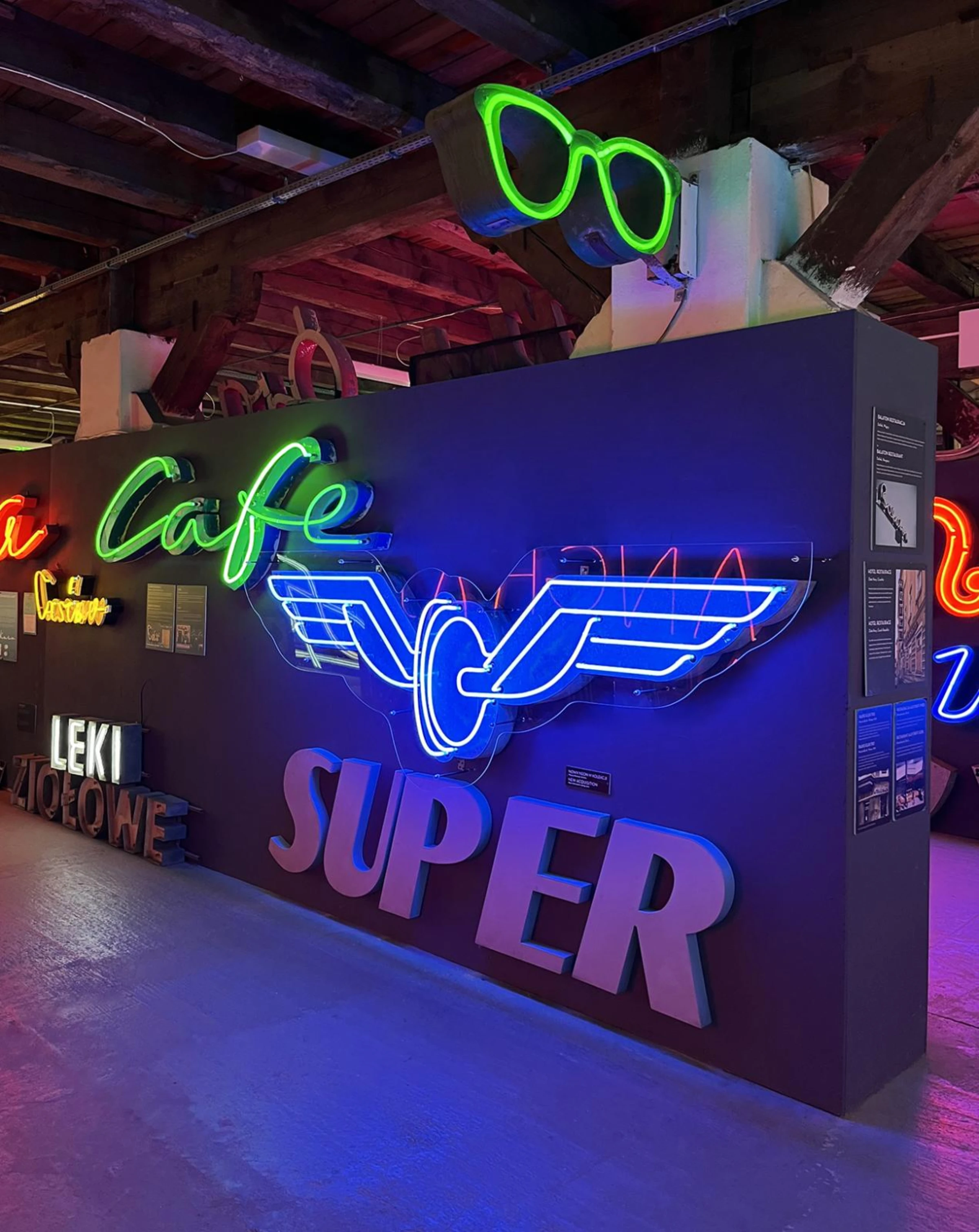
Warsaw's Neon Museum Turns Cold War Signage Into Living Urban Infrastructure
A revival centered on Warsaw's Neon Museum is reframing socialist-era signs from discarded relics into active cultural infrastructure, with restoration projects now feeding directly back into the city.
Warsaw’s neon revival has crossed a threshold from nostalgia to policy-relevant cultural practice. What began as a rescue mission for decaying Cold War signs now functions as a full ecosystem that includes conservation, public education, urban branding, and tourism economics. The center of that ecosystem is Neon Museum, which has helped transform fragments of state-socialist visual culture into a contemporary civic asset.
The institutional stakes are higher than they first appear. In many post-socialist cities, the material record of late twentieth-century public design was either politically discarded or commercially overwritten. Warsaw’s signs faced that fate after 1989, when market transition and redevelopment made maintenance impossible and symbolic continuity undesirable. By collecting, cataloguing, and restoring signs before they disappeared, Neon Museum effectively created an archive where municipal policy had left a vacuum.
Its work now extends beyond storage and display. Through restoration and selective reinstallation, the museum has pushed objects back into public space, where they operate as live urban markers rather than detached heritage artifacts. This model, museum as reversible infrastructure lab, is increasingly relevant for cities trying to preserve visual identity while managing contemporary development pressure. It aligns with broader adaptive-memory approaches used by institutions such as the Museum of Warsaw, where urban history is treated as a tool for current planning, not only retrospective storytelling.
For curators, the Warsaw case demonstrates how design history can be exhibited without freezing it. Neon objects are not neutral formal exercises, they are embedded in ideological histories, labor systems, and everyday social rhythms. A successful curatorial frame has to hold that complexity: Soviet-era modernization narratives, local graphic experimentation, and post-1989 abandonment all at once. Neon Museum’s programming and publishing activity, including its books and educational work documented on its publications program, signals that this is now a scholarship project as much as a preservation project.
The market dimension is also changing. As interest in modernist and late-modern design broadens, historically specific signage is being pulled into collecting circuits that did not exist fifteen years ago. That creates opportunity and risk. Opportunity, because private capital can support restoration and visibility. Risk, because detached objects can be stripped of place-based meaning when they move into private decorative markets. Institutions should establish stronger provenance and context standards before these objects are fully financialized.
For city officials and cultural funders, Warsaw offers an exportable framework. It pairs independent institutional initiative with public-facing outcomes that are measurable: visitor numbers, district-level footfall, educational reach, and international visibility. The museum’s model could be adapted in other cities with vulnerable vernacular graphics, from transit typography to commercial facades. The key is to preserve not only iconic pieces but also the social narratives around them, who commissioned them, who fabricated them, and how people used them in daily navigation.
There is also a geopolitical layer. In central and eastern Europe, debates about communist-era heritage are often polarized between erasure and uncritical celebration. Neon Museum’s approach points to a third path: critical conservation. It preserves material culture while acknowledging the political systems that produced it. That stance is particularly valuable in a period where culture-war framing often demands simplistic symbolic positions.
What Warsaw has built is not a retro trend. It is an institutional method for turning endangered visual culture into a durable public resource. The signs still glow, but the bigger achievement is structural: a city has learned how to keep design memory active without trapping it in the past.