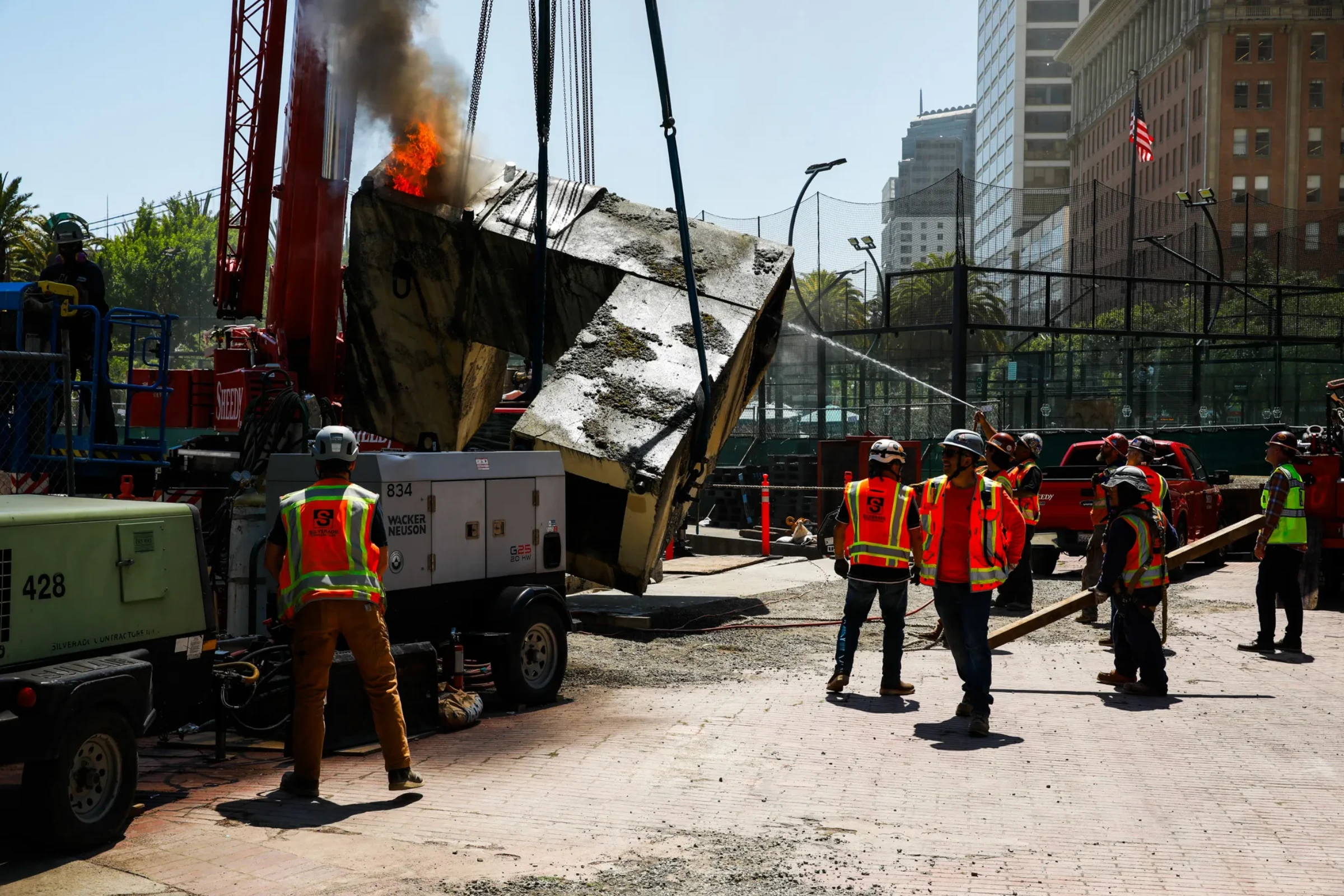
Fire at San Francisco’s Vaillancourt Fountain Turns a Demolition Into a Public Flashpoint
A blaze during dismantling of Armand Vaillancourt’s fountain intensifies scrutiny of San Francisco’s $32.5 million Embarcadero redesign and its handling of contested public art.
San Francisco’s dismantling of Armand Vaillancourt’s Brutalist fountain at Embarcadero Plaza escalated this week when the structure caught fire during removal operations. The fire was quickly contained, but the optics were unavoidable: a city taking apart a controversial landmark, with smoke visible from the waterfront, while debating what public space should represent in 2026.
City agencies described the incident as a controlled response during dismantling operations, and the work sits within a broader redesign context published by San Francisco Recreation and Park and background records around the artwork at San Francisco Arts Commission. crews using torches ignited debris and interior tubing while cutting the fountain’s welded components. The work is part of a $32.5 million plan to transform Embarcadero Plaza and adjacent play areas into a larger five-acre park environment. Local authorities described the fire as an expected risk managed on site, yet the event intensified criticism from preservationists and artists who view the process as an avoidable failure of stewardship.
Vaillancourt Fountain has always polarized opinion. Installed in 1971, weighing roughly 710 tons, and designed to circulate 30,000 gallons of water, it became one of the city’s most argued-over public artworks. The piece has been drained since 2024 for systems assessment, and supporters have argued that technical deterioration was used rhetorically to weaken the case for conservation. Opponents have long described the work as hostile to the surrounding urban fabric. Additional context around waterfront planning can also be traced through Port of San Francisco planning frameworks.
This is the standard conflict cycle for large civic sculpture in American cities. First, deferred maintenance turns complex works into budget liabilities. Next, planning language reframes removal as public benefit. Finally, a visible incident recasts a planning dispute as a legitimacy crisis. San Francisco is now in that third stage, where technical explanations can be accurate and still politically insufficient.
For curators and public-art commissioners, the real issue is process design. Was there a transparent conservation review, publicly legible alternatives, and a documented threshold at which removal became unavoidable? If those records are weak or inaccessible, even competent operations read as predetermined outcomes. The result is not simply outrage over one artwork, but a broader distrust in city-led cultural decision making.
For developers and civic planners, the lesson is equally direct. Public art does not behave like neutral street furniture once it accumulates decades of symbolic life. Demolition plans must include cultural risk modeling, not just engineering and cost controls. The fire incident now feeds a narrative that the city treated a contentious monument as a logistical obstacle, then lost control of the story at the moment of maximum visibility.
What happens next will matter beyond San Francisco. Cities globally are redesigning central plazas for climate adaptation, mobility, and mixed-use programming. Many will confront aging, polarizing artworks in prime public locations. The Vaillancourt episode is a warning that removal without persuasive cultural accounting can damage trust faster than any redesign can restore it.
The fountain may be physically disassembled, but the policy argument is only beginning. If San Francisco wants the new Embarcadero plan to function as civic repair rather than cultural erasure, it will need to show that this decision was not merely legal and fundable, but historically literate and publicly defensible.
What municipal leaders should document next is a transparent chain from condition assessment to final action, including alternatives tested, costs of stabilization, and projected use outcomes. Without that file, every technical rationale will continue to read as retrospective justification.