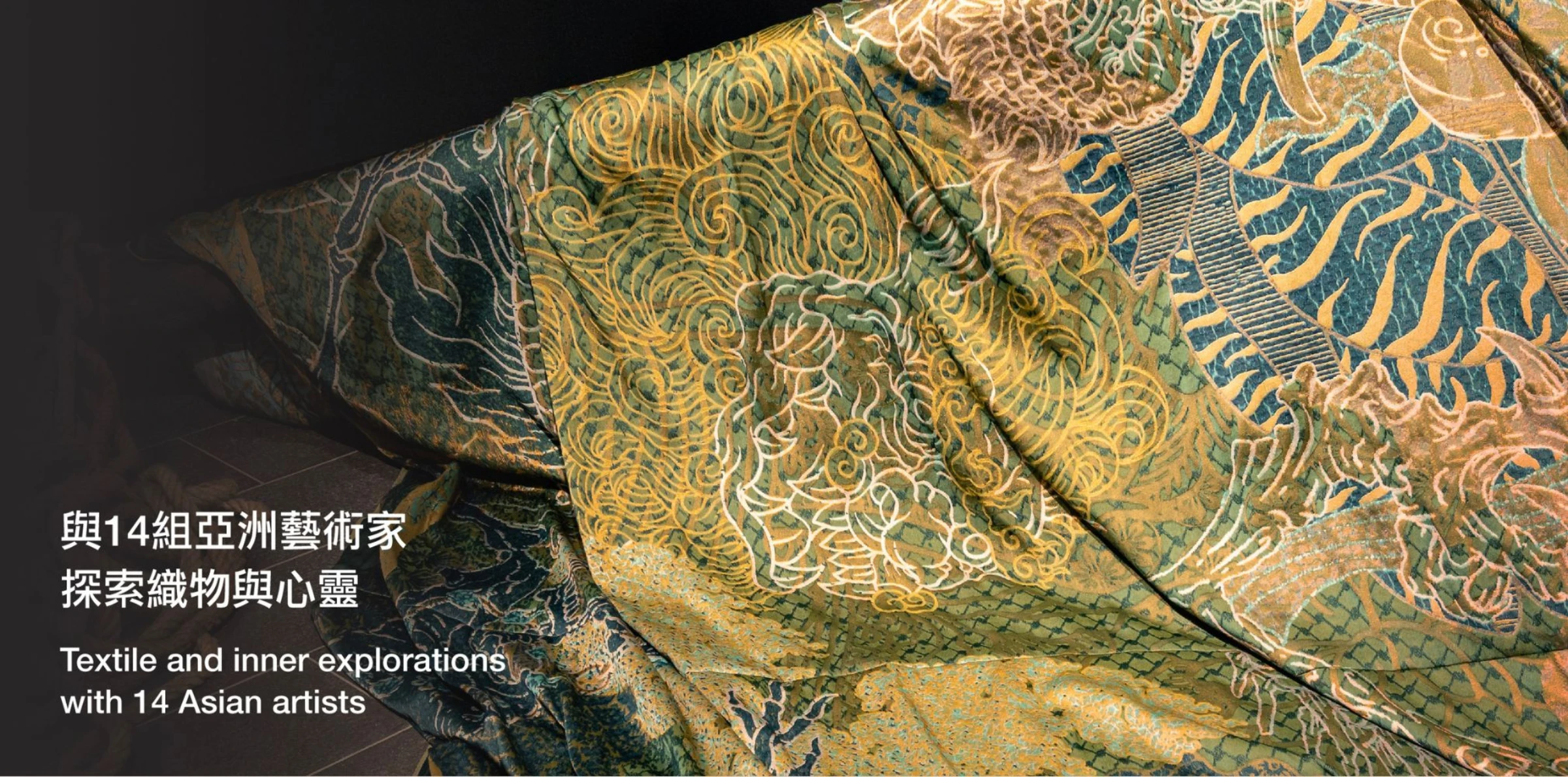
Hong Kong’s Threading Inwards Treats Textiles as Spiritual Technology, Not Craft Illustration
At CHAT in Hong Kong, Threading Inwards brings together 14 artists using textile, video, sculpture, and scent to argue that fabric can still carry memory, ritual, and cosmology under modern conditions.
Threading Inwards, now on view at Hong Kong’s Centre for Heritage, Arts and Textile, is built around a proposition that many institutions gesture toward but few pursue with enough specificity: textiles are not secondary cultural evidence, they are active carriers of cosmology, bodily memory, and spiritual relation. The Art Newspaper describes the exhibition as a survey of 14 artists from across Asia working in painting, photography, video, textile, and installation. What makes the show matter is the curatorial insistence that cloth is not an illustrative medium here. It is a structure through which worlds are held together, damaged, and reimagined.
The exhibition’s opening sequence makes that argument immediately. Visitors pass through Sang A. Han’s fabric threshold, a soft work stained with Korean ink that functions as both an object and an invitation. Beyond it, shrine-like sculptures filled with cotton from donated dolls set up a logic of charged materiality: touch, residue, and domestic objects becoming vehicles for other kinds of presence. Co-curator Wang Weiwei told The Art Newspaper that the piece welcomes viewers into a spiritual realm beyond the everyday. That may sound lofty on paper, but within the exhibition’s larger argument it is simply precise. The show is asking how textile can mediate between visible life and what exceeds it.
Its strongest curatorial choice is to refuse any single civilizational script. Wang worked with Eugene Hannah Park, Kurosawa Seiha, and Wang Huan to bring together artists whose practices move across Korean, Balinese, Uzbek, Malaysian, Hong Kong, and diaspora contexts. This matters because exhibitions on spirituality in Asia often collapse into either soft essentialism or anthropological display. Here the co-curators seem more interested in contamination, rupture, and historical loss. Park says in the article that the relationship between textile and spirituality in Asia has been reshaped by westernisation, modernisation, and colonisation. That formulation keeps the exhibition from drifting into nostalgia.
Several works appear to sharpen this point through bodily participation. The London-based Uzbek artist Aziza Kadyri uses suspended shell-like fabric structures and video to reconnect choreography, Soviet constraint, and her grandmother’s unrealised life in dance. The Balinese artist Citra Sasmita’s Sky River in Fountain of Amygdala, created with a weaving community in Central Java, combines textile with fragrant herbs and funerary reference, tying sensory encounter to rites of passage. And Hong Kong-based IV Chan’s Chloronest turns a fabric-lined alcove into a backstage sanctuary, a place where transformation is imagined as something soft, provisional, and touchable rather than monumental.
For Hong Kong, the exhibition also says something about the institutional role CHAT has carved out for itself. Unlike blockbuster museums that often instrumentalise textile as craft outreach or historical supplement, CHAT keeps returning to the medium as a live contemporary language. That approach is rooted in the site’s former textile-mill history, but it avoids the trap of heritage branding by foregrounding artists whose work remains formally and politically unsettled.
Collectors and curators should pay attention to the register of the show. Textile has become a crowded category internationally, with institutions eager to repair old hierarchies between craft and fine art. But a large share of those exhibitions still treat fabric as an overdue correction rather than a generative epistemology. Threading Inwards argues for something stronger. Cloth here is not newly legitimate because museums have granted it seriousness. It already possessed seriousness because communities have long used it to carry mourning, devotion, ancestry, labor, and transformation.
That point is why the exhibition lands now. In a cultural moment saturated with conflict, fracture, and exhaustion, the show does not offer textile as comfort object. It offers it as infrastructure for relation, something that can still bind person to ritual, body to history, and material to belief. That is a sharper and more durable claim than the usual language of softness or healing. It restores complexity to a medium too often romanticised just as institutions begin paying attention to it.