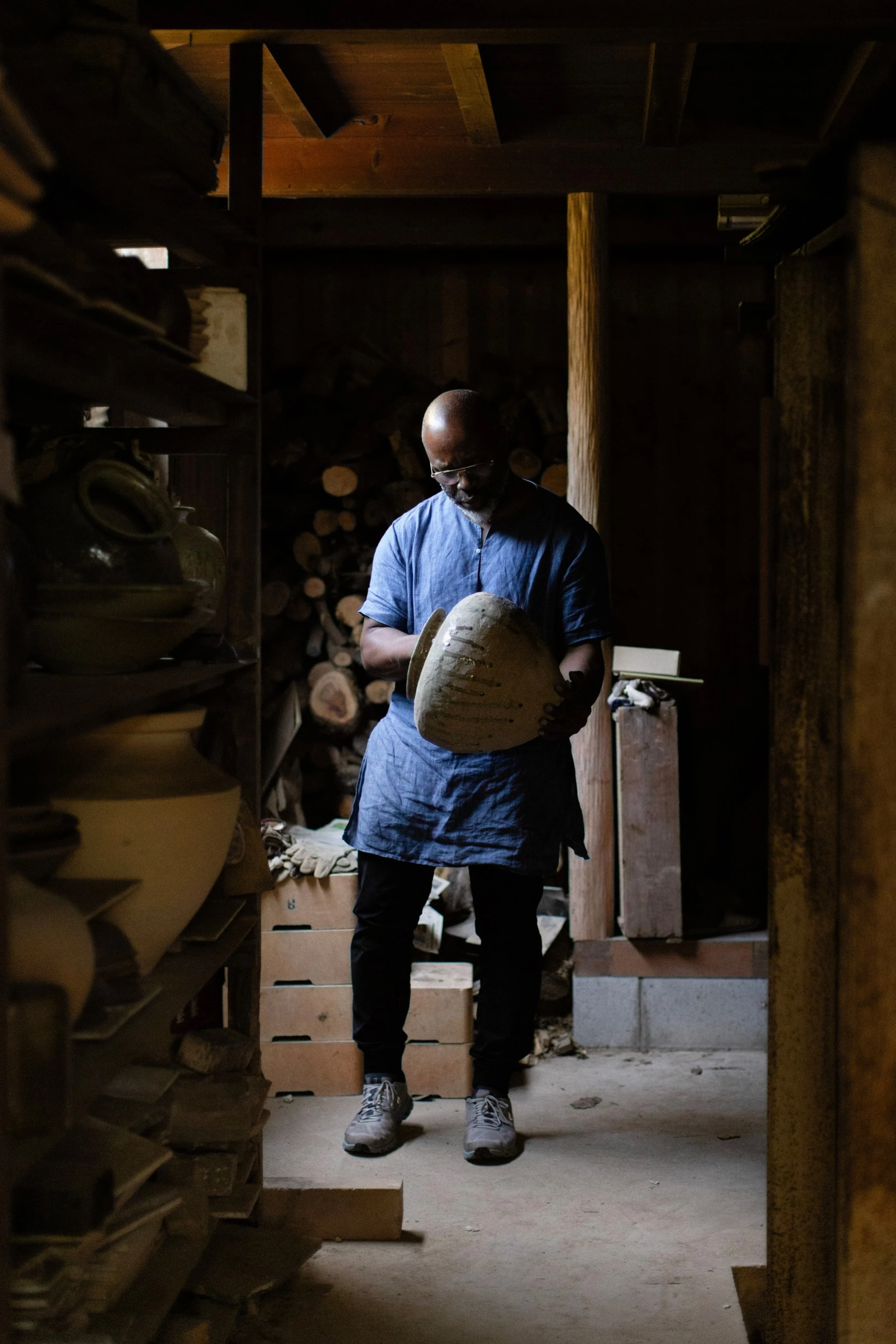
At Gagosian, Theaster Gates Turns Ownership Into Restitution in a David Drake Tribute
Theaster Gates is returning a David Drake vessel from his collection to Drake’s descendants, extending a rare restitution pathway tied to slavery-era cultural property.
Theaster Gates’s exhibition Dave: All My Relations at Gagosian pushes the conversation around David Drake beyond tribute and into transfer. Gates has said he will return a Drake vessel from his own collection to Drake’s descendants, aligning exhibition visibility with an active restitution pathway tied to slavery era extraction and inheritance.
Drake, also known as Dave the Potter, produced inscribed stoneware under conditions that denied basic autonomy to enslaved people. His jars are now central to American ceramic history, but their circulation has often prioritized market and institutional narratives over descendant centered frameworks. The current moment marks a structural shift in how those claims are negotiated and publicly staged.
The exhibition is documented by the gallery here: Gagosian exhibition page. What is notable is that Gates pairs interpretation with sacrifice, reportedly breaking his own ceramics to create a plinth supporting Drake’s vessel. That act reverses normal value hierarchy by placing Drake’s legacy materially above contemporary authorship.
Institutional precedent also matters. The Museum of Fine Arts Boston has published context on the artist and related holdings, which helps ground public understanding of Drake’s historical position: MFA Boston collection entry on Dave. Provenance and descendant consultation should be baseline practice, not optional ethics language.
For legal and policy observers, this case is valuable because it combines private collection action, gallery scale visibility, and descendant participation. Many restitution discussions remain abstract until transfer terms, custodial rights, and future stewardship are stated clearly. Gates’s decision makes those issues concrete and publicly legible.
The field implication is direct. If institutions can build robust protocols for antiquities and wartime looting claims, they can build equally rigorous pathways for slavery linked cultural property. That work requires genealogical research, legal infrastructure, and curatorial willingness to share authority with families who have historical claims.
The exhibition also insists that aesthetics cannot be separated from record. Drake’s vessels are artworks, but they are also evidence of literacy, coercion, and self inscription under violent systems. Curatorial framing that ignores that dual status risks turning history into style. Here, relation and transfer remain central to the curatorial argument.
This is why the story lands as more than fair week headline material. It models a way artists, collectors, and institutions can move from acknowledgment to action. Repair, in this frame, means changing ownership pathways and narrative authority at the same time.
There is a collecting lesson here as well. Private owners who hold historically loaded objects should expect stronger scrutiny around provenance and descendant claims in coming years. Voluntary return pathways, when documented and transparent, can reduce adversarial conflict and produce better public outcomes than prolonged legal stalemate. This requires early legal review and direct engagement with families who can demonstrate lineage and cultural stake.
For scholars and curators, companion resources include the Met’s Hear Me Now exhibition documentation and public records from institutions working with descendant communities. These materials offer practical models for label language, educational programming, and shared authority structures that move beyond symbolic acknowledgment.
A further primary source for descendant-centered scholarship is the CAA and museum programming ecosystem around Black potters of Edgefield, which continues to expand institutional context for this work. One relevant institutional framework is the Metropolitan Museum’s exhibition context page: The Met, Hear Me Now. That context strengthens the case that restitution should be integrated with interpretation, not handled as a back-office legal event.
Collectors should treat this as a signal that ethical valuation is shifting. Works tied to coercive histories increasingly carry obligations that can include documentation, descendant consultation, and eventual transfer. Market actors who ignore this shift risk reputational and institutional isolation. Actors who engage it seriously can help build a more legitimate field standard.