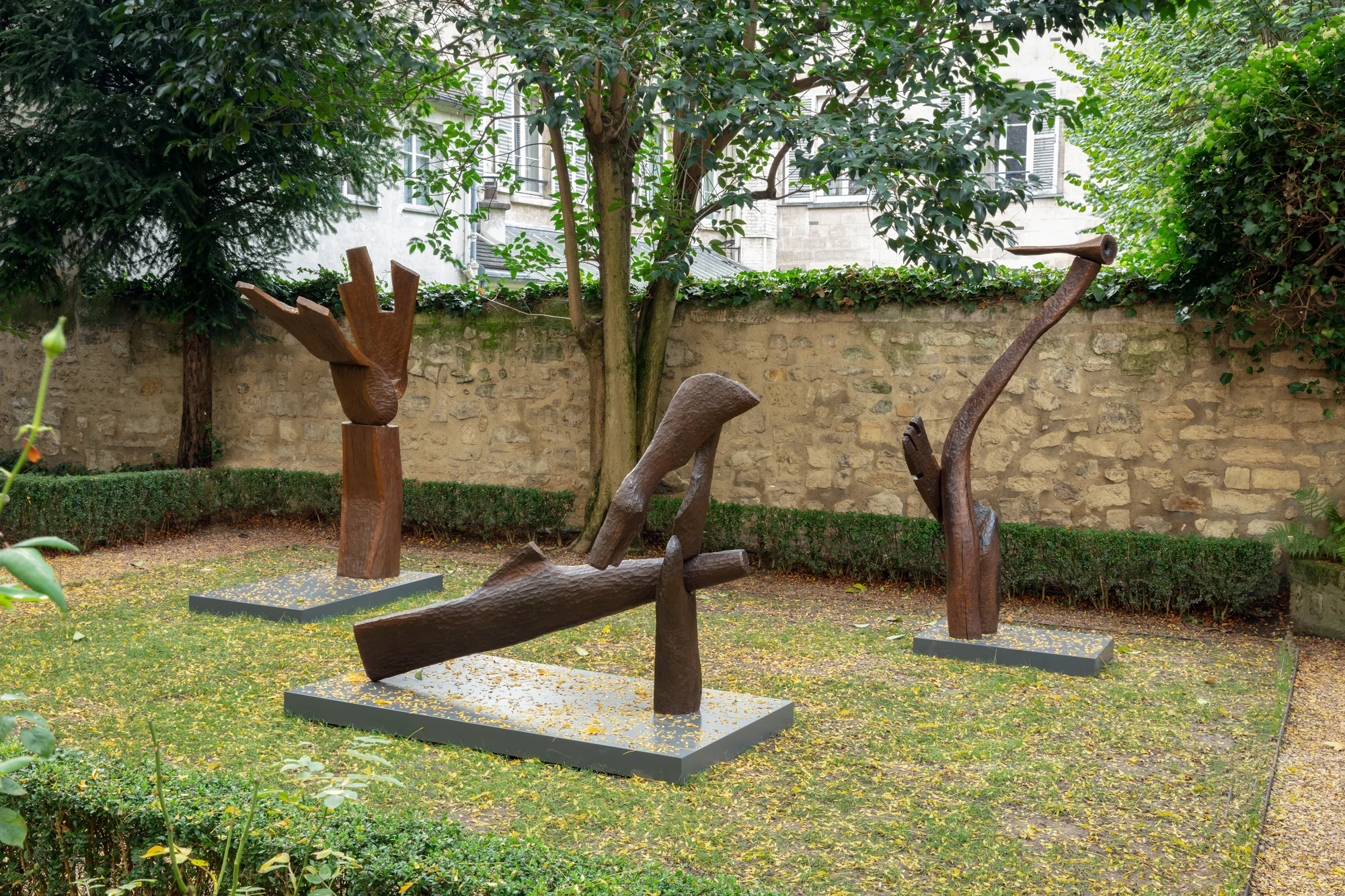
Thaddeus Mosley, Pittsburgh Sculptor of Monumental Wood Forms, Dies at 99
Mosley, the self-taught American sculptor whose carved hardwood abstractions moved from local Pittsburgh recognition to major museum acclaim late in life, died on March 6 at age 99.
Thaddeus Mosley, the self-taught sculptor known for carved hardwood abstractions that balanced mass, lift, and asymmetry, died March 6 at his home in Pittsburgh. He was 99. The artist’s death closes a 70-year practice that began in postwar Pennsylvania workshops and ended with institutional circulation across major American museums.
Born in New Castle, Pennsylvania, on July 23, 1926, Mosley grew up in a family connected to coal mining labor, then became the first man in several generations not to enter the mines. After naval service near the end of World War II, he completed a double major in English and journalism at the University of Pittsburgh. He built a studio life while working at the post office, where he remained for 40 years.
Mosley’s entry into sculpture was direct and practical. In the 1950s he saw small teak birds in a furniture display, tried carving similar forms, and moved steadily toward larger constructions. He began with castoff lumber, then shifted to fallen logs of cherry, sycamore, and hickory provided through municipal channels. The core method stayed constant: a hand-carved relation to material grain, weight, and internal balance.
His works often looked unstable at first glance, then resolved into highly engineered equilibrium. That formal language culminated in public commissions such as Phoenix (1979), a 14-foot cedar sculpture produced for Pittsburgh’s Hill District. Earlier, the Carnegie Museum of Art gave him a solo show in 1968 and acquired Georgia Gate in 1975, signaling early institutional confidence even before national attention followed.
A second major public project, Mountaintop, honoring Martin Luther King Jr., was installed in the Upper Hill in 1989 using limestone and brick. That work showed Mosley could shift media while preserving his sculptural logic: compressed verticality, implied bodily contour, and controlled monumentality without theatrical excess. Even at civic scale, he refused decorative overstatement.
After decades of working outside the market spotlight, Mosley’s last decade remapped him from a regional figure to a national sculptural reference point.
For decades, Mosley remained better known in Pittsburgh than in New York or Los Angeles. That changed after his inclusion in the 2018 Carnegie International and a survey that traveled between the Baltimore Museum of Art, Art + Practice, and the Nasher Sculpture Center from 2021 to 2023. In 2025, the Public Art Fund mounted an outdoor bronze presentation in City Hall Park, extending his audience again.
By the time wider acclaim arrived, Mosley was in his nineties. Asked in 2023 what that late recognition felt like, he answered with characteristic economy: the work had not changed, the situation had. The line matters because it names a structural reality in American art, where institutional timing, not artistic development alone, often determines who enters canonical discourse.
Mosley is survived by partner Teruyo Seya, six children, eight grandchildren, and two great-grandchildren. His work is held by institutions including the Guggenheim, the Whitney Museum, and the Seattle Art Museum. For curators and collectors, the consequence is immediate: postwar American sculpture narratives now have to account for Mosley as a central builder, not a regional exception.