Simon Fujiwara Turns Mudam Into a Theme Park of 21st-Century Anxiety
Mudam Luxembourg opens a two-decade survey of Simon Fujiwara that threads war, disease, pornography, and digital identity into one staged environment.
Mudam Luxembourg has opened one of the sharper museum surveys of the spring with A Whole New World, a twenty-year look at Simon Fujiwara’s practice that refuses the comfort of a single theme. The show, on view through August 23, does not present a neat retrospective arc. It stages a collision between mass-media desire, historical violence, illness, and self-invention, then asks visitors to decide what counts as authenticity when every image already feels pre-processed.
The exhibition’s structuring image is Fujiwara’s recurring character Who the Baer, deployed here in a new composition that openly riffs on Picasso’s Guernica. In Fujiwara’s version, bodies are piled rather than actively battling, and the work points toward aftermath rather than event. That shift matters. Instead of monumentalizing catastrophe, the painting concentrates on the political economy of cleanup, memory, and selection: who gets carried into the next narrative, and who is flattened into visual residue. For curators working on post-conflict programming, this is the part of the show to scrutinize, because it treats iconography as a contested public resource rather than an untouchable canon.
Fujiwara also folds autobiography into that public register. Works in the Syphilis cycle convert personal diagnosis into lineage-building, placing the artist in conversation with historical figures also associated with the disease. The move is provocative because it refuses medicalized shame and treats pathology as a social script, one that disciplines bodies and reputations differently across periods. Institutions have lately embraced “vulnerability” as programming language, but this material is less confessional than strategic. It asks how biography can be weaponized against an artist and then reauthored from inside the work.
The late-gallery section on Koh Masaki, assembled as The Way, pushes the show’s ethics of looking to a harder edge. Fujiwara contrasts pornographic visibility with an intimate hospital image, effectively splitting consumption from care. That distinction lands with force in a museum environment where viewers are trained to process images quickly. Here, delay is the point. The installation asks whether spectators can move from extraction to attention, especially when the subject has already been circulated as commodity.
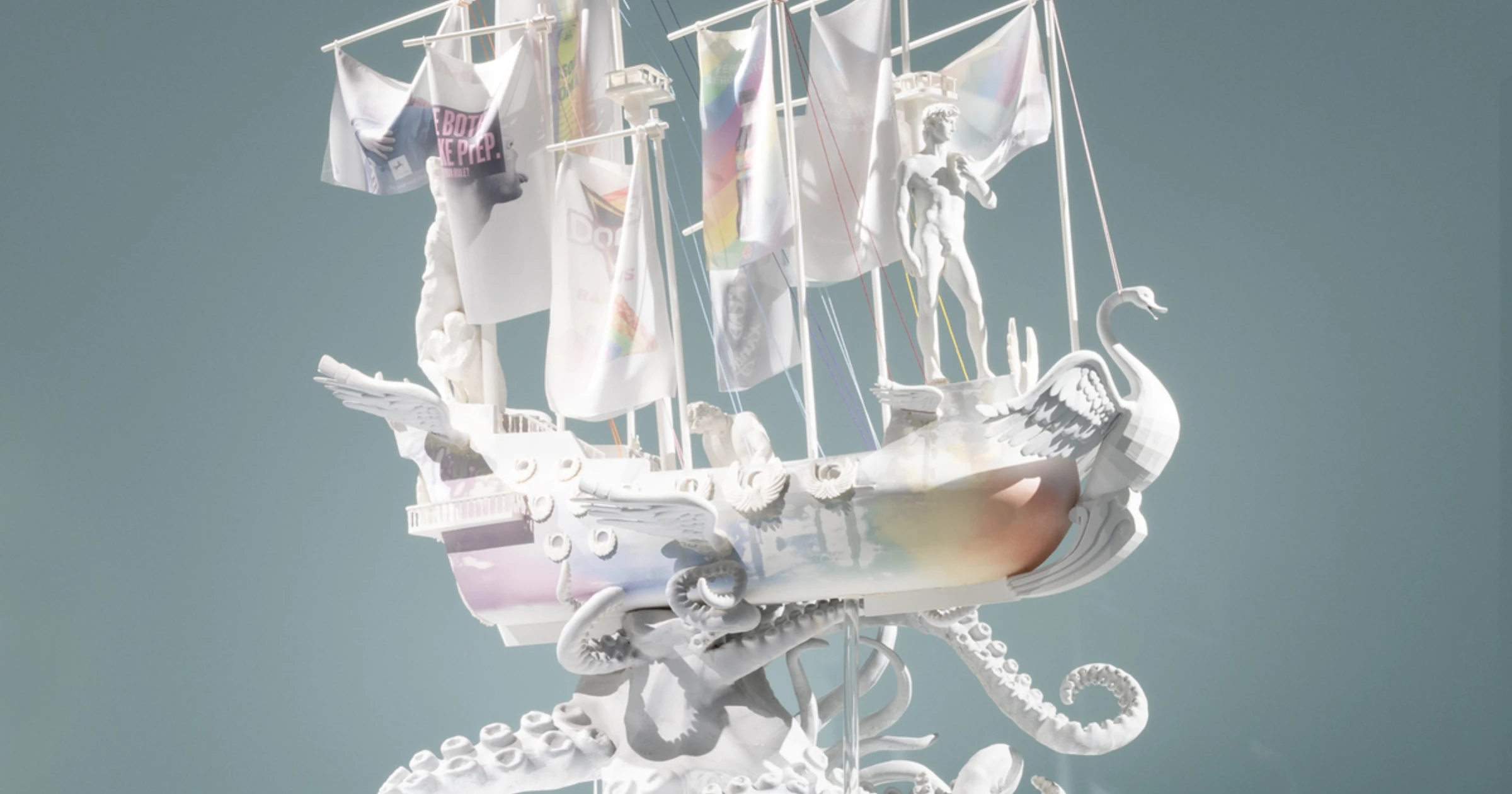
Formally, the exhibition is organized as an environment with “lands,” a theme-park logic that could have become gimmick but instead clarifies Fujiwara’s long project. The artist has repeatedly examined how institutions package affect as experience. By leaning into scenography, he exposes the script rather than hiding it. For museum professionals, this is a useful case study in exhibition design as argument: architecture and circulation are not neutral delivery systems, they are editorial choices that determine where empathy, discomfort, and spectacle are permitted to sit.
The survey also arrives at a moment when European institutions are recalibrating around audience development, attention competition, and digital mediation. Mudam’s framing, and the museum’s broader anniversary positioning, signal confidence in work that is neither market-friendly decor nor strictly pedagogic social practice. Fujiwara’s art can be funny, abrasive, and intentionally unstable, but the throughline is disciplined. Across projects, he tracks how identities are assembled from copies, fragments, and inherited scripts, then sold back to us as personal truth.
Collectors and advisors should read this show less as a “controversial” package and more as a durable proposition about image culture after originality. Fujiwara’s strongest works are not topical one-liners. They are structures that hold contradictory affects at once: seduction and disgust, recognition and estrangement, sincerity and performance. That is why the survey matters beyond Luxembourg. It offers a model for how mid-career presentations can do real critical work without pretending to stand outside entertainment, branding, and circulation, the very systems contemporary art now depends on.
For those planning spring travel, the practical takeaway is straightforward. Start with the large pictorial works, then spend time in the sections on illness and media persona, where the exhibition’s stakes become clearest. The show is not asking visitors to choose between politics and aesthetics. It demonstrates, with unusual precision, that in 2026 the two are inseparable at the level of form.