Sam Doyle at Outsider Art Fair Signals a Stronger Institutional-Market Circuit for Self-Taught Art
A concentrated presentation of Sam Doyle works at Outsider Art Fair highlights how collector stewardship, fair positioning, and museum uptake are reshaping valuation for self-taught artists.
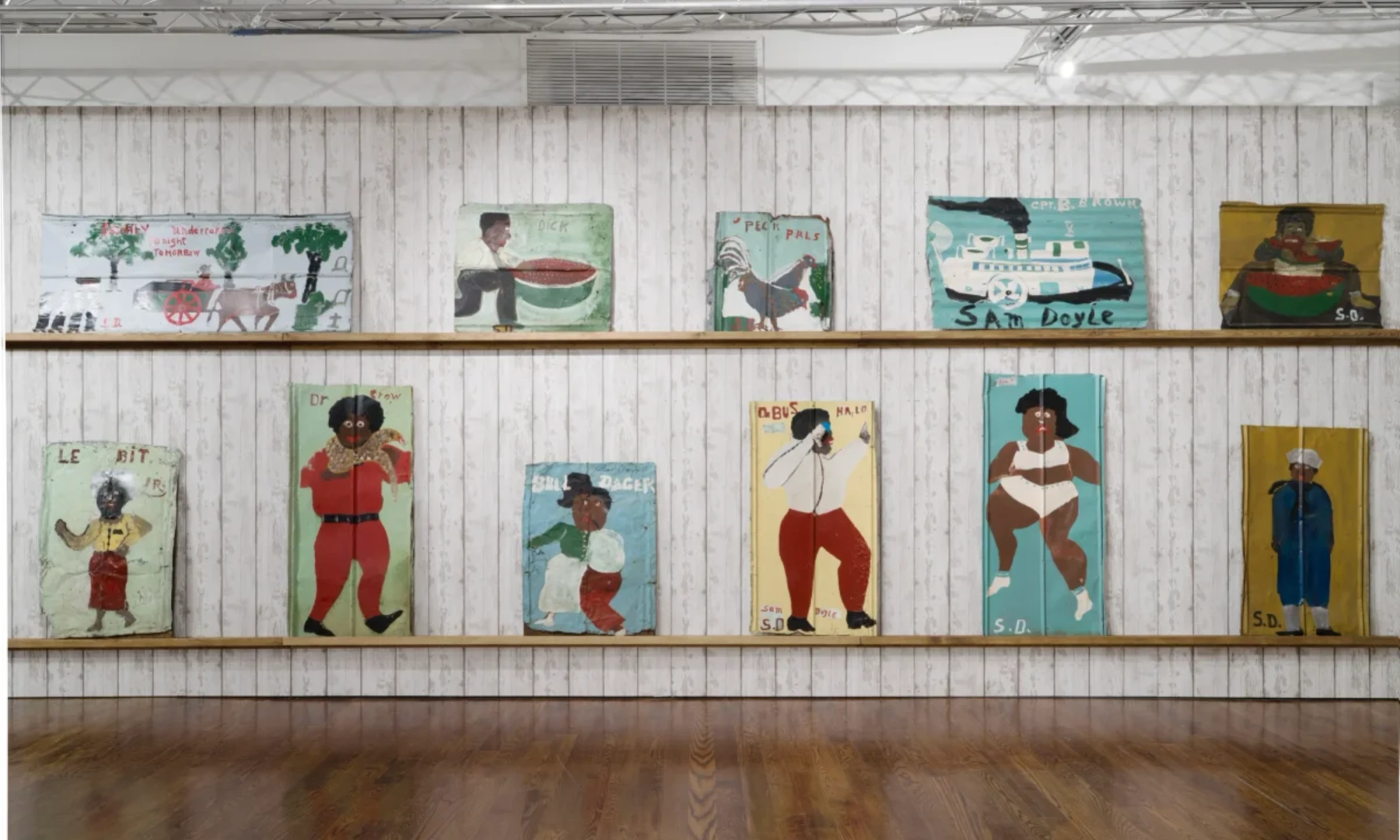
One of the sharpest presentations at this year's Outsider Art Fair is a group of twenty Sam Doyle works shown by The Gallery of Everything, drawn from the collection of publisher Bob Roth. Reported prices ranging from 35,000 to 85,000 dollars are notable, but the larger story is structural: Doyle's market position is now being stabilized by collector stewardship tied to institutional ecosystems rather than short speculative cycles.
Doyle, born in 1906 on Saint Helena Island in South Carolina, built a visual archive of Gullah life through portraits and narrative scenes painted on found materials. The works retain local specificity while carrying broader historical charge, including references to Robert Smalls, Martin Luther King Jr., Ray Charles, and Jackie Robinson. That layered iconography helps explain why his work keeps re-entering curatorial discourse beyond the outsider-art niche.
The Art Newspaper report underscores a key point: this fair presentation is linked to a longer arc that includes landmark institutional exposure and sustained critical uptake. Doyle's appearance in Black Folk Art in America at the Corcoran in 1982, followed by attention from artists like Basquiat and later references in works by Ed Ruscha, demonstrates that his influence has circulated across both community memory and blue-chip contemporary networks.
Institutional anchors now make that arc easier to verify and study. Readers can track current fair context through [Outsider Art Fair](https://www.outsiderartfair.com/new-york), museum scholarship through the [Intuit Art Museum](https://www.art.org/), and recent exhibition trajectories at the [Whitney Museum](https://whitney.org/), [Smithsonian American Art Museum](https://americanart.si.edu/), and [Royal Academy of Arts](https://www.royalacademy.org.uk/). This set of links matters because it demonstrates that Doyle's profile is being reinforced across independent, nonprofit, and major institutional channels.
From a market perspective, this convergence reduces the old binary between outsider authenticity and institutional legitimacy. Works that once circulated primarily through specialized collectors now sit inside broader acquisition conversations shaped by historiography, representation debates, and museum-led reframing of American modernity. If pricing continues to rise, the durability will depend on documentation, conservation, and responsible placement, not only on fair momentum.
The fair context is also significant in another way. Outsider Art Fair remains one of the few commercial platforms where close material reading can still compete with hype cycles. Doyle's found-wood and tin supports force viewers to confront facture, weathering, and handwork that digital circulation cannot fully convey. That physical encounter continues to be central to why his work converts first-time viewers into serious advocates.
Another reason this booth matters is timing. The fair sits at the intersection of private collecting, museum programming, and renewed scholarship around regional Black visual traditions in the US South. Doyle's paintings are no longer being read as isolated vernacular artifacts. They are being read as active narrative technologies that documented social life under conditions of exclusion, and that can still reorganize institutional narratives in the present.
Overall, this Sam Doyle presentation marks a mature phase in the artist's afterlife. It combines cultural memory, scholarly relevance, and price discipline in a way that suggests long-term institutional staying power. For collectors and curators alike, the signal is clear: Doyle is no longer an occasional rediscovery story, but a foundational case in the ongoing rewrite of American art history.
For readers tracking the institutional thread in real time, start with fair context at https://www.outsiderartfair.com/new-york , museum framing at https://www.art.org/ , and public collection interpretation at https://americanart.si.edu/ and https://whitney.org/ . Cross-checking these channels helps distinguish durable recognition from temporary demand.
Verification links for this market-institution cycle: <a href="https://www.outsiderartfair.com/new-york">Outsider Art Fair New York, <a href="https://www.art.org/about">Intuit Art Museum, and <a href="https://americanart.si.edu/artists/sam-doyle-1309">Smithsonian records.