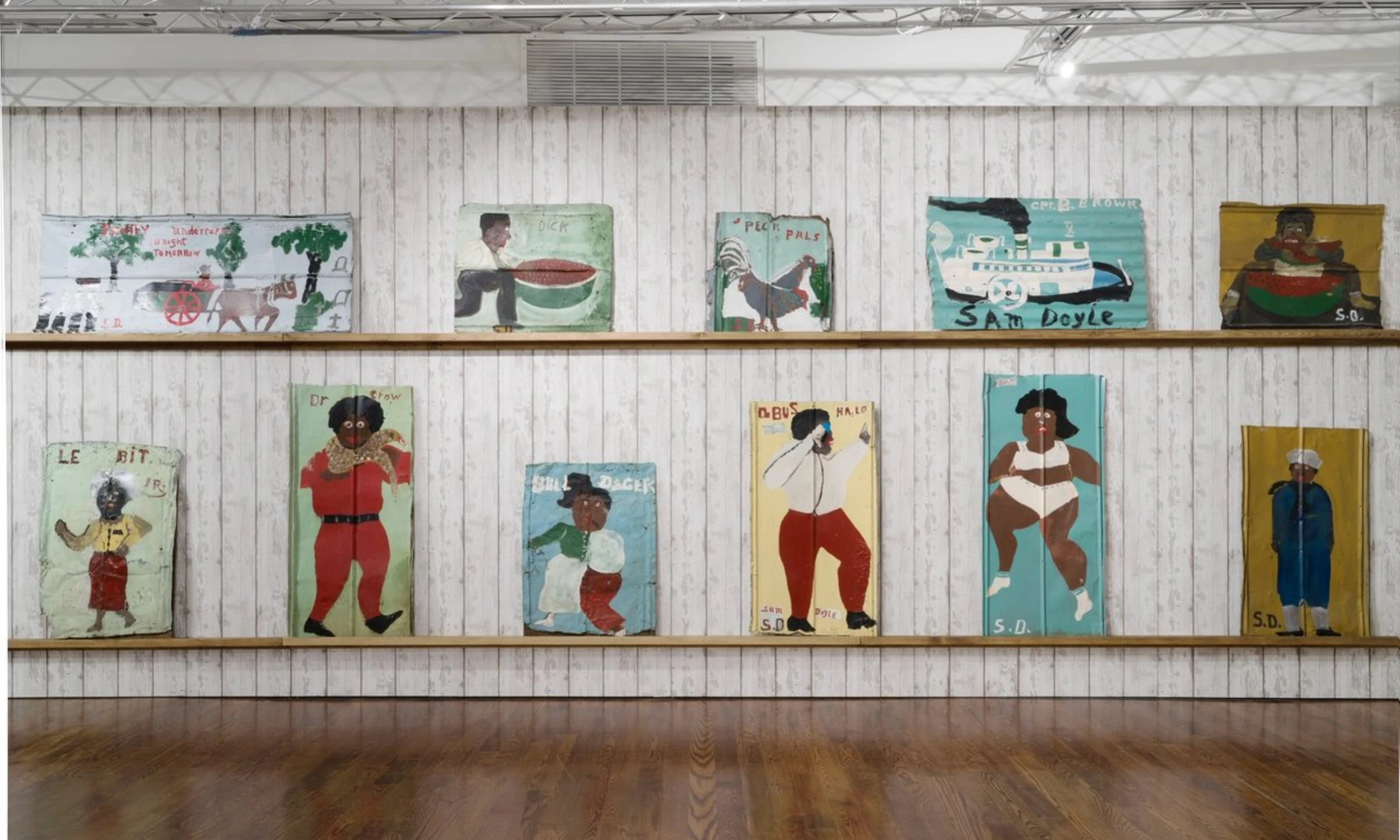
Sam Doyle at Outsider Art Fair Shows How Self-Taught Histories Are Being Repriced
A focused presentation of Sam Doyle works at New York's Outsider Art Fair highlights how institutions and collectors are revaluing self-taught artists through historical framing and tighter supply.
A concentrated booth of Sam Doyle paintings at this year's Outsider Art Fair in New York has become one of the clearest signals of where the self taught segment is heading. The presentation does not rely on novelty language. It relies on historical density, provenance focus, and a recognisable story of community rooted practice that institutions can meaningfully program.
Doyle, born in 1906 on Saint Helena Island in South Carolina, built a visual record of Gullah life through portraits and narrative scenes painted on found materials. That practice, once read mostly through ethnographic framing, is now being positioned as a foundational artistic archive with formal, historical, and social weight. The shift in framing is crucial because it changes who feels licensed to collect and exhibit the work.
The fair platform at Outsider Art Fair gives this repositioning a commercial stage, while gallery stewardship by The Gallery of Everything emphasizes curated coherence over inventory breadth. Price points reported in the mid five figure range place the works inside a zone where seasoned collectors can still build meaningful groups before the category hardens.
Institutional validation has already been compounding. Doyle's work has appeared in contexts tied to Whitney Museum of American Art, Smithsonian American Art Museum, and major UK programming circuits. That cross Atlantic presence matters because it reduces the risk that outsider art remains siloed as a temporary market theme in one city.
The deeper question is whether buyers are acquiring narrative or structure. Narrative buying chases moving stories and can unwind quickly. Structural buying looks at scarcity, scholarship momentum, conservation condition, and exhibition repeatability. Doyle's case supports the second mode because the body of available work is finite and the institutional research runway is still expanding.
Another factor is intergenerational collecting behavior. Younger buyers often enter through fairs and thematic surveys rather than canonical postwar categories. For them, self taught artists are not an add on category but part of the core conversation about American modernity, race, labor, and vernacular image making. That demand profile can stabilize liquidity if scholarship keeps pace.
Still, this is not a frictionless market. Documentation quality varies across older works, and condition issues can materially affect long term value. Collectors need to assess support materials with the same rigor applied in blue chip sectors: exhibition records, publication references, restoration history, and consistency in titling and dating conventions.
The strongest outcome of the current moment would be a tighter alignment between fair visibility and museum quality interpretation. When institutions contextualize artists like Doyle beyond token inclusion, they widen the base of informed demand and reduce speculative whiplash. That benefits artists' legacies, collectors, and public understanding at once.
Sam Doyle's fair visibility this season should therefore be read as more than a single booth success. It is evidence that the market for self taught histories is maturing into a field where curatorial seriousness and collecting strategy are converging, and where category labels matter less than the durability of the work itself.