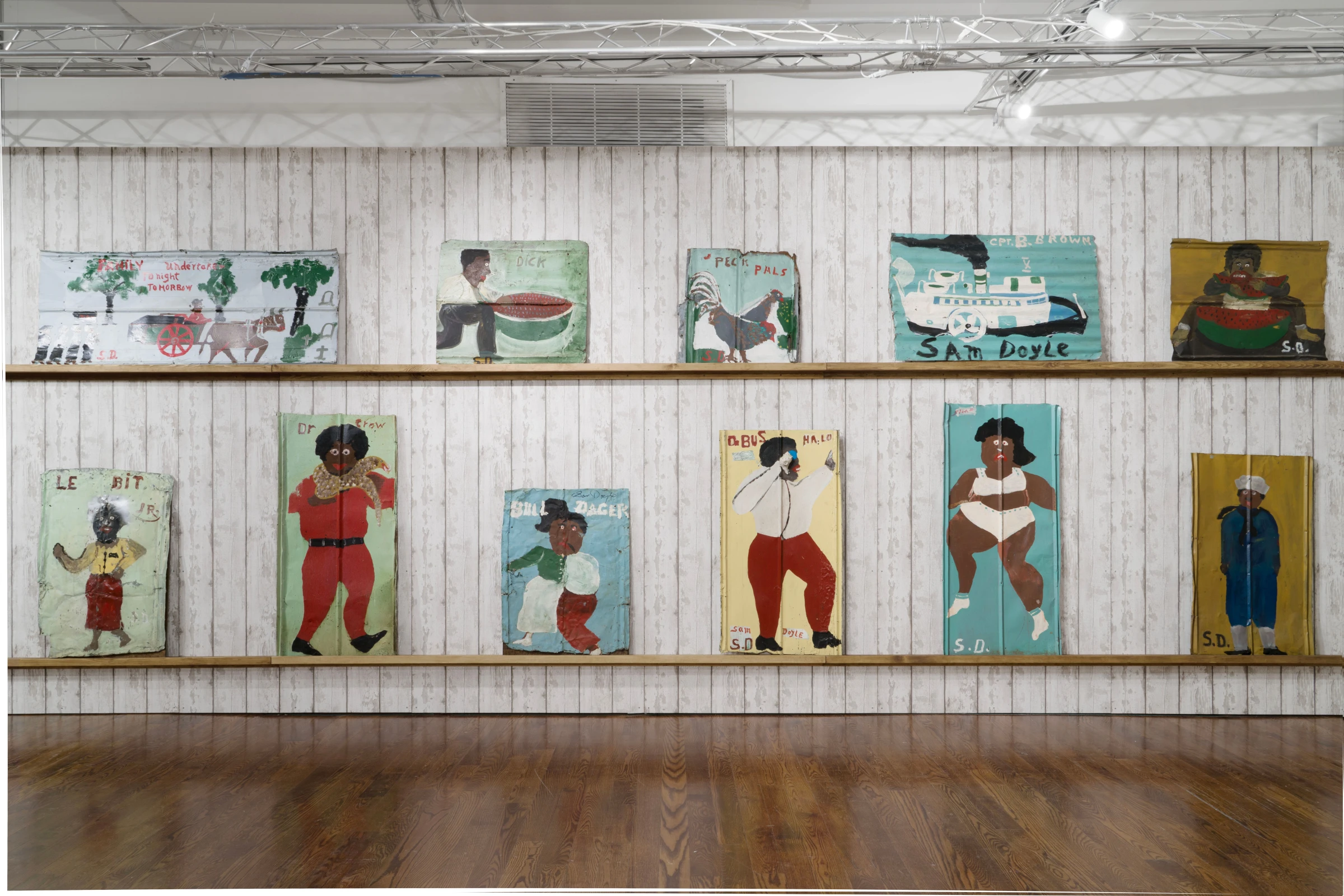
Sam Doyle Works Draw Focus at Outsider Art Fair From Bob Roth Collection
A focused presentation of Sam Doyle works at Outsider Art Fair highlights how institutional attention is reshaping market and curatorial treatment of self taught art.
A concentrated group of Sam Doyle paintings at this year's Outsider Art Fair has become one of the clearest examples of how self taught art is being reframed inside mainstream market and museum circuits. The presentation, drawn from collector Bob Roth's holdings and shown by The Gallery of Everything, places Doyle's work in a context that foregrounds both local history and broader art historical relevance.
Doyle's practice emerged from the Gullah community of St Helena Island in South Carolina, where oral histories, social memory, and vernacular storytelling shaped both subject matter and visual language. His portraits and narrative scenes function as social documents, but they also demand formal reading: color decision, edge handling, compositional economy, and text-image interplay all drive the work's force on the wall.
Fair discourse around outsider categories often oscillates between romanticization and market correction. Both approaches can miss what matters. The more rigorous frame starts with the work itself, then situates production conditions, community context, and circulation history without collapsing everything into biography. Doyle rewards that method because his pictures carry specific information and deliberate structure beyond identity shorthand.
The market story is real but secondary. Reported pricing at this presentation sits in a range that signals confidence from both specialist and crossover buyers. Yet the more meaningful shift is institutional. When museums, archives, and scholars build durable interpretive frameworks around artists like Doyle, price movement follows from deeper legitimacy rather than short term speculative momentum.
Recent museum visibility for Doyle and peer artists has broadened the conversation around what counts as central to American art history. That process is unfinished. Canon expansion can still become extractive if works are detached from the communities and historical conditions that produced them. Responsible institutional practice requires acquisition with context, publication depth, and long horizon stewardship.
For fair visitors, the strongest way to read this booth is to resist novelty framing. Ask what each picture is doing formally, what historical references are active, and how the installation builds argument across works. When a display can answer those questions, it moves from sales presentation to curatorial proposition. This one comes closer to that standard than most themed outsider booths.
There is also a distribution question. Self taught art has often entered major institutions through episodic enthusiasm rather than sustained policy. If current attention continues, museums need collection strategies that avoid one off gestures and build coherent holdings over time. That includes provenance research, conservation planning for unconventional materials, and partnerships with scholars who understand regional histories.
The Sam Doyle presentation is therefore useful as a barometer. It reflects rising confidence in an artist whose importance has been evident for decades, and it tests whether market and museum systems can support that recognition with serious infrastructure. The answer will be measured in acquisitions, publications, and repeat curatorial commitment after fair season ends.
Readers tracking this shift should monitor activity at the Intuit Art Museum, the Smithsonian American Art Museum, the Whitney Museum of American Art, and the Royal Academy of Arts, where institutional framing has direct downstream impact on collecting behavior.