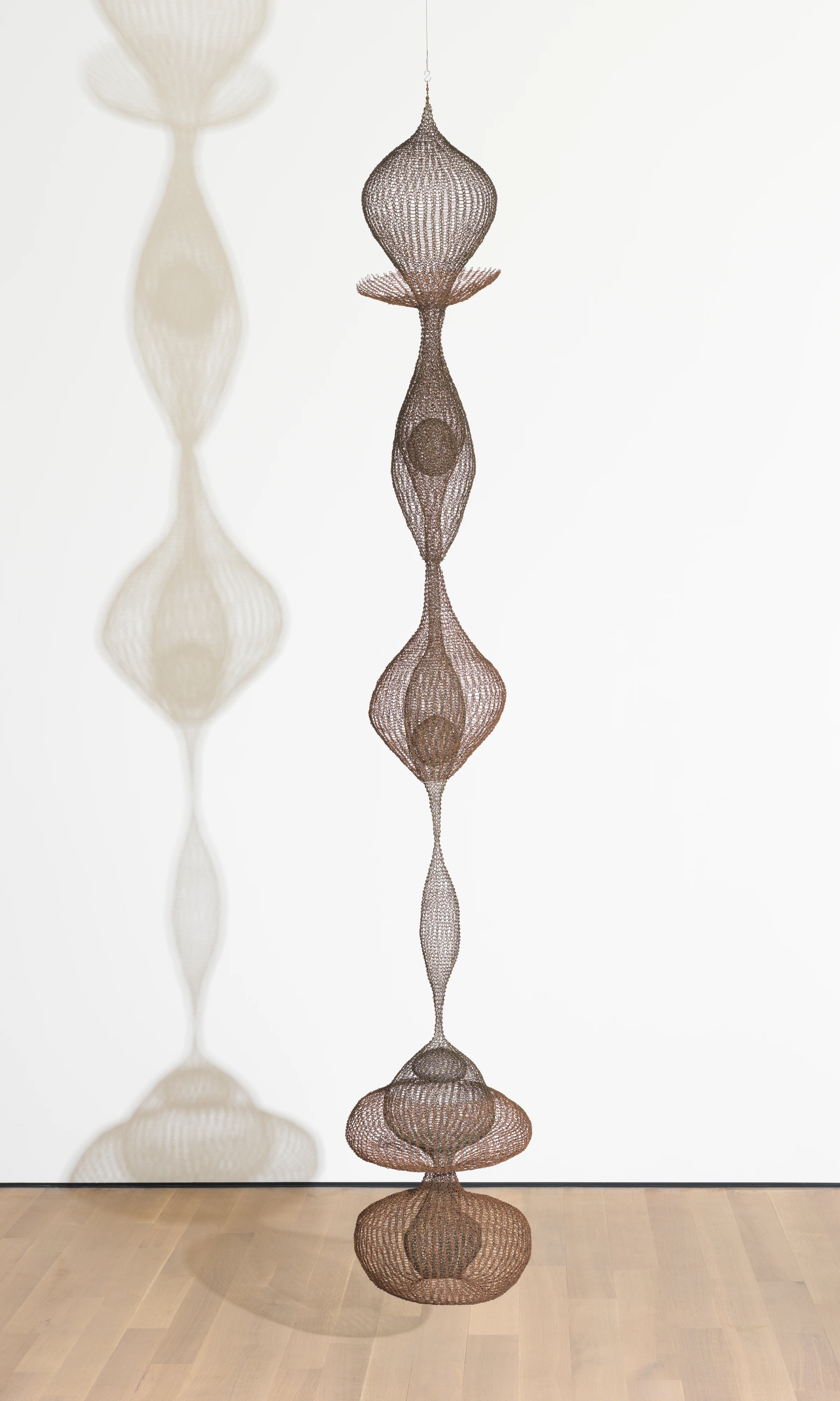
Ruth Asawa’s Family Opens a Permanent Gallery in San Francisco
Ruth Asawa Lanier Inc. will open at Minnesota Street Project in May, adding a permanent, family-led venue devoted to the artist’s work and archive.
A permanent gallery dedicated to Ruth Asawa will open this spring at Minnesota Street Project in San Francisco, a move that shifts part of the artist’s market and curatorial stewardship into a family-run structure with year-round programming. The new space, Ruth Asawa Lanier Inc., is scheduled to debut on May 9 and will open with a presentation focused on Asawa’s sculpture and works on paper. For collectors and institutions, the key fact is not only the opening date, it is governance: the gallery is being built by heirs who already control substantial archival knowledge and long-term conservation priorities around the artist’s practice.
That governance model matters because Asawa occupies a specific position in postwar American art. She is both institutionally canonized and still actively recontextualized, especially as museums revisit craft hierarchies, pedagogical practices, and West Coast modernism. Her suspended wire forms are now core references in museum displays of twentieth-century sculpture, including holdings at SFMOMA and major national institutions. A permanent venue in San Francisco gives curators a stable point of contact for loans, scholarship, and interpretive framing that can move faster than periodic estate releases.
The location inside Minnesota Street Project is also strategic. The complex has become a practical hub for Bay Area dealers, nonprofit spaces, and visiting curators seeking concentrated programming outside legacy downtown districts. By placing a single-artist program there, the family can stage focused historical arguments while still benefiting from steady foot traffic generated by neighboring galleries. In practical terms, that can improve audience quality for scholarship-led installations that might otherwise be diluted inside broader commercial group shows.
The family’s leadership, including Asawa’s daughters and grandson, has framed the venue as an extension of her civic life in San Francisco, where she lived for decades and advocated for arts education. That is consistent with Asawa’s biography, including her formative years at Black Mountain College’s legacy network and her later local work on public art and school-based cultural programs. For curators, this expands the available institutional narrative beyond a pure market story. The gallery can position exhibitions around process, teaching methods, and social context, which often gets compressed when works circulate primarily through auctions and fair booths.
There is also a timing factor. Asawa’s centennial-era attention has already pushed museum demand and publication volume higher, and family-led structures can either stabilize or fragment that momentum depending on execution. A dedicated venue with regular exhibitions offers a mechanism for tighter cataloguing and more coherent placement decisions. If the program prioritizes documentation and transparent provenance pathways, it can reduce friction for mid-size museums seeking loans and acquisitions with clear ownership history.
For collectors, the opening signals that access to high-quality Asawa material may increasingly run through curated, relationship-driven channels rather than broad speculative circulation. For curators, the more important implication is continuity: one place where scholarship, exhibition design, and estate-level decision making can be aligned over multiple seasons. In a market where artist estates frequently become administratively diffuse, a permanent gallery can function as both editorial desk and stewardship office. San Francisco, in this case, is not incidental geography. It is the site where Asawa’s local history and global institutional demand now meet in a formal structure.