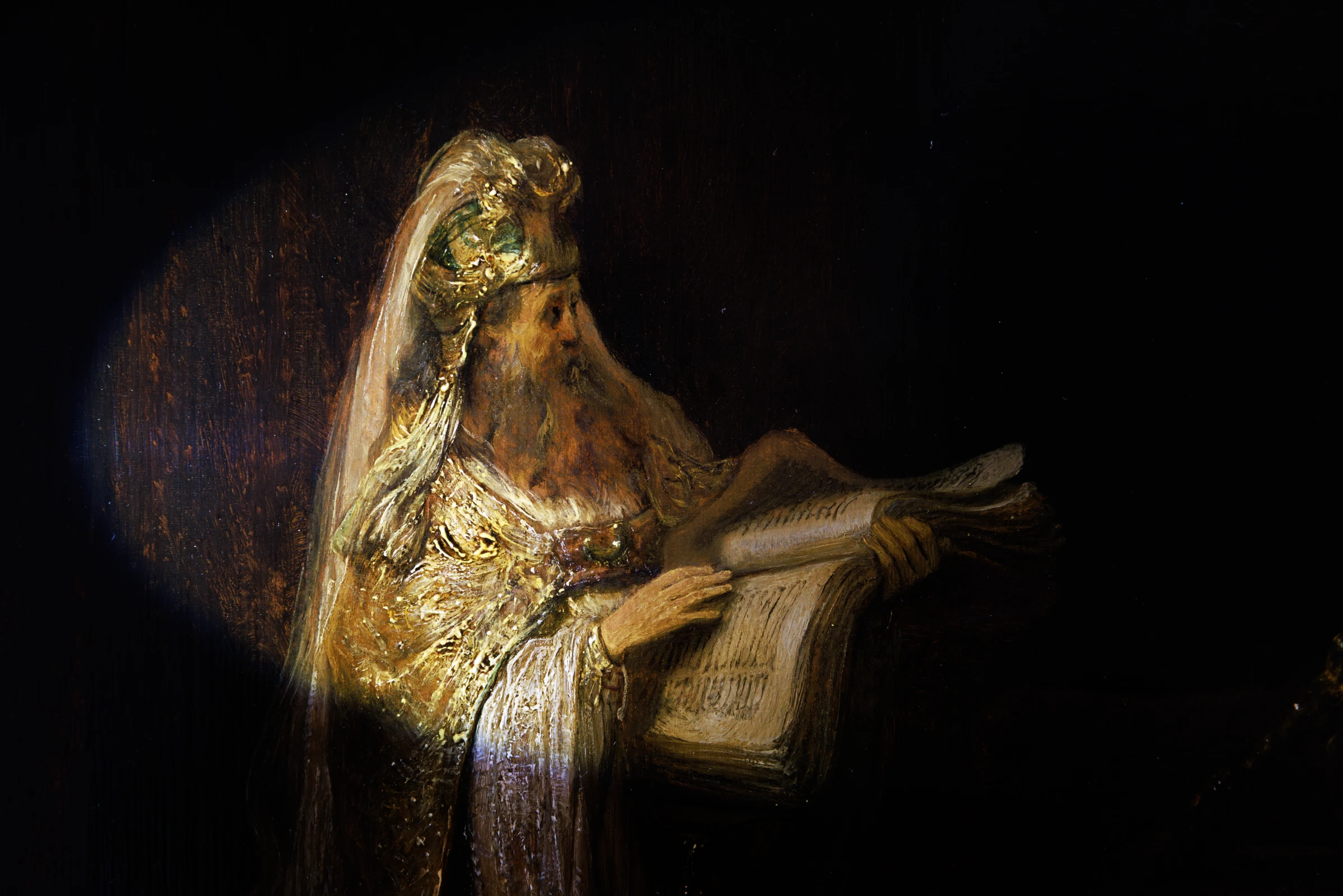
Rijksmuseum Authenticates Lost Rembrandt and Puts It on View in Amsterdam
A painting dismissed as workshop output for more than half a century has been reattributed to Rembrandt after a two-year technical study at the Rijksmuseum.
The Rijksmuseum has authenticated a painting long excluded from Rembrandt’s accepted oeuvre and placed it on public view in Amsterdam this week. The work, Vision of Zacharias in the Temple from 1633, had been deattributed in 1960 and subsequently cataloged as workshop production for decades.
According to reporting first published by Artforum, the canvas was brought back to the museum by heirs of a private collector who acquired it in 1961 after its scholarly fall from grace. Their central question was simple and expensive: did the oversized signature point to bravado from a pupil, or to a real Rembrandt still hiding in plain sight?
Rijksmuseum researchers then spent two years running technical and material analysis, including pigment comparisons, signature matching, and macro-XRF imaging that revealed compositional changes beneath the visible surface. Those adjustments are a key indicator of authorial process, and the museum concluded the work is authentic, dating to when Rembrandt was twenty-seven.
The discovery matters less as a market jackpot than as a reminder that attribution is still a living process shaped by tools, patience, and institutional will.
This is the kind of rediscovery that reshapes several conversations at once. It affects valuation immediately, moving a painting from a low six-figure ceiling into a different market stratum, but it also impacts curation, publication, and the rhythm of future exhibitions built around early Rembrandt. Attribution events like this can alter loan negotiations and insurance assumptions for years.
The Rijksmuseum’s decision to show the painting alongside twenty-five accepted Rembrandts gives the public and scholars a direct comparative context rather than a speculative press cycle. That framing is smart. It lets the institution make its case in the gallery, where brushwork, tone transitions, and spatial intelligence can be judged in real time against known anchors.
More broadly, the case is a reminder that connoisseurship has not been replaced by technology, it has been extended by it. Imaging and lab methods can narrow uncertainty, but attribution remains an interpretive act requiring historians, conservators, and curators willing to absorb disagreement. The result in Amsterdam is not only a rediscovered painting. It is a rediscovered confidence in slow, rigorous museum work.
There is also a wider market governance lesson here. When a major museum reattributes a work through published technical process, it raises pressure on private authentication claims that rely on opaque expert circles and selective disclosure. Transparent institutional methodology does not end disputes, but it changes the standard against which future attributions are judged by buyers, insurers, and courts.
For younger scholars, the case may become a teaching model for cross-disciplinary collaboration: curators framing historical stakes, scientists producing technical evidence, and conservators translating material behavior into arguments about authorship. That combined method is increasingly the norm at top museums. The Amsterdam result demonstrates why. Strong attributions are rarely the product of a single eye.
The timing of the announcement is also strategic. Presenting the painting now, with substantial supporting data, allows the Rijksmuseum to shape the scholarly conversation before speculative market narratives dominate coverage. By anchoring interpretation in conservation records and technical reports, the museum has created a template other institutions can emulate when revisiting contested attributions from mid-century cataloging cycles.