Rembrandt Attribution Fight Reopens in Chicago with 'Old Man with a Gold Chain' Pairing
A disputed version of 'Old Man with a Gold Chain' on view in Chicago is reigniting debate over autograph replicas, workshop practice, and how authority works in Old Master scholarship.
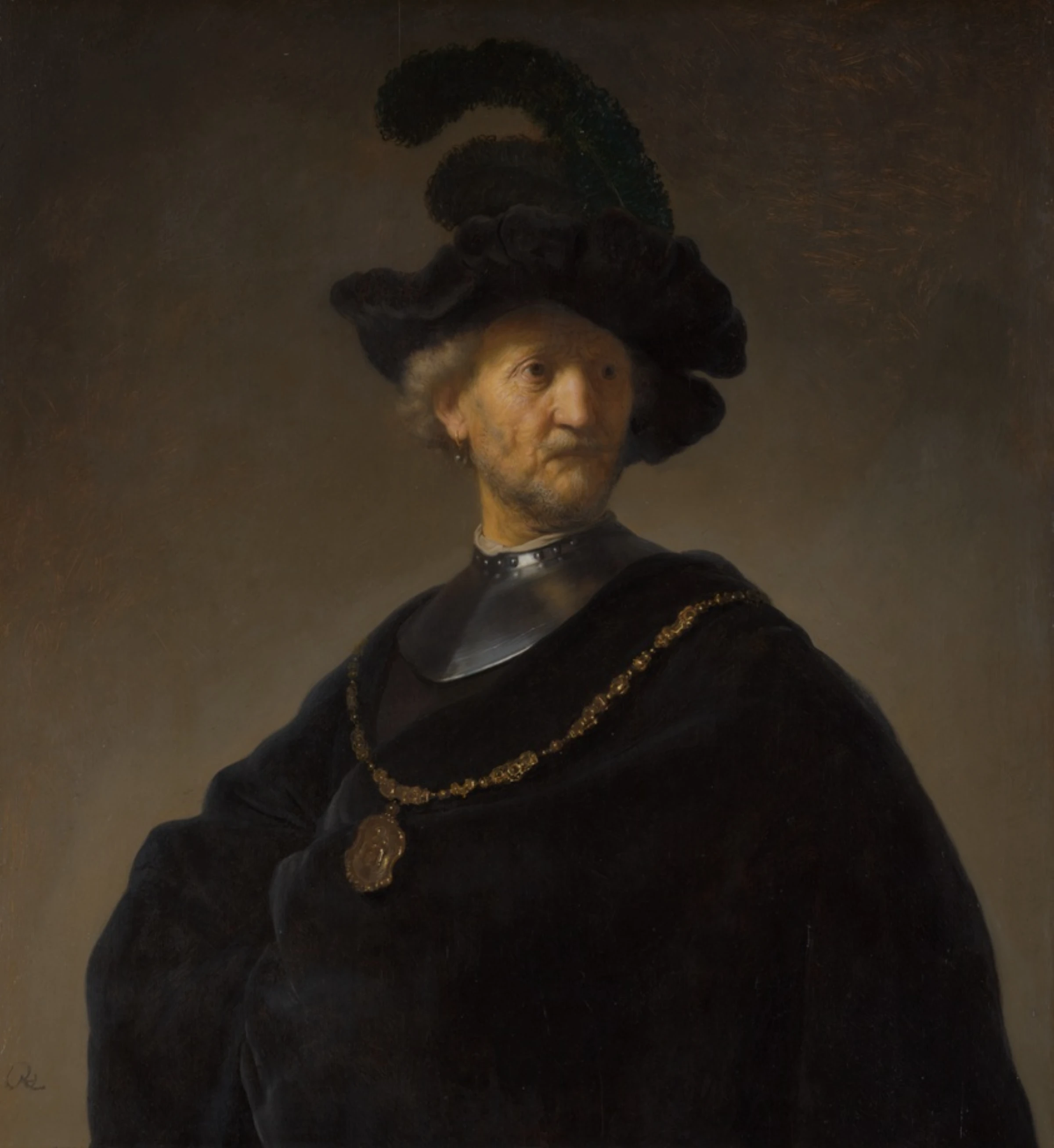
Attribution disputes are the operating system of the Old Master field, and the latest Rembrandt argument in Chicago has reopened one of its most sensitive zones: the border between workshop output and autograph production. A version of Old Man with a Gold Chain long treated as a copy is now being advanced by scholar Gary Schwartz as potentially by Rembrandt himself. The painting hangs beside the Art Institute of Chicago’s accepted original, turning a connoisseurship debate into a public-facing curatorial experiment.
What makes this case consequential is not only the artist’s name. It is the methodological pressure it places on categories that museums, dealers, and insurers rely on. If a work can move from workshop attribution toward autograph status, valuation changes, loan status changes, and publication hierarchies change. The audience sees two near images. The market sees two very different financial and historical positions, separated by scholarship, technical evidence, and institutional consensus.
The Art Institute has framed the pairing carefully and has not claimed final consensus. That restraint is important. In Rembrandt studies, certainty has always moved over time, especially as new technical analysis and archival comparisons emerge. The institute’s own collection page for Old Man with a Gold Chain anchors the accepted work, while the temporary side-by-side display allows specialists to compare facture, support, and compositional decisions under direct visual conditions.
The dispute also lands in a post-Rembrandt Research Project landscape where inherited authority has become less monolithic. The six-volume RRP project radically reduced accepted attributions before later reinstatements, proving that canon formation is iterative rather than final. Current debates around autograph replicas, studio collaboration, and serial image-making are part of that longer correction. They move scholarship away from the lone-genius myth toward a workshop economy model where authorship can be layered and strategic.
For curators and collectors, the practical implications are clear. First, attribution should be read as a probability framework, not a binary. Second, provenance and technical dossiers need ongoing revision when new scholarship emerges. Third, exhibition context can produce knowledge, not merely illustrate it. The planned continuation of this discussion in Gotha through the Rembrandt 1632 exhibition circuit reinforces that these questions are not being closed quickly.
Institutionally, the case is a reminder that museums can stage disagreement without eroding authority, provided the evidence is transparent and the language is precise. In market terms, that transparency helps reduce volatility by showing how claims are tested. In scholarly terms, it keeps the field open to correction rather than freezing consensus around legacy verdicts.
For now, Chicago’s paired display does exactly what serious curatorial work should do. It makes a high-stakes attribution question legible to the public while leaving room for disagreement among specialists. In Rembrandtland, that is not a weakness. It is the work.
Collectors with exposure to seventeenth-century Dutch painting should treat this episode as a reminder to prioritize evidence files over label certainty. A strong file includes technical imaging, support analysis, provenance sequence, restoration history, and comparison to accepted benchmarks in public collections such as the Rijksmuseum. It also includes clear language about unresolved issues, because unresolved issues are normal in this segment.
Scholars are already signaling that the case will continue in exhibition settings beyond Chicago, including programming at the Herzogliches Museum in Gotha. That continuation matters. Attribution debates gain quality when they are exposed to multiple curatorial teams and technical viewpoints instead of being settled in a single publication cycle. In that sense, this is a healthy dispute, rigorous, public, and evidence-driven.
The final verdict may take years. The immediate contribution is clearer: a major museum has turned connoisseurship into a visible research process, and that transparency sets a standard others should follow.