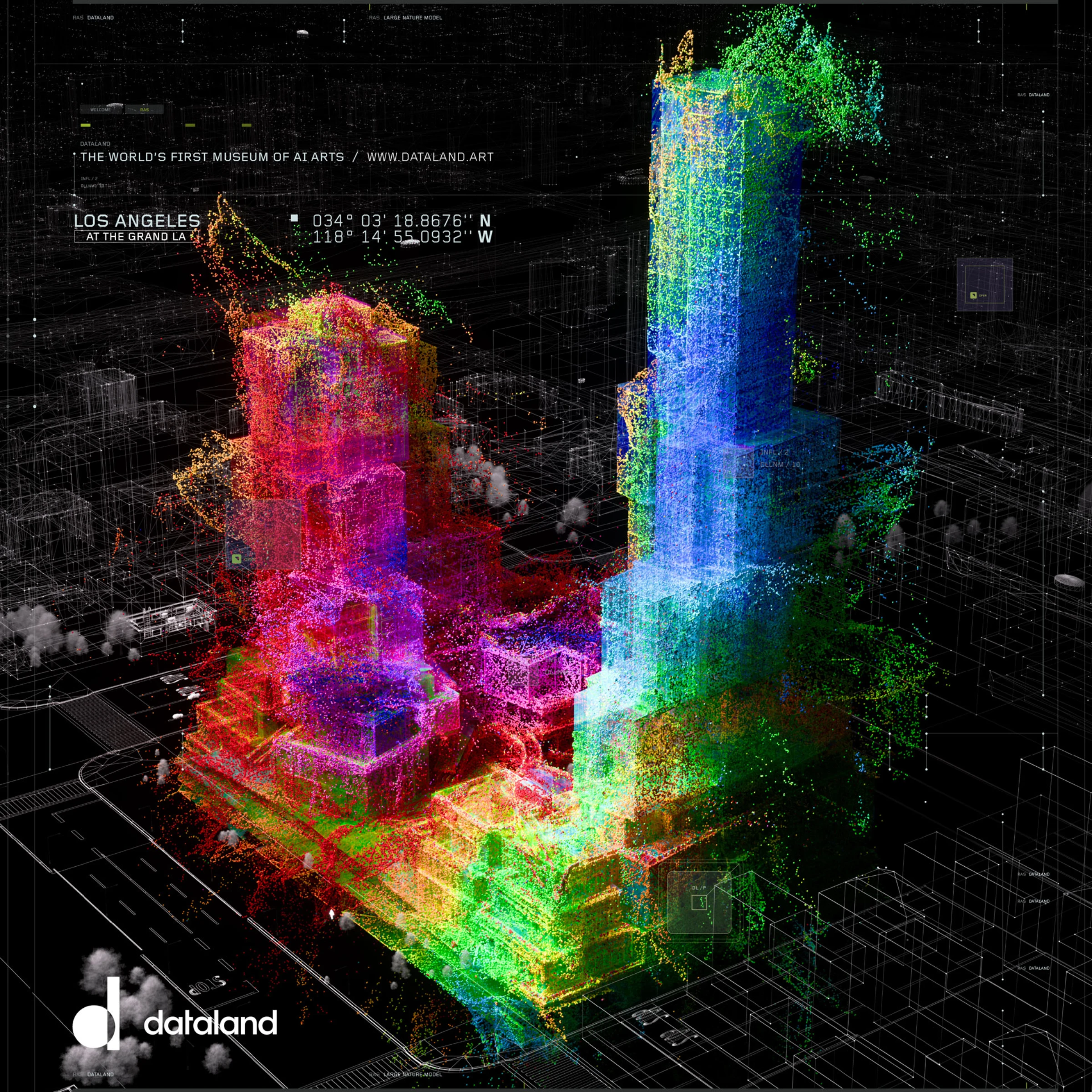
Refik Anadol’s Dataland Sets June Opening and Tests the AI Museum Thesis
Dataland opens June 20 in Downtown Los Angeles with a rainforest data installation that positions AI-native exhibition design as institutional infrastructure.
Dataland, the AI-focused museum founded by Refik Anadol and Efsun Erkiliç, has set June 20 as its opening date in Downtown Los Angeles. After more than two years of planning, the institution arrives with a clear proposition: machine learning is not only a production tool for artists, it can structure the museum experience itself. In a period when many institutions are still treating AI as a public-program add-on, Dataland is committing to it as architecture, curatorial framework, and operating identity.
The location matters. The museum is opening inside The Grand L.A., close to The Broad, the Museum of Contemporary Art, and Walt Disney Concert Hall. That cultural corridor already attracts audiences used to large-scale installation and media-forward programming. Dataland is betting that the same public will accept AI-native work at institutional scale, not as spectacle alone but as a recurring reason to return.
The debut exhibition, Machine Dreams: Rainforest, spans five galleries and is built from ecological datasets including birdsong, weather systems, and plant records. The museum describes these outputs as digital sculptures. Whether one agrees with that label or not, the curatorial ambition is evident: to convert model training and simulation into an exhibition language legible to general audiences. For curators, this is the key test. Can data transformation become a rigorous exhibition form, or does it remain an immersive effect with weak interpretive scaffolding.
Dataland also foregrounds infrastructure claims. The project notes that a significant portion of the 35,000-square-foot footprint is dedicated to the technical systems that run the experience, and that its model stack draws on data from institutions such as the Smithsonian Institution, the Natural History Museum, London, and the Cornell Lab of Ornithology. In other words, this is an art space that presents compute as part of the curatorial object, not backstage utility.
Collectors should pay attention to how this opening may reset evaluation criteria for digital practice. If Dataland succeeds, demand may shift from isolated screen works toward larger systems-based commissions, dataset licensing partnerships, and long-term maintenance contracts. Those are different cost structures from traditional media, and they require different stewardship literacy from patrons and institutions alike.
There are obvious fault lines. Energy use, model transparency, rights around training data, and audience fatigue with immersive formats are not peripheral concerns, they are central to the project’s credibility. Dataland’s team is addressing sustainability messaging early, but the real judgment will come from operational transparency over time, especially once visitor volumes scale.
Still, the opening marks a clear moment in museum strategy. Rather than waiting for consensus, Anadol’s team is moving first and building a public-facing container for AI art discourse in real time. That can fail, and it can still be historically important. Institutions that lead format change are often judged harshly in year one and cited as precedent in year five.
For Los Angeles, the timing is useful. The city already has strong gravitational pull for film, music, and architecture. A museum built around computational image-making extends that ecosystem and invites new overlap between art audiences and technical communities. If Dataland can convert curiosity into sustained attendance, it will not just validate one artist’s trajectory, it will force other institutions to decide how seriously they plan to program the machine era.