Qualeasha Wood’s Bed-Rot Dispute Exposes a Fast-Moving Authorship Problem in Performance Art
After artist Qualeasha Wood said a viral 24-hour bed-rot performance copied her earlier work, the argument moved beyond social media and into a familiar art-world fault line: who controls authorship when format travels faster than attribution.
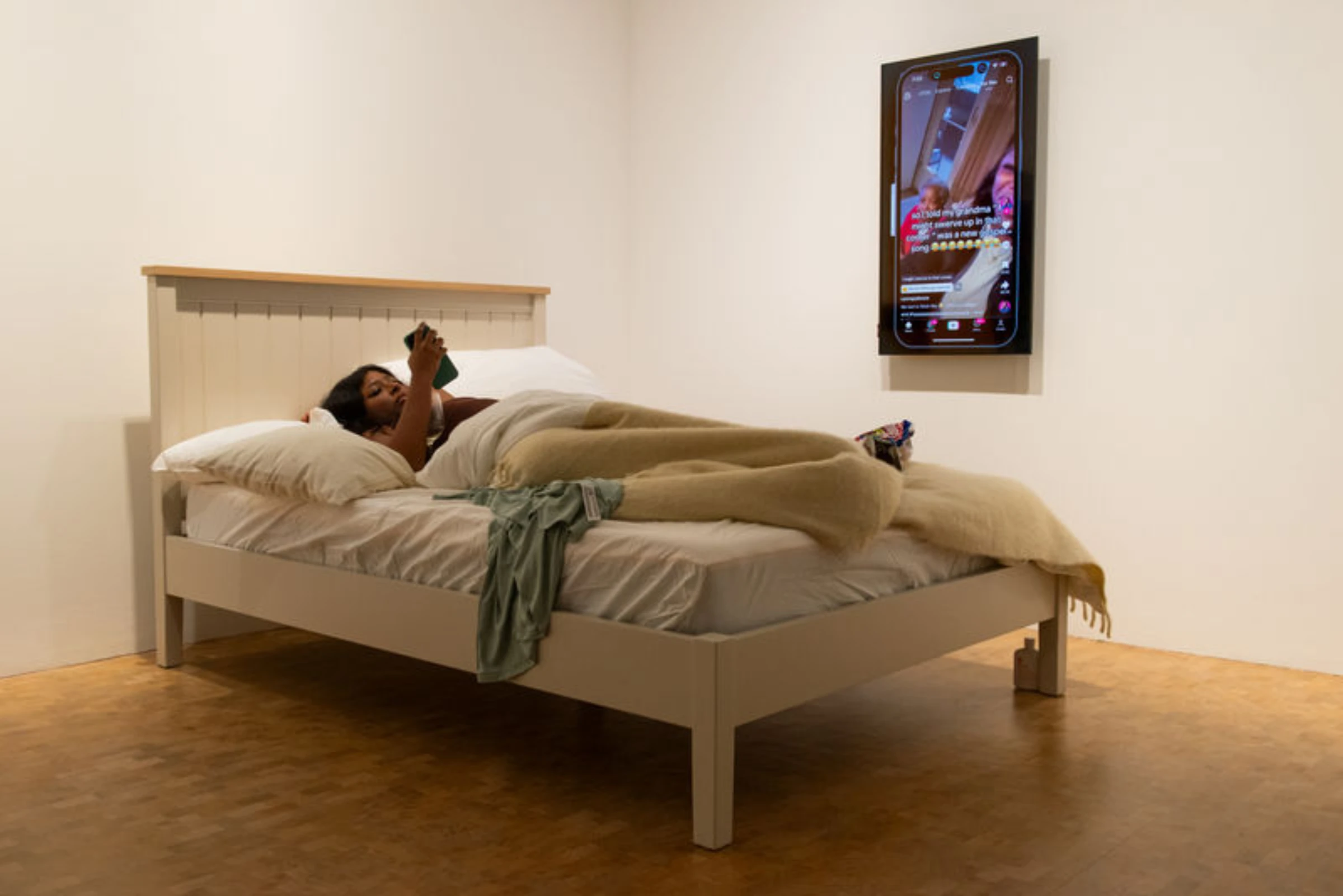
Artist Qualeasha Wood publicly challenged a viral 24-hour bed-rot performance this weekend, arguing that the work reproduced the core proposition of her own earlier piece, Attention Economy. The immediate dispute played out in the same channels that distributed the allegedly derivative work, and that symmetry is the point. This is no longer a niche conflict about studio influence. It is a structural test of how authorship functions in performance practices built to circulate as clips, loops, and repostable gestures.
Wood’s practice has consistently worked at the intersection of digital labor, surveillance, Black femme visibility, and platform-conditioned attention. Through projects presented with institutions including the Victoria and Albert Museum, she has staged states of exhausted visibility that feel intimate but are in fact highly constructed critiques of monetized attention. Her gallery context at Pippy Houldsworth Gallery has framed this as an ongoing body of work rather than an isolated action, which matters when assessing whether later performances are quotation, influence, or extraction.
The legal system rarely offers artists an easy remedy for this category of conflict. Copyright can protect fixed expression, documentation, and certain choreographic structures, but it is weaker when what travels is a conceptual scaffold: a body in bed, endless scrolling, durational self-display, and audience complicity through passive watching. In a post-platform attention economy, that scaffold is exactly what spreads fastest. The result is a mismatch between legal doctrine and cultural production, where the thing most likely to be copied is often the thing least likely to receive formal protection.
This is where institutions, galleries, and commissioning bodies need clearer standards. If a performance language is inseparable from an artist’s long-term research, then due diligence cannot stop at visual similarity. It should include chronology, declared references, and whether the later work entered circulation with meaningful acknowledgment of prior authorship. Organizations like the American Alliance of Museums and archives guided by Getty Conservation Institute new-media documentation frameworks already emphasize provenance and context for time-based work. The same rigor should be applied before institutions amplify derivative gestures.
The real issue is not whether bed-rot is a meme, it is whether artists can still claim authorship when performance formats are optimized for frictionless copying.
The market side is not exempt. Collectors buying performance documentation, editioned video, or installation remnants increasingly ask whether a work is culturally legible online. That pressure can reward recognizable formats over rigorous attribution. Advisors and acquisition committees should respond by demanding process evidence: commission history, prior presentations, curatorial statements, and third-party documentation trails. If a work’s visibility was built on another artist’s established language, that is a valuation risk as well as an ethical problem.
What happened in this case will likely fade from the trending feed quickly, but the underlying governance problem will not. Platform-native performance now moves on a timescale where imitation can become canon before institutions finish basic fact-checking. The art world cannot solve this with moral outrage alone. It needs repeatable protocol: verify lineage, disclose influences, and correct records publicly when attribution gaps are identified. Without that infrastructure, artists working at the edge of digital culture will keep subsidizing the visibility of faster imitators.
Wood’s claim has therefore done more than call out one viral piece. It has exposed a production condition that curators, programmers, and collectors have tolerated because it was convenient. The next step is straightforward. Build authorship checks into programming decisions before the clip goes live, not after the backlash begins.