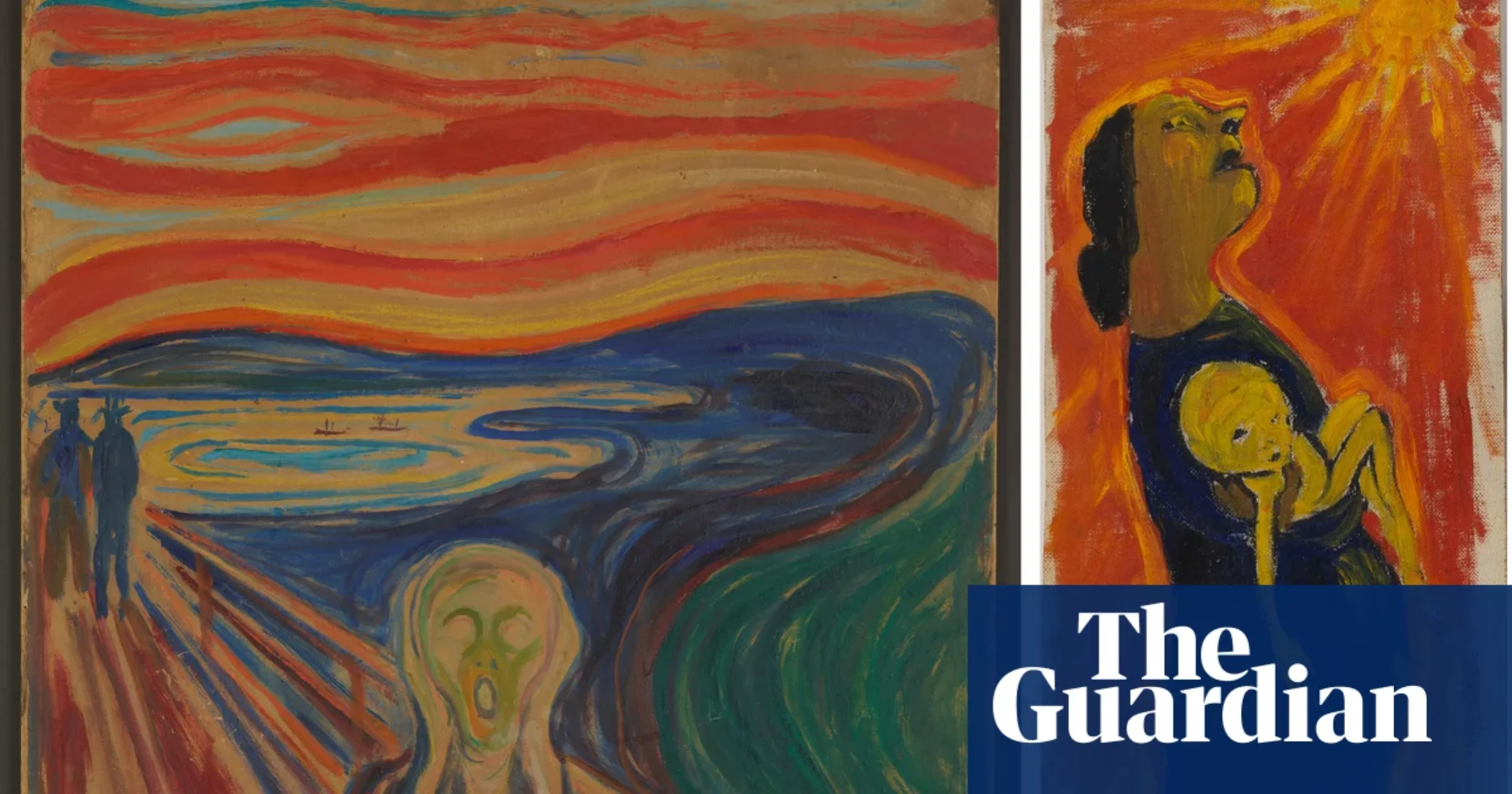
Unearthed Rego Painting Recasts Munch as a Foundational Influence
A newly surfaced teenage work and archived letter show Paula Rego’s early, direct encounter with Edvard Munch, reframing her later visual language through a documented line of influence.
A newly unearthed Paula Rego painting and a letter she wrote as a teenager have transformed what had mostly been an interpretive hunch into a documented art-historical connection: Edvard Munch was not simply a distant parallel, but an early and explicit influence. The evidence appeared as curator Kari J. Brandtzæg prepared the Munch Museum’s major Rego exhibition in Oslo.
The object at the center of the revision is Rego’s painting Drought (1953), made when she was still in her teens. The archival trigger is a 1951 letter in which Rego describes visiting the Tate and being intensely affected by Munch’s work, especially The Scream and Inheritance. Together, those two sources make a stronger argument than stylistic resemblance alone.
That distinction matters because influence claims are often inflated by visual similarities that emerge from broad historical atmospheres. Here, however, we have direct testimony plus a newly surfaced object that carries formal echoes in color, emotional pressure, and figural drama. In short, the case is evidentiary, not speculative.
Brandtzæg has described the discovery as a curatorial and archival breakthrough, and she is right to frame it that way. This is not a publicity footnote attached to a blockbuster exhibition. It is a structural correction to scholarship around one of the most significant figurative painters of the late twentieth century.
For museums, the practical effect is immediate. Wall texts, catalog timelines, and educational framing around Rego’s development now need revision if institutions want to maintain scholarly credibility. It is no longer sufficient to narrate Rego’s early formation through a generic modernist environment. The Munch encounter belongs in the primary developmental sequence.
The story also exposes a familiar institutional problem: early work by major women artists is often under-preserved, under-cited, or scattered across private holdings until late in the artist’s career or after death. When those records surface, they can force late-stage rewriting of the canon. Rego’s case is a textbook example of how archival gaps distort interpretation for decades.
At a broader level, this is a reminder that archives remain active infrastructure, not static storage. In a culture sector increasingly pushed toward event velocity, resale headlines, and social-first programming, slow documentary work can still produce the most consequential shifts in understanding.
Readers who want to follow the institutional and historical context can start with the reporting at <a href='https://www.theguardian.com/artanddesign/2026/mar/15/paula-rego-edvard-munch-unearthed-painting-letter-the-drought' target='_blank' rel='noopener'>The Guardian, then review background material from <a href='https://www.munchmuseet.no/en/' target='_blank' rel='noopener'>Munchmuseet and the <a href='https://www.tate.org.uk/art/artists/paula-rego-1823' target='_blank' rel='noopener'>Tate’s Rego archive pages.
The takeaway is not that Rego can now be 'explained' by Munch. She cannot. The takeaway is that serious art history updates when evidence appears, even if that evidence disrupts clean narratives institutions have repeated for years. That is what happened here, and the field should adjust accordingly.
Expect this discovery to ripple beyond one exhibition cycle. Future monographs, course syllabi, and institutional interpretation will likely reposition Rego’s early years within a broader trans-European conversation about expressionism, affect, and political figuration. If that revision is carried out rigorously, the benefit is not only historical accuracy. It is better critical language for discussing how artists absorb, transform, and contest influence across generations.