Unearthed Letter Recasts Edvard Munch as a Formative Influence on Paula Rego
A newly surfaced teenage letter and an early painting, Drought, reveal how strongly Munch's emotional palette and iconography shaped Paula Rego's early visual language.
A newly unearthed letter from Paula Rego's teenage years has sharpened, and arguably settled, a long-suspected line of influence: Edvard Munch was not just a distant reference point but an early catalytic force in her formation as an artist.
In the letter, written in 1951 after a school visit to the Tate, the 16-year-old Rego describes being overwhelmed by Munch's work, naming The Scream and Inheritance in strikingly personal terms. The language is not academic admiration; it reads like recognition, almost like permission.
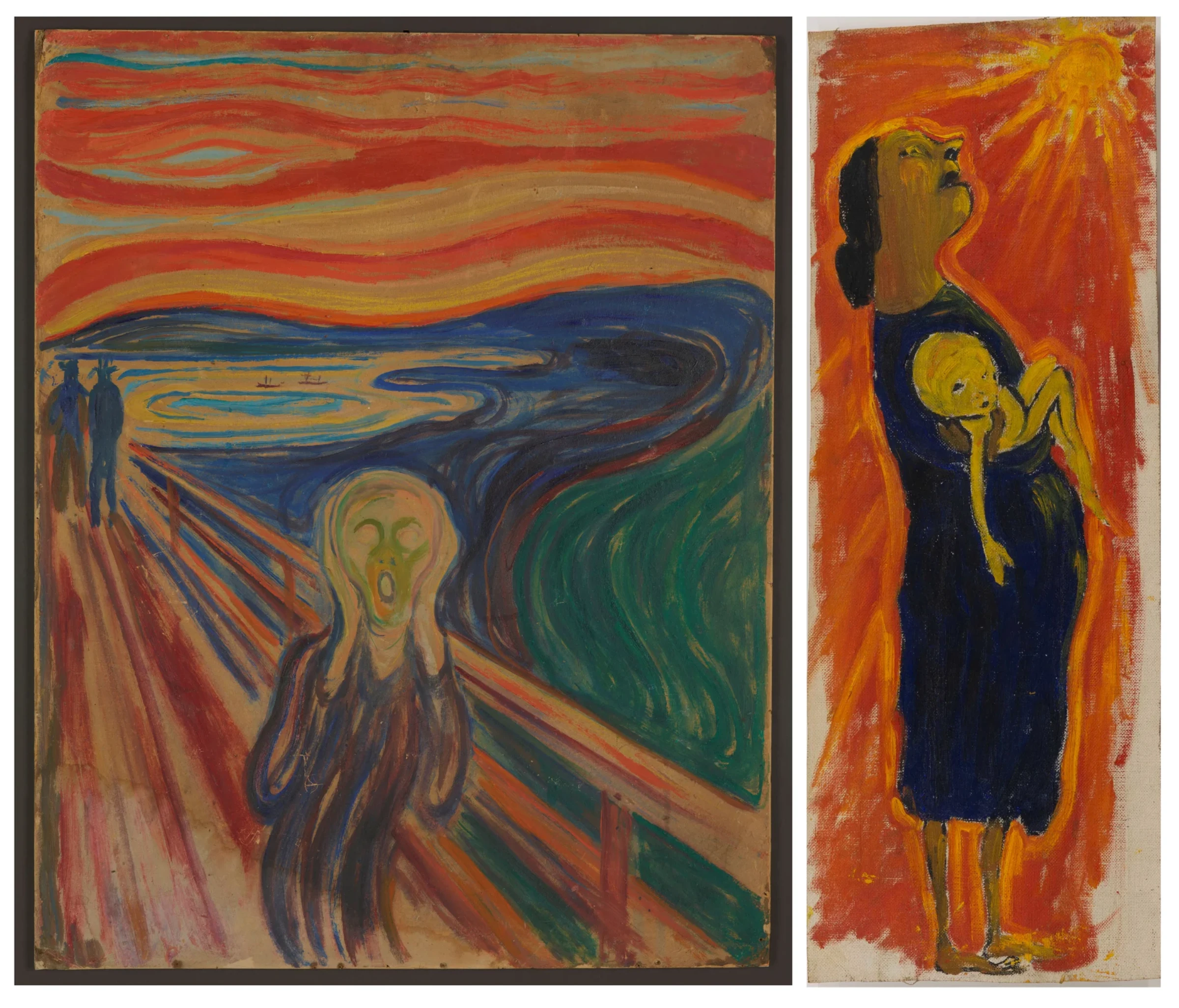
That archival evidence gained additional weight with the rediscovery of Rego's small early painting Drought, which had remained out of public circulation for years. Curators at MUNCH identified clear formal and chromatic echoes of Munch's 1890s vocabulary, particularly in red-yellow tension, emotional distortion, and psychic atmosphere.
Together, the letter and painting convert a curatorial hunch into a traceable genealogy. This matters for more than attribution: it changes how institutions frame Rego's early practice, and it complicates the old tendency to isolate her influence map within Iberian and British contexts alone.
The timing is strategic. Drought will appear in Dance Among Thorns, the first major museum exhibition in the Nordic region dedicated to Rego, opening at MUNCH in April. That placement turns a biographical footnote into a structural argument about cross-European modernism.
It also affects how we read Rego's mature paintings. Her later theatrical scenes, with their charged interiors and moral abrasion, have often been interpreted through biography and politics alone. The Munch connection adds another axis: an early model for translating dread, vulnerability, and bodily intensity into visual syntax.
For scholarship, the episode is a reminder that archives still move history. Late discoveries can rebalance canon narratives that were shaped as much by incomplete records as by critical consensus. Researchers working with the British Library's National Life Stories oral histories had clues for years, but the letter provides documentary precision.
For institutions, the case will likely influence future wall-text and catalog framing at places such as Tate and at the Casa das Histórias Paula Rego. Once an influence moves from speculation to evidence, interpretive neutrality is no longer defensible.
For audiences, the practical takeaway is simple: read Rego's emotional dramaturgy with Munch in the room. Not as imitation, but as an early permission structure for making anguish, body politics, and psychological intensity visible without apology.
The discovery also repositions curatorial responsibility. If institutions now possess direct evidence of Rego's encounter with Munch in 1951 and 1952, then exhibition narratives that ignore this link risk repeating an outdated map of influence. Readers should expect this material to appear in upcoming interpretation at MUNCH and in future scholarship indexed through resources like CAA bibliographies.
More broadly, this episode models how art history advances in practice: not by sweeping reinterpretations alone, but by patient archival recovery, cross-checking oral testimony, and integrating newly surfaced evidence into public-facing narratives. That process is slow, but when it works, it changes the canon from the inside.
What looked like parallel temperament now looks like transmission. And with documentary proof on the table, future writing on Rego will need to account for that shift directly, because this is no longer an elegant comparison,it is an art-historical fact pattern.