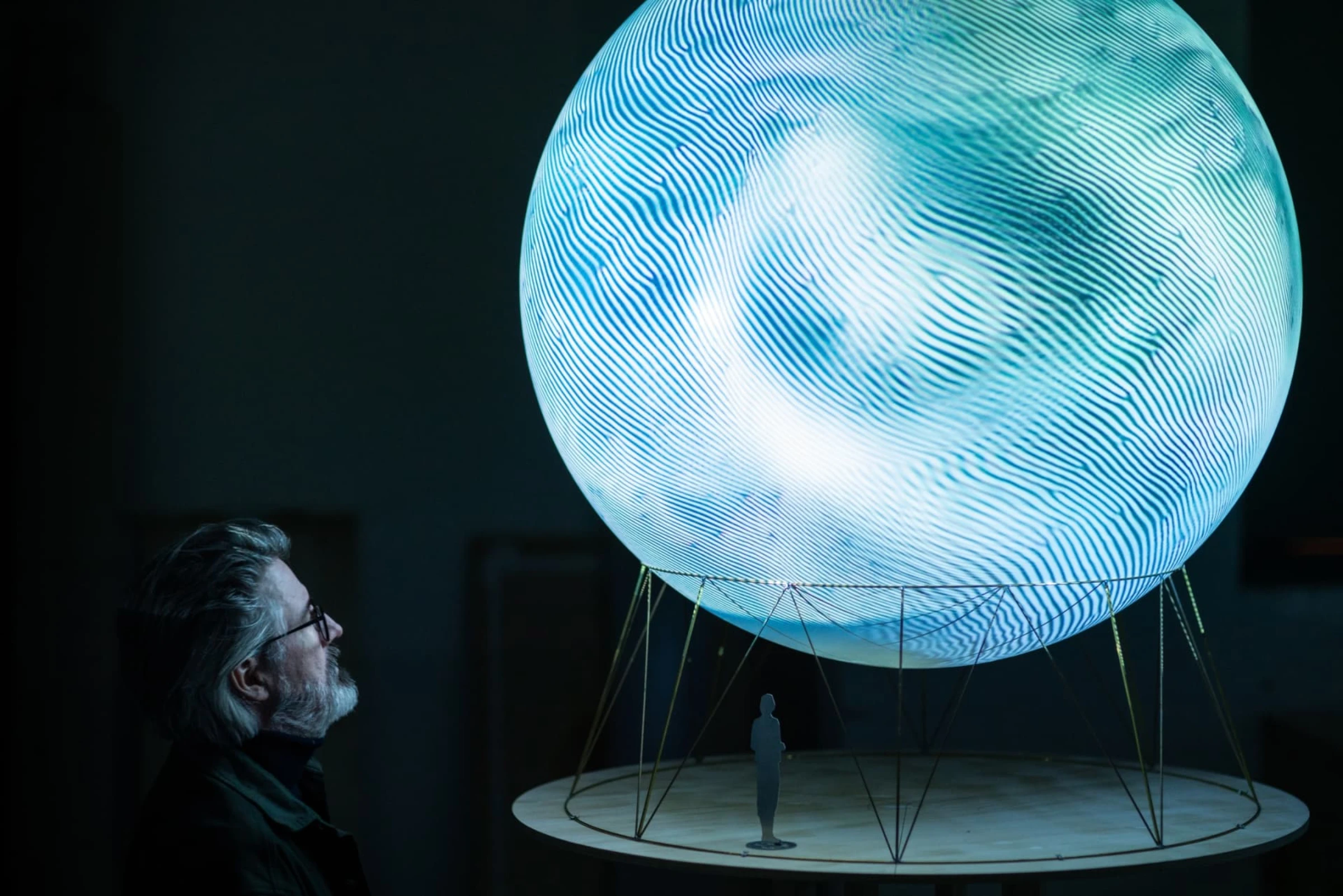
Olafur Eliasson’s Great Salt Lake Night Work Turns Climate Data Into Public Ritual
A ten-night public artwork in Salt Lake City reframed ecological loss as a civic event, using field recordings and projected light to translate the Great Salt Lake’s decline into a shared urban experience.
For ten nights between late March and early April, Salt Lake City hosted one of the more precise public-art gestures of the year. Olafur Eliasson’s A symphony of disappearing sounds for the Great Salt Lake transformed Memory Grove Park into a nightly listening site, pairing projected light with layered field recordings drawn from the Great Salt Lake ecosystem. The commission was part of the multi-year Wake the Great Salt Lake initiative, developed with the Salt Lake City Arts Council, the mayor’s office, and Bloomberg Philanthropies’ public-art program. The project’s premise was simple and unusually clear: use cultural infrastructure to make environmental risk legible in public space.
The installation’s central object, a large elevated sphere projected from multiple points around the park, was not presented as monumental sculpture in the old sense. It worked instead as a changing display surface, a temporary planet in the city, where light sequences moved from granular flicker to gridded cartography to saturated color fields. The sound component, developed with producer Koreless from recordings in the Western Soundscape Archive, carried the work’s argument. Rather than score the piece with abstract ambience, Eliasson and collaborators used ecological signal, brine flies, bird migration calls, and changing acoustic texture, to track how habitat instability is heard before it is fully seen.
That shift matters because the Great Salt Lake crisis is not speculative. Long-term water diversion, regional growth, and climate pressure have reduced the lake significantly, exposing lakebed that can release toxic dust into surrounding communities. A public artwork cannot substitute for policy. But it can change who feels implicated, and on what terms. By running nightly at a predictable hour and remaining free to attend, the project leaned into repetition and accessibility, two factors that many municipal climate campaigns still underestimate. In this case, the civic format did part of the political work.
The framing from local leadership was also notable. Felicia Baca, director of the Arts Council, emphasized that local artists and international figures were brought together under shared environmental priorities. That is a better model than parachute commissioning. Salt Lake City used Eliasson’s global profile to draw outside attention, while anchoring the work to local partners and a local ecological emergency. The result was not an imported spectacle with generic climate messaging. It was a place-specific commission with a defined public, a defined landscape, and a defined timeline.
For curators and commissioners, the project is a useful reminder that climate art becomes stronger when it is attached to municipal schedules, clear partners, and concrete public touchpoints. The work did well on social media, but the more serious takeaway is structural. It linked city arts governance, environmental discourse, and audience behavior in one repeatable loop. If similar commissions are to scale, institutions need less vague sustainability language and more program design that names a constituency, a location, and a measurable context, exactly what this project attempted in Salt Lake City.
The broader lesson extends beyond Utah. Public art’s strongest climate interventions now tend to operate in the middle range, neither activist signage nor museum didacticism, but civic ritual that can hold emotion and information at once. Eliasson’s project sat in that register: mournful without paralysis, sensory without evasiveness, and public without flattening complexity. In a field crowded with declarations, that level of formal and institutional discipline is rare.
There is a governance lesson here as well. The project worked because commissioning, permitting, and communications were integrated early, not treated as separate silos. Cities trying to build climate-oriented public art quickly should study this sequencing: define the ecological question, secure institutional partners with real authority, and design a public format that can repeat across multiple nights. That combination builds memory, and public memory is often the missing condition for policy momentum.