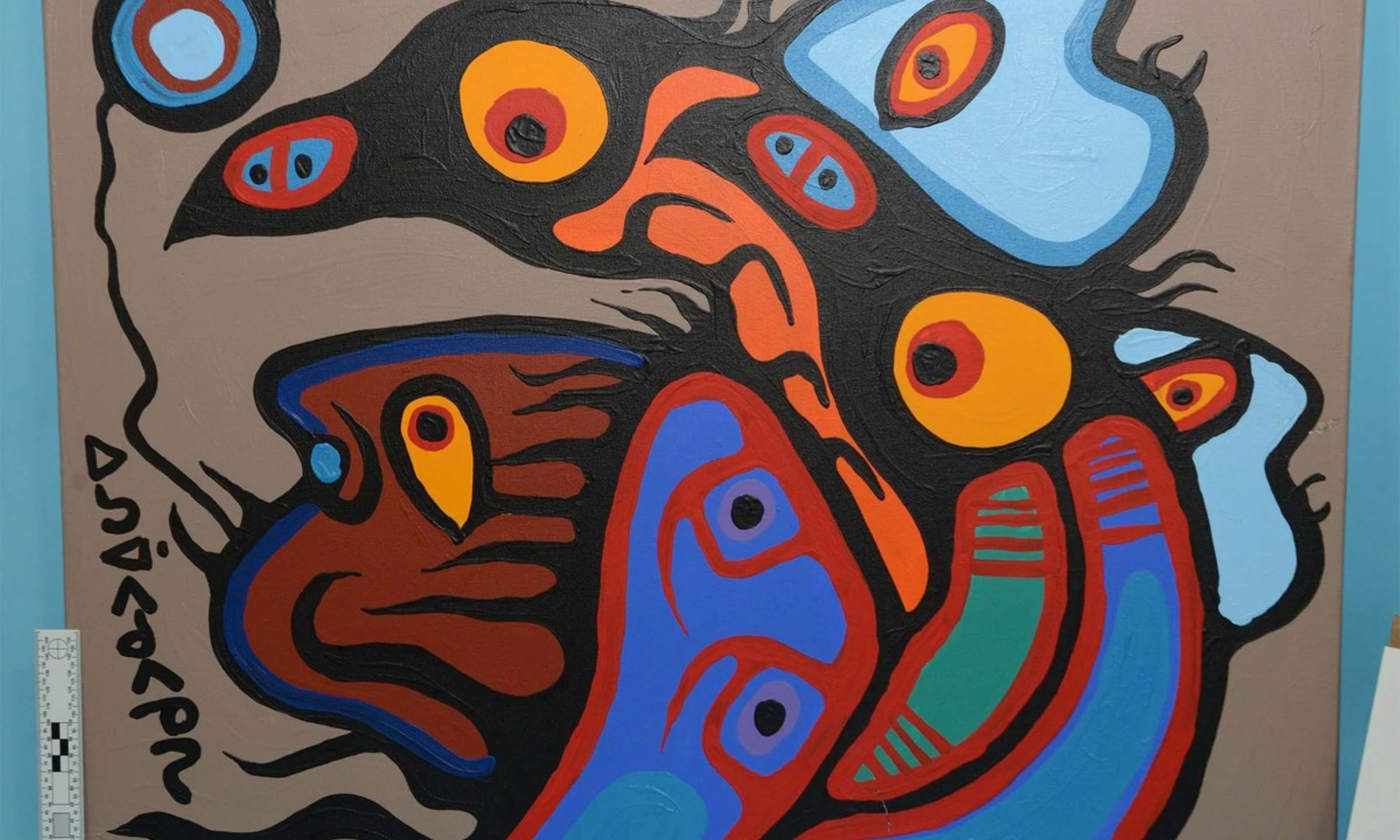
New allegations delay final sentencing in the Norval Morrisseau forgery case
The long-running Norval Morrisseau forgery scandal has entered another volatile phase as new allegations complicated sentencing, extending legal uncertainty around authentication, estate authority, and market trust.
A final sentencing expected to close one of Canada’s most damaging art-fraud sagas has been delayed after new allegations surfaced in court, extending uncertainty around forged works linked to Norval Morrisseau. The postponement keeps the case open not only legally, but institutionally, as stakeholders continue to contest authority over the artist’s legacy.
The central defendant had already been found guilty on multiple fraud-related counts tied to fake Morrisseau paintings. What changed was not the existence of forgeries, but the scope of responsibility now being argued. New claims introduced at sentencing widened the frame to include disputes about estate conduct and authentication history.
That shift matters because forgery cases in the art market rarely stop at criminal conviction. They quickly become governance disputes involving families, foundations, dealers, and experts who issue or withhold legitimacy. In practical terms, the legal process and the market process run on different clocks.
For Indigenous artists’ estates, the stakes are even higher. Questions of authorship, spiritual and community context, and commercial circulation can become entangled in institutions that were not built to account for those dimensions. The Morrisseau case has repeatedly exposed that structural mismatch.
Collectors and secondary-market operators now face a familiar but costly condition: inventory that may be legally tradeable in some contexts yet practically frozen by trust deficits. Auction houses and private dealers are likely to tighten intake scrutiny for works attributed to Morrisseau until a more stable authentication regime is recognized.
Canadian institutions, from provincial museums to legal bodies, are also under pressure to articulate clearer standards for documentation, expert testimony, and restitution pathways when fraudulent works have already entered circulation. Bodies such as the Art Gallery of Ontario and the McMichael Canadian Art Collection are frequently referenced in broader debates on canon formation and public trust. Resources from the Department of Canadian Heritage also shape how public institutions approach due diligence and collection policy.
The lesson for the wider market is straightforward: authentication systems that depend on informal consensus are fragile under adversarial legal pressure. If records are incomplete, or if authority is contested between estates and third-party experts, criminal findings do not automatically restore confidence.
This is why the case continues to resonate beyond Canada. Comparable disputes over attribution and fraudulent production have affected markets in Europe and the US, but the Morrisseau scandal is unusually consequential because it intersects with Indigenous exploitation, institutional gatekeeping, and decades of uneven documentation.
A delayed sentence may feel procedural, yet it extends the period in which victims, buyers, and communities remain in limbo. Every month without a settled framework increases litigation risk and complicates future scholarship. It also reinforces a hard truth: market cleanup is often slower than market damage.
For now, the most credible path forward is transparent evidence standards, coordinated provenance review, and governance structures that include Indigenous stakeholders with real authority. Without that, the case will keep producing verdicts without closure.
The court calendar will eventually move. Whether the ecosystem around Morrisseau moves with it is the real test of accountability in this chapter of Canadian art history.
The longer the uncertainty persists, the harder it becomes for scholarship, restitution claims, and legitimate market activity to separate cleanly from contaminated inventory. Closing that gap will require coordinated legal outcomes and curatorial policy, not one or the other in isolation.