Guide: What to See in the New Museum’s $82M Expansion Reopening
New York’s New Museum reopens with a major OMA-designed expansion, new commissions, and the institution-wide exhibition ‘New Humans: Memories of the Future.’ Here’s how to approach it.
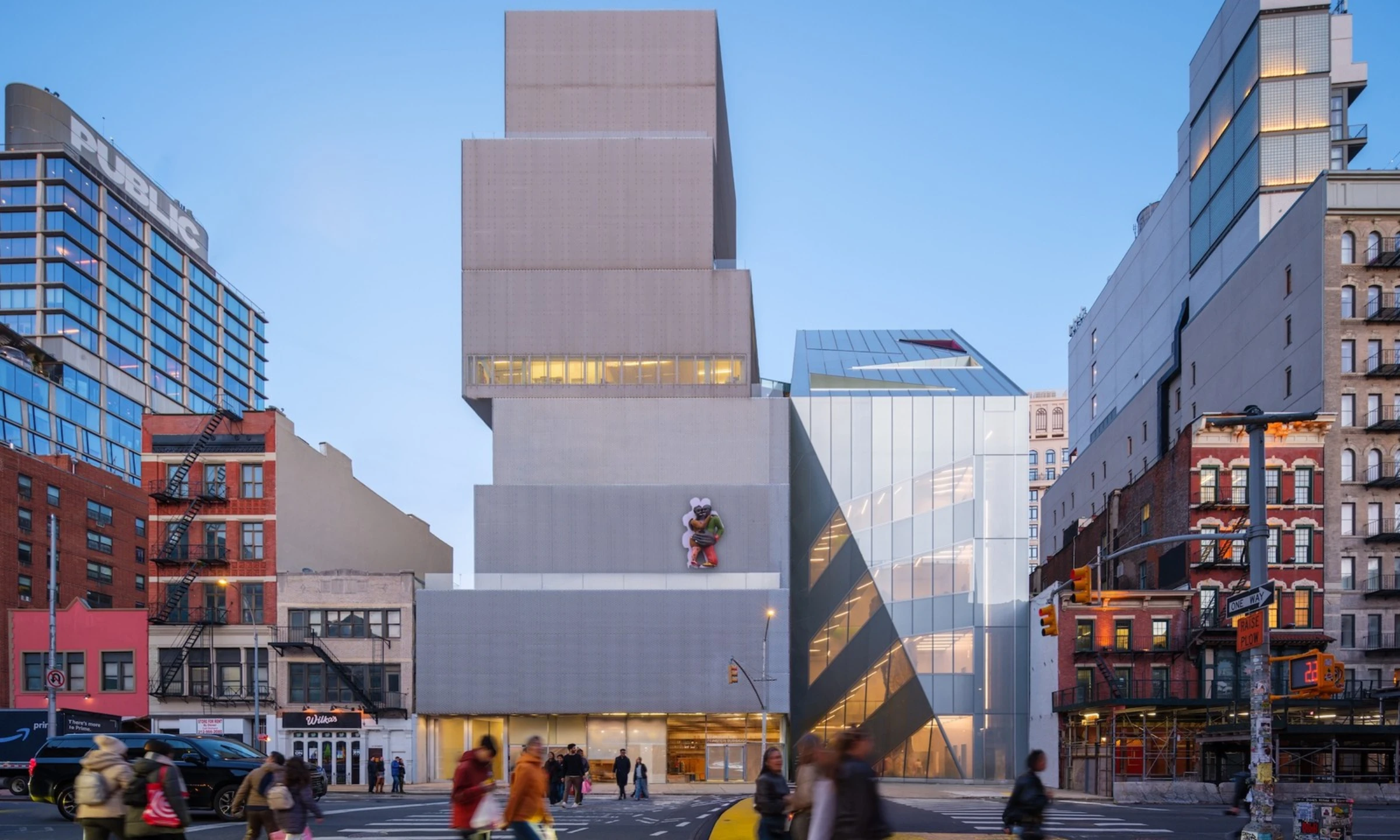
After four years of construction, New York’s New Museum reopens with an $82 million expansion that doubles its footprint to about 120,000 square feet. This is not a cosmetic refresh. It is a structural reset of how the institution presents exhibitions, supports production, and hosts public life on the Bowery. If you are going in opening week, a little strategy will make your visit significantly better.
The new building, designed by OMA principals Shohei Shigematsu and Rem Koolhaas with Cooper Robertson, is meant to extend the museum’s 2007 SANAA building rather than compete with it. Think of the architecture as a continuity project with a different rhythm: more visible circulation, stronger vertical flow, and a street facing public presence that keeps activity legible from outside. Before you rush to checklist viewing, spend ten minutes reading the building itself.
Start your visit in the shared public zones where the institution has installed permanent commissions by Tschabalala Self, Klára Hosnedlová, and Sarah Lucas. These are not decorative gestures around the main event. They are the main event in miniature. They signal how the museum now wants to frame contemporary practice: materially bold, publicly present, and embedded in architectural movement rather than isolated in white cube silence.
From there, map your route through New Humans: Memories of the Future, the reopening exhibition that occupies both old and new buildings and includes more than 200 artists. The show’s premise, as reported by The Art Newspaper, links current technological anxiety to the social and political shocks of the 1920s. That framing can sound broad on paper, but in person it works best when read as a sequence of arguments, not as a total thesis you must accept wholesale.
A practical way to approach the exhibition is to alternate between dense galleries and transitional areas, especially stairs and atrium vantage points. The expanded plan creates moments where you can recalibrate scale and narrative before entering the next cluster of works. If you attempt to absorb all rooms in one uninterrupted pass, fatigue will flatten distinctions and the most ambitious curatorial moves will blur into visual overload.
Pay attention to temporal pairing. The show places contemporary artists like Tau Lewis, Wangechi Mutu, and Precious Okoyomon in conceptual conversation with 20th century figures including Francis Bacon, Salvador Dalí, and Hannah Höch. Instead of asking whether every pairing is perfect, ask what each pairing tries to reveal about bodies, systems, and the politics of being human in moments of accelerated change. That question opens the exhibition more effectively than category based viewing.
One of the expansion’s most important features sits outside blockbuster logic: production infrastructure. The museum has built a stronger artist in residence environment and a permanent home for NEW INC, its incubator for art and technology. These additions matter because they shift value from display alone toward long horizon support for making, collaboration, and entrepreneurial experimentation. If you are assessing institutional strategy, this is the core development to watch.
Youth programming is another consequential layer. The new Bowery Art Space initiative and ongoing teen fellowship work indicate that the museum is not only scaling physical space but also trying to deepen local educational relevance. In a city where many institutions talk about audience futures while programming primarily for established patrons, this is a meaningful test of whether expansion dollars can produce durable public pathways rather than launch season optics.
Use the sky room and public amenities deliberately. The seventh floor views, theatre, and social spaces are part of the museum’s argument about how contemporary institutions should host thinking across exhibitions, talks, and informal conversation. If you are visiting with limited time, it is better to do fewer galleries and include these nodes than to sprint every room and miss the expanded social architecture that now defines the museum’s character.
Timing also matters. Opening weekend includes free access, but if possible, return for a calmer visit during regular operation. After launch crowds thin, the institution’s real pace becomes clearer. You can then test whether the expanded building supports sustained looking, not just event traffic. For planning details, verify hours and ticket policy directly on the museum site and related city listings such as NYC Tourism.
The strongest way to read this reopening is as a wager on what a non collecting contemporary museum can be in 2026: a producer of new work, a civic learning platform, and a flexible architecture for public argument. Whether that wager holds will depend less on opening weekend spectacle and more on programming consistency over the next two years. For now, the expansion gives the institution the space and tools to attempt it at full scale, and that alone makes this reopening worth serious attention.