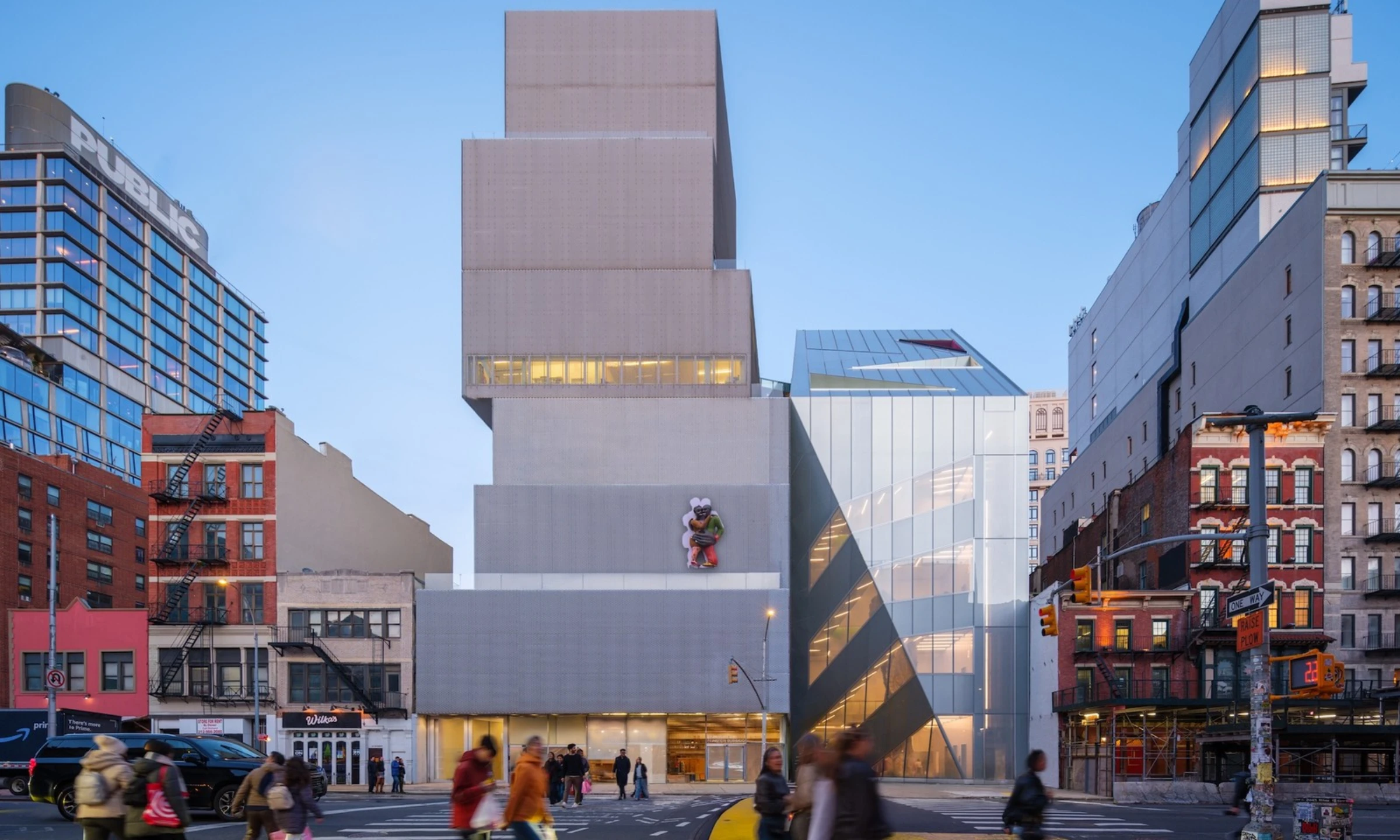
New Museum Unveils Expansion, Doubling Footprint
The New Museum in New York has opened its $82M expansion, doubling its footprint with new galleries, artist resources, and public spaces poised to expand both its presence and its program ambition.
The New Museum has opened its $82 million expansion, doubling its size with new amenities that reflect not just a physical project but a broader evolution in scale and mission. The added space includes new galleries, more artist studios, and enhanced public facilities calibrated to create a more robust institutional ecosystem.
The expansion provides visible resources for experimentation and research, a new skyroom, a larger shop more space for teen programming ,and a theatre for performances. For an institution that has always prided itself on responding to the moment, the added programming capacity makes its future even more interesting.
The New Museum launched in 1977, so its growth has occurred alongside rapid economic and social change, and its history can reveal and interpret the world outside the museum walls.
The exhibition with which the new space opens is also revelatory. "New Humans: Memories of the Future" is massive because the space is massive but it could only be built with the new infrastructure in place: It is also an argument that the past has much to teach us about the current human condition but that the art of our time has something to say about the past as well.
If the thematic construct sounds reminiscent of many other shows, the New Museum’s new expansion may prove that it can push ideas in a way that makes it different from all the other institutions with similar ideas.
For museum goers and institutional watchers, this is a moment to see if there is a recipe for exponential growth even when most museums have the opposite mindset. If it’s just a larger version of the same museum, then it would be difficult to see its point. But from this vantage point it looks ready to propose an entirely new relationship between museums and their publics and museums in general.
If smaller institutions had an excuse to think as though their resources were too diminished for impact, the New Museum presents an argument: Build as small as possible, always allow for growth, and then expand deliberately at turning points.
The New Museum is hardly the last arts institution to think about the growth model the institution it is modeling is not a model to copy but a method for other museums to adopt and reinvent for their location and mission.
For comparison, contextual documentation is published openly by a number of cultural institutions, including visitor numbers and impact studies documented by the Metropolitan Museum of Art, commissioning programs catalogued by the Walker Art Center, and strategic expansion plans published by SFMOMA. This provides context for assessing the long-term effectiveness of expansion initiatives.
Ultimately, The New Museum sees art is a lens through which we can understand, interpret and transform the world outside the museum, it sees art as transformative but if its transformation also transforms the museum into something else it could change how we view art institutions.