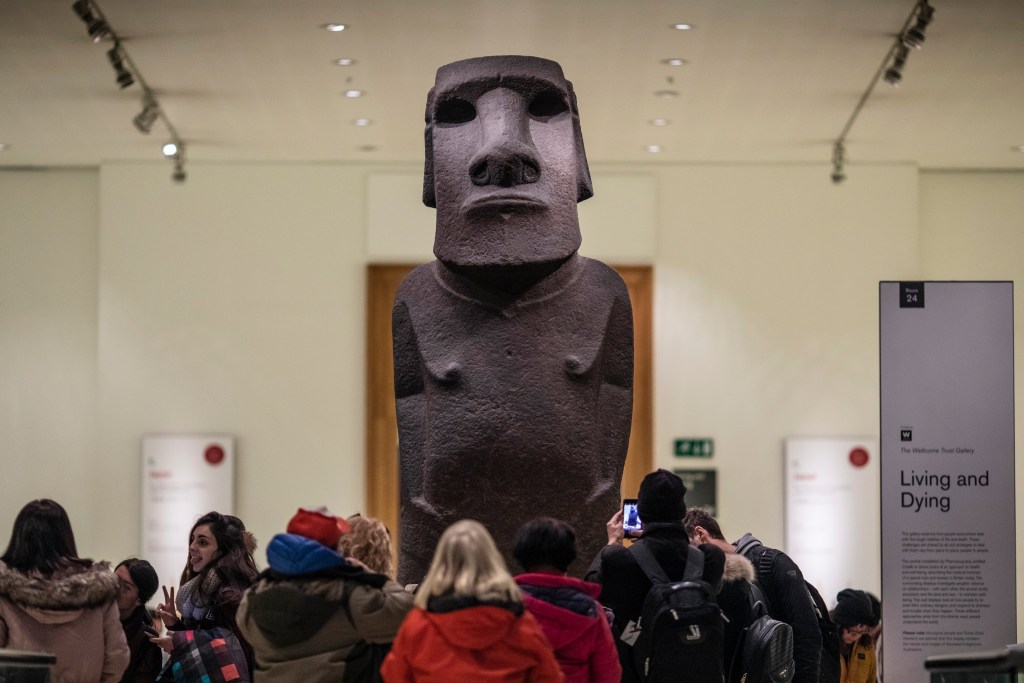
New Research Recasts the Removal History of Hoa Hakananai’a at the British Museum
Archaeologist Mike Pitts argues that the 1868 removal of Hoa Hakananai’a involved more local collaboration than previously documented, a claim that complicates but does not settle repatriation demands from Rapa Nui leaders.
A new historical claim is reframing one of the British Museum’s most contested objects. Archaeologist Mike Pitts has argued that recently surfaced evidence suggests Hoa Hakananai’a, the moai removed from Rapa Nui in 1868 and now held in London, may not have been taken through a simple unilateral seizure. Instead, he proposes that local participation and negotiation were involved in the removal process, based on newly reviewed eyewitness material and photographic documentation.
The object in question is not marginal. Hoa Hakananai’a is among the most culturally and symbolically significant moai associated with Rapa Nui history, and its location in London has long served as a focal point in broader debates over colonial collecting and museum accountability. Since 2018, Rapa Nui representatives, with backing from Chilean authorities, have formally pressed for its return, arguing that the statue’s spiritual and communal role cannot be fulfilled in an overseas encyclopedic context.
The new archival claim does not erase the repatriation question, it changes the evidentiary terrain on which that question will now be argued.
Pitts’s intervention does not deny imperial power structures. Rather, it challenges a specific narrative sequence by introducing evidence that, in his reading, indicates a more complex encounter between British naval personnel and island communities at the time of excavation. Reported materials include an image said to depict the statue with removal equipment and testimony describing local guidance around the statue’s context. For museum historians, this is the kind of archival disruption that can quickly shift interpretive emphasis.
Yet complexity should not be mistaken for resolution. Even if collaborative elements existed in the 1868 episode, the legal, ethical, and political conditions under which collaboration occurred remain central. Rapa Nui in the 19th century was shaped by severe external violence, coercive labor systems, missionary intervention, and demographic collapse, conditions that sharply limit the explanatory power of consent language detached from asymmetrical power realities.
This is why the debate is moving from headline binaries toward layered standards of legitimacy. A museum may now be asked to address at least four questions at once: what happened procedurally in the removal, what conditions governed that procedure, how subsequent custody was justified, and what present-day obligations exist to source communities. Pitts’s evidence speaks mainly to the first question. Repatriation claims speak to all four.
The British Museum has repeatedly cited statutory constraints, especially the British Museum Act 1963, when resisting deaccession demands. But legal constraint is not the same as ethical closure. Across Europe and North America, institutions have expanded long-term loans, shared custodianship models, and negotiated returns even under restrictive legal frameworks, particularly where sustained diplomatic and community-led pressure has made retention narratives institutionally untenable.
For art-world readers, the significance of this case extends beyond one statue. It demonstrates how repatriation discourse is entering a new evidentiary phase. Early cycles often hinged on broad moral claims versus legal ownership defenses. The current phase is denser: micro-histories, shipping records, witness accounts, provenance reconstructions, conservation histories, and community testimony are all being mobilized at once. Curatorial authority increasingly depends on an institution’s willingness to hold these records in public view.
In practical terms, Pitts’s findings will likely intensify scrutiny rather than reduce it. If the archival record is more complicated than previously stated, museums and claimants alike will be pressed to refine their arguments with greater historical precision. That can be productive, provided it does not become a delay mechanism disguised as scholarship.
What remains unchanged is the central political fact: Rapa Nui representatives continue to define Hoa Hakananai’a as living heritage rather than detached artifact. Any sustainable institutional response will have to engage that claim on its own terms, not only on statutory grounds. The new research may reshape the story of removal, but the question of where the object belongs, and under what ethical framework, is still fully open.