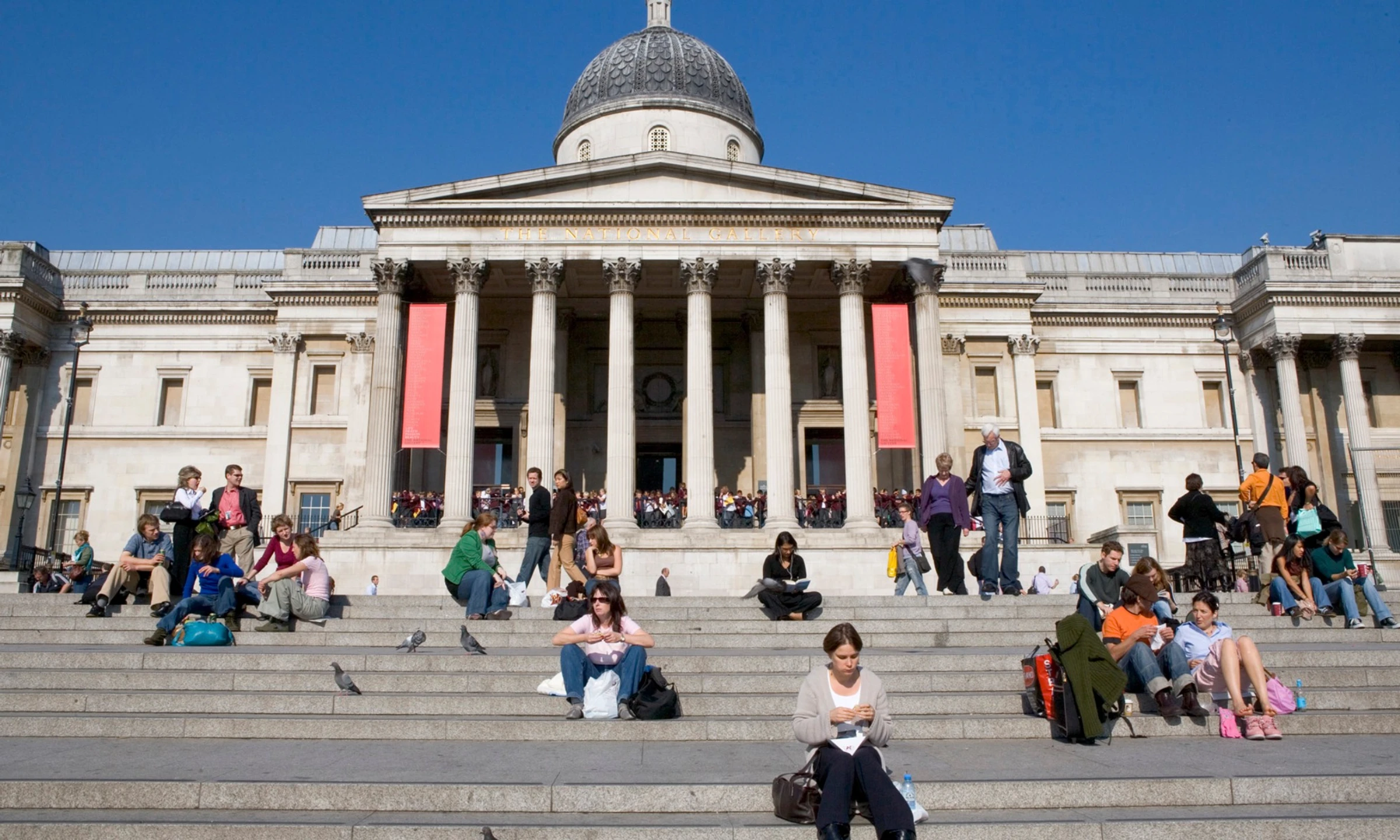
London National Gallery Still Trails Pre-Covid Attendance Despite Sainsbury Wing Reopening
The National Gallery rose to 4.2 million visitors in 2025 but remains far below 2019 levels, showing how London museum recovery is now shaped by structural shifts in tourism and audience behavior.
London’s National Gallery reported 4.2 million visitors in 2025, a meaningful rise from 3.2 million in 2024. The increase confirms that demand remains strong for major painting institutions. But the larger reality is less comfortable: the museum is still far below its pre-pandemic benchmark of roughly 6 million visitors in 2019.
The reopening of the Sainsbury Wing helped improve flow and reduced friction at entry points. Better queue handling and security logistics pushed monthly numbers upward. Yet even with those gains, current traffic patterns suggest recovery is partial rather than complete, and likely to settle below the levels museums once treated as normal.
The key drag is international tourism. The gallery says overseas visits remain about 1.7 million lower than in 2019. That gap is not a rounding error. It changes spending patterns, seasonal peaks, and the broader value chain around exhibitions, retail, and donor-facing programming.
Across London, similarly mixed signals are visible. Tate Modern and Tate Britain also remained soft in 2025. By contrast, the Natural History Museum surged and overtook the British Museum in annual attendance rankings, reinforcing that family-oriented and science-led formats are currently converting post-crisis demand more effectively than many art institutions.
For the National Gallery, the strategic path forward is clear. It must continue to rebuild international appeal while also deepening domestic relevance. That means sharper interpretation, stronger public-facing programming, and exhibition structures that justify repeat visits from local audiences rather than one-off destination traffic.
The institution has already signaled a wider long-term ambition through expansion planning. If those plans align architecture, audience development, and curatorial risk, the museum could emerge from this cycle with a more resilient model. If not, annual totals may plateau in a zone that is viable but structurally weaker than the pre-2020 era.
The bigger lesson for museum leadership is that attendance is now a lagging indicator of deeper shifts in mobility and attention. Recovery cannot be measured only by year-on-year growth. It has to be measured against changing audience composition, repeat behavior, and the capacity to sustain relevance without perpetual blockbuster dependency.
Another pressure point is labor. The gallery has already signaled budget constraints, and staffing decisions will shape visitor experience as much as architecture does. Museums cannot talk about welcome while trimming front-of-house and interpretive capacity beyond functional limits. Experience quality determines whether first-time domestic visitors return.
Programming strategy will matter just as much. Institutions that rely on occasional mega-shows to close annual gaps are vulnerable to cost spikes and scheduling shocks. A stronger model is portfolio-based: one anchor exhibition, one rigorous research-led display, and one public-facing series that lowers entry barriers without diluting curatorial standards.
Finally, the competitive set has changed. London visitors now compare museums with immersive leisure venues, digital entertainment, and rising travel costs in real time. Art institutions need to prove that a visit offers cognitive and emotional return unavailable elsewhere. Attendance will follow when that value proposition is clear, repeatable, and legible to audiences beyond specialists.
Primary references: <a href='https://www.theartnewspaper.com/2026/03/20/london-national-gallery-visitor-numbers-remain-below-pre-covid-levels-despite-renovation-boost' target='_blank' rel='noopener'>The Art Newspaper report, <a href='https://www.nationalgallery.org.uk/' target='_blank' rel='noopener'>National Gallery, <a href='https://www.tate.org.uk/' target='_blank' rel='noopener'>Tate, and <a href='https://www.alva.org.uk/' target='_blank' rel='noopener'>ALVA.