Misan Harriman Turns Protest Photography Into a Permanent Civic Space at Hope 93
Misan Harriman’s The Purpose of Light has returned to Hope 93 in London as a permanent installation, shifting protest photography from event coverage into durable institutional memory.
Misan Harriman’s The Purpose of Light has returned to London’s Hope 93 not as a temporary hit but as a permanent installation, and that distinction matters. The Art Newspaper reports that the project, which gathers Harriman’s photographs of protests across the UK, US, and South Africa over the past seven years, has been rehung as a long-term fixture in the gallery’s lower level. That move changes the status of the work. It is no longer simply reportage framed for the market. It is being positioned as a durable civic archive inside a private art space.
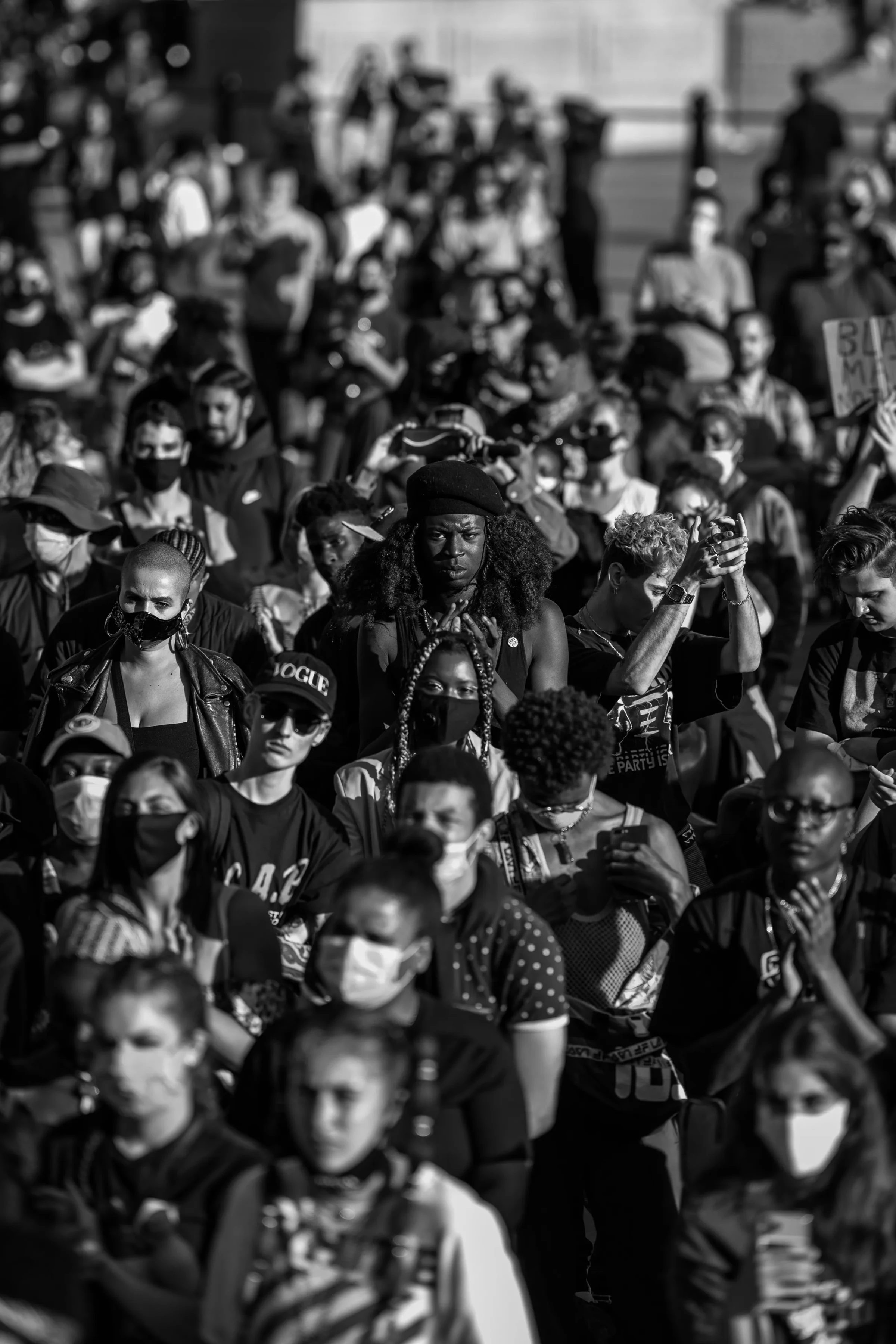
Harriman, who first became widely visible through magazine portraiture and cover shoots, has spent the past several years building a parallel body of work rooted in demonstrations, vigils, and collective grief. In the new installation, more than 100 photographs are presented in dense salon-style hangs across three rooms. According to the paper, the images range from Black Lives Matter protests to Gaza demonstrations, March for Congo actions, and gatherings responding to the deaths of George Floyd and Renee Good. The point is not a single cause. Harriman told the paper that the through-line is solidarity, the impulse of people to stand together during a period of upheaval.
That framing gives the project its seriousness. Protest imagery can flatten quickly into moral branding, especially when it is absorbed by the art market. Harriman avoids some of that trap by insisting on witness over slogan. The photographs do not ask to be read as campaign graphics. They ask to be read as evidence of bodies assembling in public under pressure. Hope 93’s own presentation of the project reinforces that reading by emphasizing the exhibition as a sustained environment rather than a sequence of individual trophy prints. The gallery is not selling viewers a neatly packaged politics. It is asking them to remain inside a visual record of civic strain.
The institutional context matters as much as the pictures. Hope 93, founded by Aki Abiola, has positioned itself as a gallery attentive to underrepresented artists and historically charged narratives. The decision to keep Harriman’s installation in place with support from private collectors suggests an alternate model of patronage. Instead of acquiring politically legible work and dispersing it into private homes, collectors have underwritten its continued visibility in situ. That is a small but meaningful structural difference. It turns collecting into a form of custodianship rather than simple possession.
There is also a question of timing. Protest photographs often circulate most intensely in the days or weeks after an event, when news demand is high and emotion is still raw. A permanent installation refuses that tempo. It asks what these images do after immediacy fades. In that sense, Harriman’s project begins to function less like photojournalism and more like a memorial architecture of recent dissent. The basement installation becomes a room where viewers can measure how one demonstration speaks to another, and how the aesthetics of protest accumulate into a social history.
Collectors and curators should watch the formal implications too. Harriman’s black-and-white images carry the polish of someone deeply fluent in magazine photography, natural light, and cinematic composition. That finish gives the work broad public legibility, but it also introduces a risk: aesthetic beauty can sometimes neutralize political urgency. Here, however, the density of the hang helps resist that drift. Individual pictures may be elegant, but the installation as a whole leans toward overload, repetition, and insistence. It is harder to consume as a tasteful sequence of iconic images when it surrounds the viewer like a wall of unresolved claims.
The larger significance is that Hope 93 has effectively made a case for the gallery as a site of public memory, not only a site of circulation. At a moment when institutions often speak of community while retreating into programming caution, this project offers a more concrete proposition. Give politically charged work permanence, give it space, and let audiences return to it repeatedly. If The Purpose of Light succeeds on those terms, it will matter not just as a strong body of photographs but as an argument about how art spaces can hold the afterlife of protest without domesticating it.