Melvin Edwards, Sculptor of the ‘Lynch Fragments,’ Dies at 88
Melvin Edwards, whose welded steel works transformed the language of political abstraction, has died at 88.
Melvin Edwards, one of the most consequential sculptors in postwar American art, has died at 88. His death closes a career that repeatedly forced institutions to confront how race, violence, labor, and material intelligence live inside sculpture. Edwards is often introduced through the Lynch Fragments, the welded steel series he began in 1963, but the larger achievement is broader: he expanded abstraction’s moral range without reducing it to illustration or slogan.
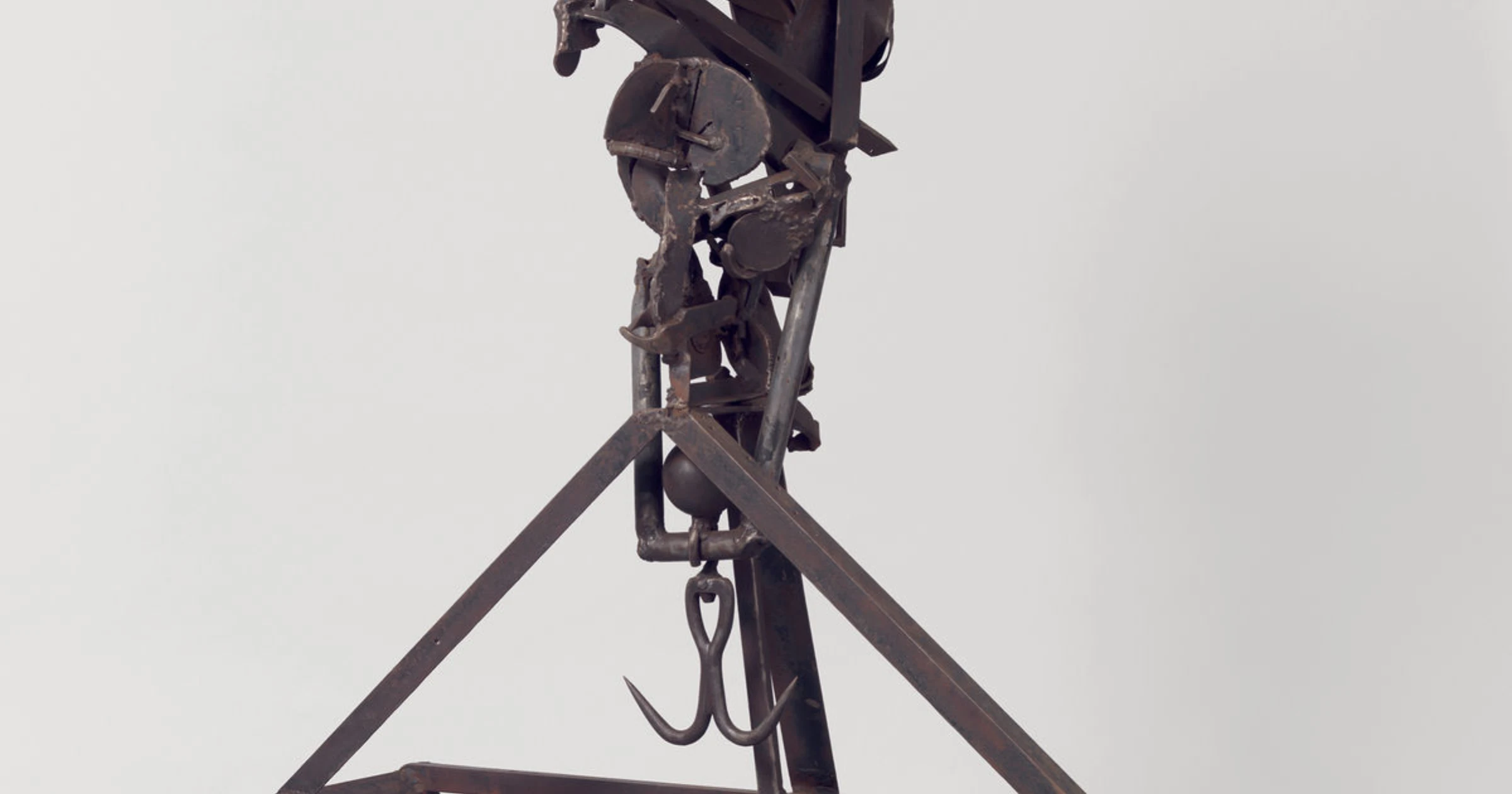
Working with chains, tools, spikes, and forged elements, Edwards built a sculptural language where compact scale did not imply modest stakes. The works carry compression, pressure, and force. They ask viewers to read steel not as neutral form but as social material, tied to work, punishment, movement, and survival. In that sense, Edwards did not merely add political content to abstraction. He changed the terms of what abstraction could do in public.
His life trajectory also shaped that language. Born in Houston in 1937, raised partly in segregated and then integrated environments, educated at the University of Southern California, Edwards learned welding while studying painting and quickly grasped what metal could hold that canvas could not. By the time he moved to New York in the late 1960s, his vocabulary was already clear: dense, charged objects that looked like evidence as much as sculpture.
Institutional recognition came in cycles rather than in a smooth ascent. He became the first Black sculptor to receive a solo show at the Whitney Museum of American Art in 1970, yet like many peers he navigated periods of under-recognition and uneven market visibility. Over subsequent decades, his work entered major collections, including the Museum of Modern Art, the Metropolitan Museum of Art, and the Smithsonian American Art Museum. Later retrospectives and surveys, including major museum presentations in the United States and Europe, confirmed what artists had long argued: Edwards was not peripheral to the history of postwar sculpture, he was central to it.
For curators, his death will intensify ongoing questions about canon structure. Edwards’s practice sits across categories that institutions still treat as separate tracks: African diasporic modernism, American post-minimal trajectories, political sculpture, and transatlantic material practice shaped by long engagement with African metal traditions. His work resists compartmentalization, which is exactly why it remains difficult and productive for museums. It demands installation strategies and interpretive writing that can hold formal analysis and historical violence in the same frame.
For collectors, the immediate market consequence is predictable but not trivial. Estate-sensitive moments often produce short-term price pressure, but with Edwards the larger dynamic is institutional. Acquisition committees that delayed decisions may accelerate them; trustees who previously treated him as a specialist position may now view him as core 20th-century inventory. The strongest works will likely be contested less as category buys and more as anchor works for broader narratives of modern and contemporary sculpture.
What endures most is the standard he set. Edwards proved that sculpture can be physically concise and historically expansive at once. He showed that welded steel can carry memory without theatrics, and that rigor does not require detachment. In a period when museums are rewriting collection histories and reassessing who shaped the language of form after 1945, his work remains a measure of seriousness. It asks whether institutions are willing to read what is in front of them, and whether they are willing to build programs equal to it.