Marc Newson’s Château La Coste Survey Repositions Design Object as Outdoor Sculpture
A new Marc Newson presentation at Château La Coste pairs pavilion display with a monumental outdoor work, bringing long-circulating design pieces back into institutional view.
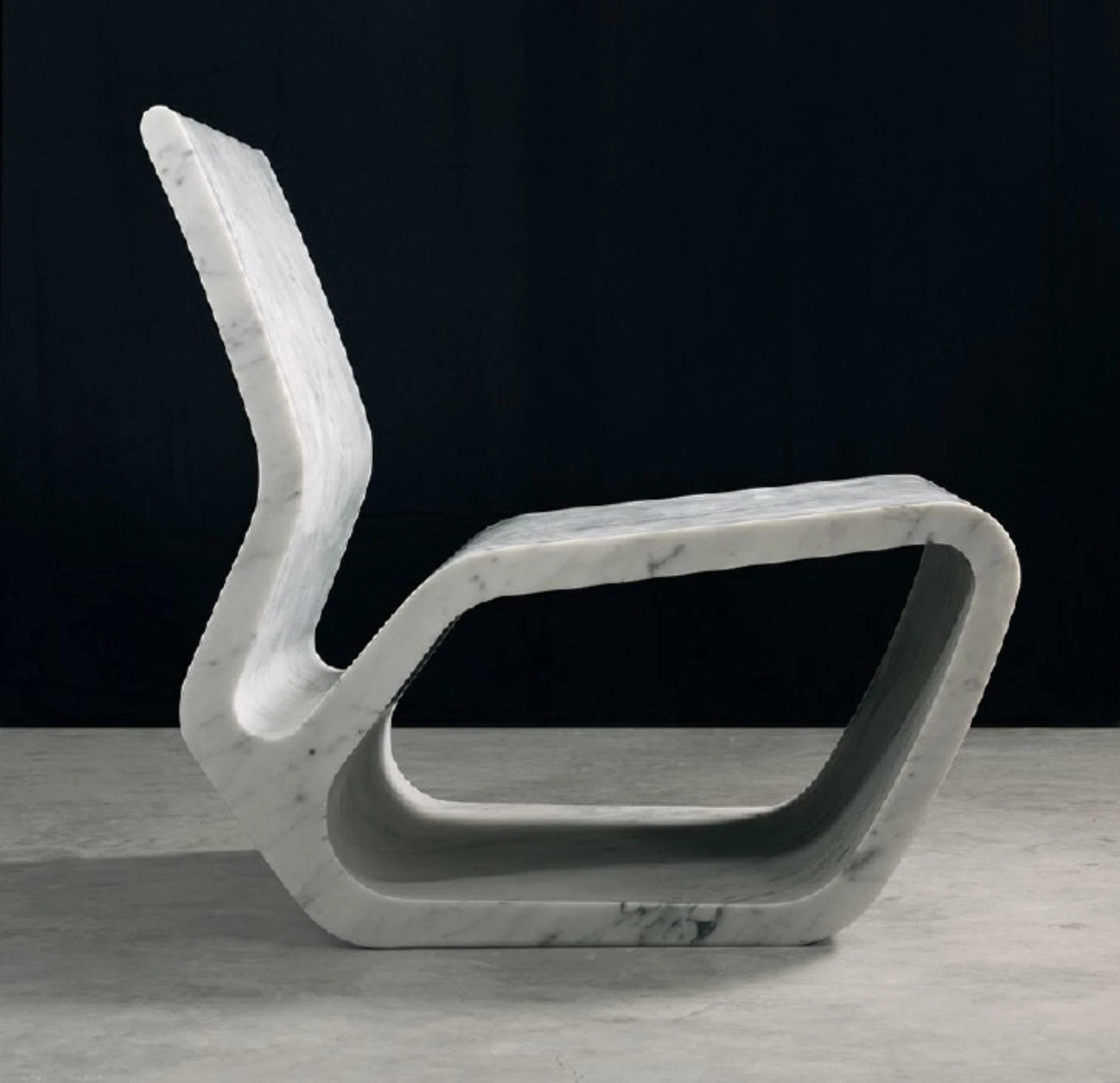
Château La Coste’s new Marc Newson presentation is less a retrospective in the museum textbook sense than a tightly edited proposition about how design history can be staged in a contemporary art setting. The project combines an indoor survey inside Oscar Niemeyer’s final pavilion building at Château La Coste with the outdoor installation of Electra, a monumental work originally developed in the 1990s and only now receiving sustained public visibility.
The core narrative around Electra is unusually revealing. Commissioned in the Olympic orbit of the mid-1990s, produced in aluminum by UK fabricators, shipped across continents, and never properly installed in its intended cycles, the work sat in logistical afterlife before being restored and reintroduced. Many design objects circulate through private hands or fair contexts without full institutional framing. Here, the delayed realization becomes part of the meaning. The sculpture is not a novelty unveiling. It is a recovery of unfinished public intent.
The indoor component extends that logic. Rather than attempting exhaustive chronology, Newson has described the selection as a curated cross-section of four decades, with works that sit between functional design and sculptural form. The inclusion of the Lockheed Lounge, one of the best-known works in late twentieth-century collectible design, makes the market dimension unavoidable. But the show format at La Coste shifts emphasis from price mythology to context, linking object design to architecture, landscape circulation, and audience movement.
That setting matters. La Coste has increasingly operated as a hybrid site where vineyard tourism, architecture pilgrimage, and contemporary art programming overlap. Newson’s survey enters that ecosystem as both cultural programming and destination strategy. For institutions elsewhere, the key question is whether this model can be translated without flattening into lifestyle branding. At its best, the La Coste approach uses architecture and commissioning to make looking slower and more comparative. At its weakest, it can feel like high-end backdrop culture. This exhibition appears to push toward the former by anchoring the display to a concrete curatorial throughline.
There is also an instructive ownership dynamic in the background. The work Electra has reportedly been acquired by collector Philip Serafim, whose holdings include Newson-designed objects and vehicles. That move underscores a broader structural reality in design-art crossover territory: institutional display, private acquisition, and narrative control are now deeply interdependent. Curators who work in this field must account not only for formal innovation but for provenance pathways, fabrication histories, and post-exhibition visibility.
For collectors and advisors, this show is a reminder that mature design markets increasingly reward context-rich objects, works with documented production stories, linked architectural commissions, and credible exhibition histories. For curators, the opportunity is slightly different. Projects like this can reopen questions that the market often settles too quickly: where design object ends and sculpture begins, what scale does to interpretation, and how site conditions can reset reading habits around familiar works. Newson’s La Coste presentation does not resolve those questions, but it stages them clearly, which is precisely what strong institutional programming should do.
In that sense, the exhibition is not only about one designer’s career arc. It is about institutional method: how to reinsert celebrated objects into a framework where context does as much interpretive work as rarity. If more venues adopt that approach, design-focused shows could move beyond trophy display and recover their strongest function, clarifying how objects shape culture, space, and collective imagination over time.
There is also pedagogical potential in pairing historical works with newly contextualized interpretation materials, fabrication documentation, correspondence, and installation histories that show how these objects moved through institutions and private collections. Done well, that approach helps younger curators and collectors read design not as isolated iconography but as a network of production, circulation, and changing public reception.