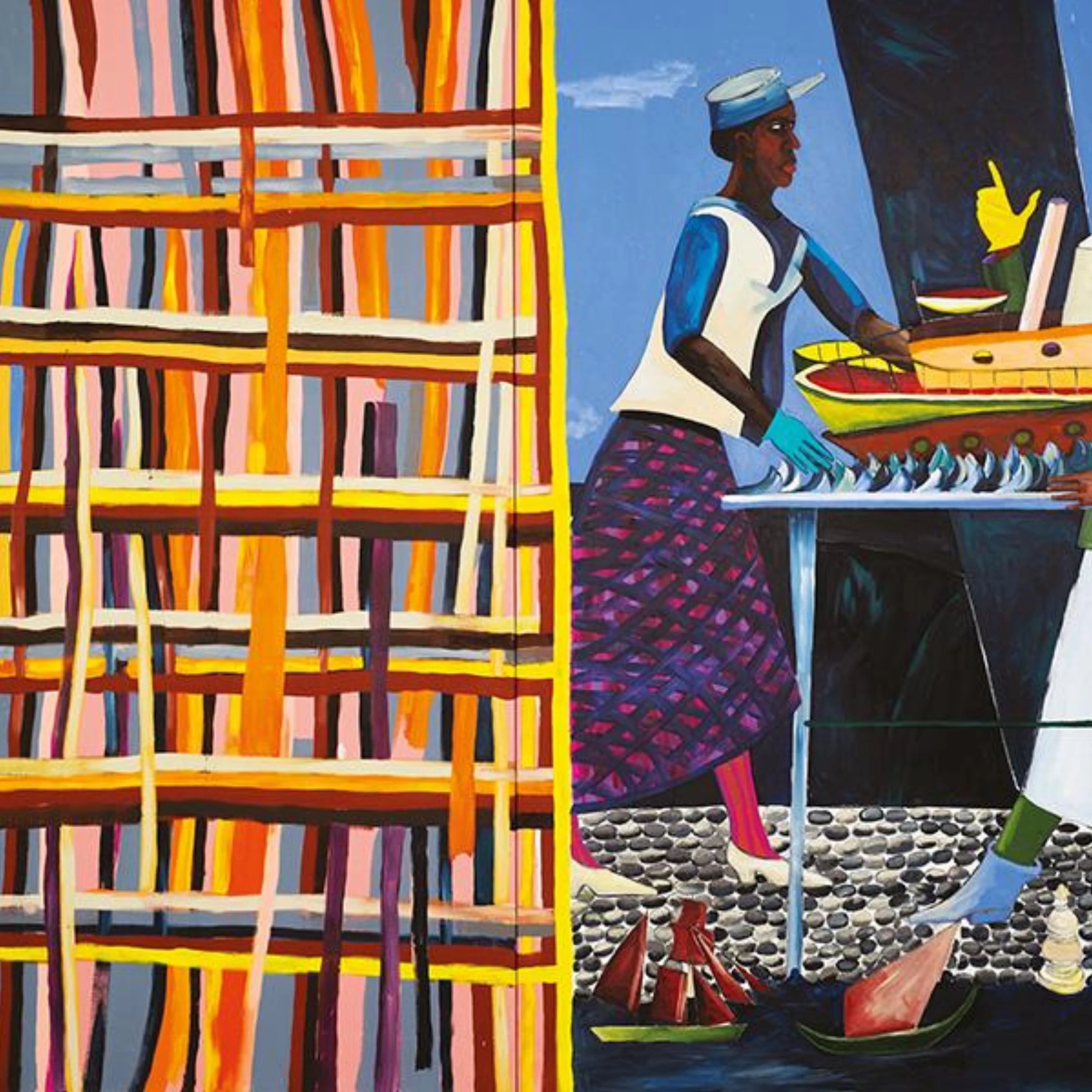
Lubaina Himid Recasts the British Pavilion as a Stage of Unease at Venice
At the 2026 Venice Biennale, Lubaina Himid frames Britain as a place of calm surfaces and unresolved exclusion.
La Biennale di Venezia has handed the British Pavilion to Lubaina Himid, and she has used that platform to test what a national presentation can still do in a moment of geopolitical strain. Her framing of Britain as socially calm but structurally uneasy gives the pavilion a clear thesis from the first room.
Within the broader 2026 exhibition at <a href='https://www.labiennale.org/en/art/2026' target='_blank' rel='noopener'>La Biennale Arte 2026, Himid’s project stands out for refusing spectacle as a shortcut to urgency. The work turns to staging, pacing and the gap between speech and silence to produce pressure.
Himid’s biography is inseparable from this move. Born in Zanzibar and raised in England, she has built a practice that repeatedly asks who is visible, who is interpreted, and who is granted institutional coherence. Those questions now sit inside the architecture of the <a href='https://www.labiennale.org/en/art/2026/great-britain' target='_blank' rel='noopener'>Great Britain Pavilion.
Her comments around the opening, especially on belonging and unease, clarify that this is not a symbolic gesture attached to a national platform. It is a structural argument: the nation appears stable when viewed from official language, but unstable when viewed from lived experience.
For curators, the project is a practical reminder that national pavilions can still function as editorial sites rather than branding kiosks. Himid does not present a unified cultural identity. She presents a contradictory social field and asks visitors to move through it.
This curatorial method is materially specific. Paintings and figures do not illustrate a press statement; they create temporal drag. Visitors must slow down, reconsider relations between figures, and register a sound environment that withholds easy closure.
Collectors should pay attention to this tactic because it models how major commissions can generate value without spectacle inflation. The pavilion does not compete on monumentality. It competes on conceptual control, historical depth and formal restraint.
Institutional boards often ask for work that is legible in one sentence. Himid’s pavilion pushes in the opposite direction. It is legible as a proposition, but not reducible to a slogan, and that distinction matters for long-term cultural credibility.
The Venice context sharpens the stakes. A national building in the Giardini carries a heavy archive of power, diplomacy and hierarchy. Himid uses that inherited frame, then bends it toward a different audience contract, one based on interpretation instead of patriotic display.
In market terms, projects like this reframe what institutional prestige should reward. Not volume, not media velocity, but sustained interpretive labor. For a biennial cycle often dominated by rapid takes, this pavilion insists on duration, and that insistence is its force.