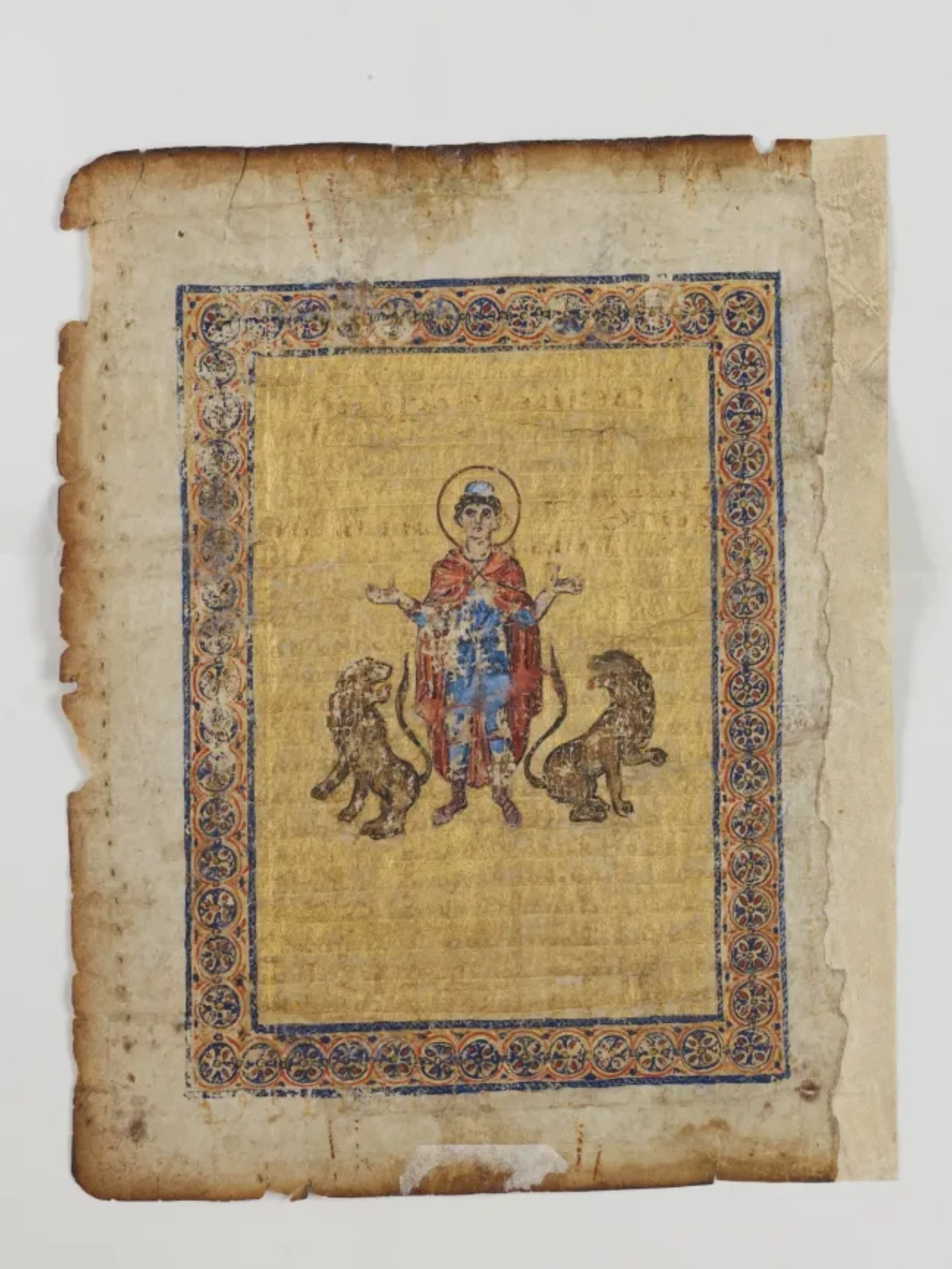
Lost Archimedes Palimpsest Leaf Identified at Blois Museum
Researchers have identified a long-missing leaf of the Archimedes Palimpsest in Blois, adding a major new fragment to one of the most important manuscripts in the history of science.
A long-missing leaf of the Archimedes Palimpsest has been identified in Blois, reconnecting a detached page to one of the most important surviving witnesses to ancient mathematics. The discovery, reported by researcher Victor Gysembergh, immediately elevates a regional museum holding into a globally significant manuscript event.
The page was linked to the known codex through comparison with 1906 photographs by scholar Johan Ludvig Heiberg. This matters because manuscript history is built through verifiable joins, not speculation. A confirmed match restores structure to a text tradition that has been fragmented by centuries of reuse, dispersal, and sale.
According to the report, the newly identified leaf includes material from "On the Sphere and the Cylinder" beneath later religious writing. That layered state defines the palimpsest itself: an older scientific text scraped and overwritten, yet still partially recoverable through conservation and imaging technologies.
Readers who want context should start with the CNRS announcement, then compare the broader history at the Walters Art Museum, where much of the manuscript has been studied and exhibited.
The archival lesson is clear: documentation outlives institutional cycles. Heiberg's old photographs became decisive evidence more than a century later. In an era of budget pressure, that should strengthen the case for investing in photography, cataloging standards, and open research access across public collections.
The object also exposes how unstable our narratives of knowledge still are. We treat canonical science as settled, yet key sources remain vulnerable to private ownership patterns, undocumented movement, and uneven technical access. Every recovered leaf recalibrates both scholarship and public understanding.
Next-stage work is likely to involve multispectral imaging and potentially other non-invasive analysis. Similar methods previously transformed legibility of difficult palimpsest passages. If approved, this page could yield further recoverable text and diagrammatic detail that refines current philological interpretations.
The curatorial stakes are bigger than this single discovery. Institutions increasingly claim stewardship over global memory, but stewardship without deep metadata and long-term imaging strategy is fragile. Smaller museums, archives, and laboratories are now proving they can produce high-impact scholarship when these systems are maintained.
For a broader frame, see manuscript conservation guidance from the British Library Collection Care and imaging research resources from the Met's conservation labs. The Blois identification belongs in that wider story: cultural memory recovered through patient, technical work rather than headline spectacle.
It also reorients the geography of authority. Discoveries of this scale are often assumed to emerge from capital-city institutions with large communications teams. Instead, a municipal museum in Blois became central to a transnational scholarly story, proving that local repositories remain essential to global historiography.
Another reason this matters is pedagogical. Archimedes is commonly taught as abstract genius detached from material culture. The palimpsest forces the opposite view: ideas survive through scribes, monasteries, collectors, curators, conservators, photographers, and researchers working across centuries. Knowledge is social infrastructure, not solitary myth.
Finally, the find should encourage museums to publish more high-resolution holdings metadata, even for objects considered minor or fragmentary. What looks marginal today can become decisive evidence tomorrow. In manuscript work, the next breakthrough is often hiding in plain sight inside an under-described object record.