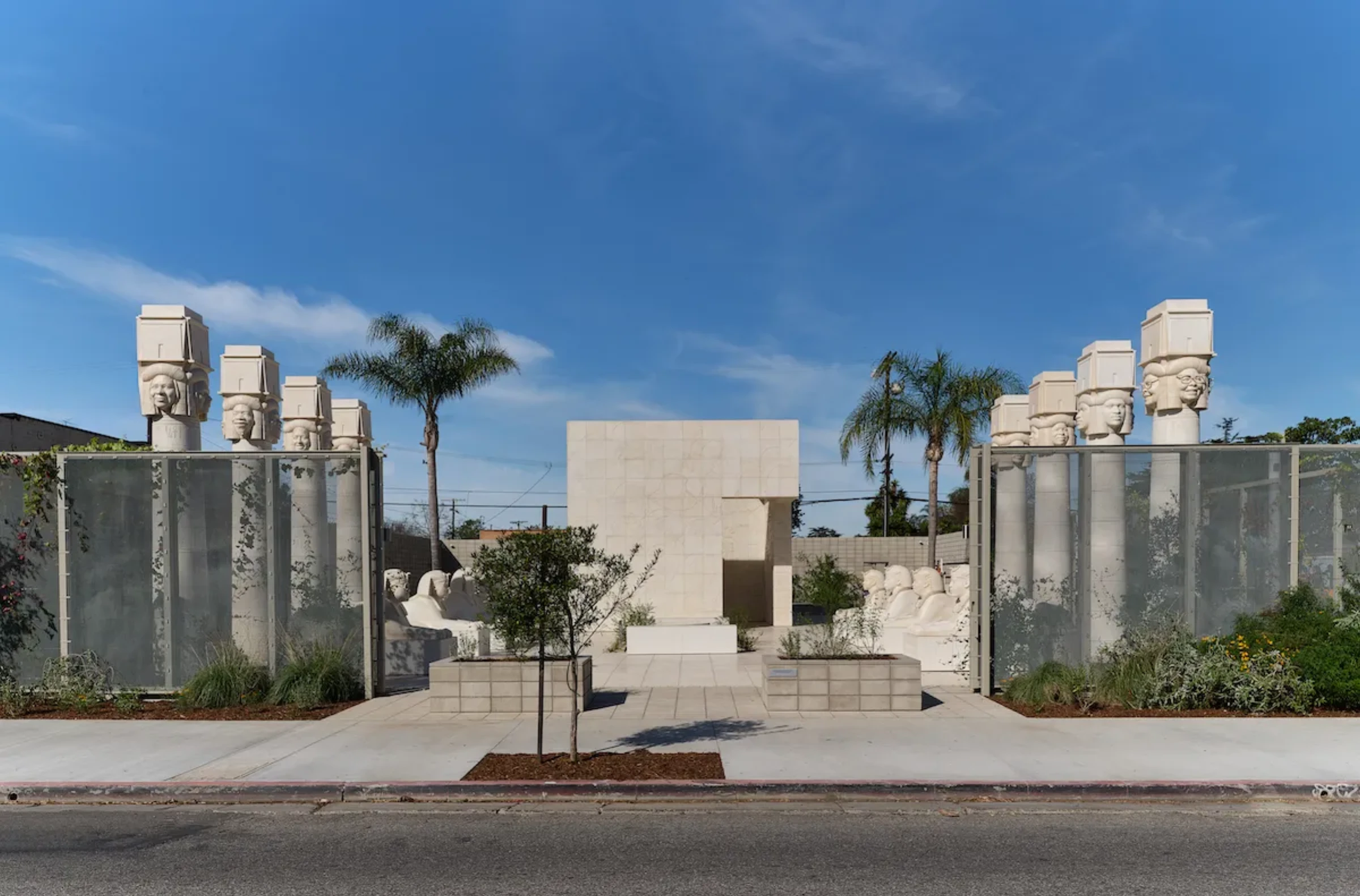
Guide: How to Read Lauren Halsey’s New South Central Sculpture Park
Lauren Halsey’s long-planned public work in South Central Los Angeles is now open. Here’s what to look for beyond the headline and why this project matters as civic infrastructure, not just spectacle.
Lauren Halsey’s long-developed sculpture park in South Central Los Angeles is now open, and the key to reading it well is to resist treating it as a one-off object. This is not merely a new work to check off a city culture list. It is a spatial argument about who gets to script neighborhood memory, who controls visual language in public space, and what forms of cultural authorship survive outside museum architecture.
ARTnews reports that Halsey first conceived the project years ago, and that its realization arrives after a long gestation that included high-profile presentations elsewhere, from institutional contexts in Los Angeles to major international visibility. That timeline matters because the park is best understood as a continuity move, not a pivot. The themes are familiar in her practice, but the stakes are different when those themes are embedded in local ground rather than borrowed institutional terrain.
Start your visit by reading the site as an archive. Halsey’s work repeatedly draws from vernacular signage, neighborhood iconography, commercial residue, and hand-built symbolic systems that mainstream art histories often dismiss as informal or marginal. Here those materials are not citation devices for elite interpretation. They are presented as constitutive knowledge, carrying social memory and political dignity on their own terms.
Second, look at address. Ask who the work speaks to first. Many public-art commissions claim community orientation while actually signaling to funders, tourists, and urban branding agendas. Halsey’s stated ambition has long centered South Central audiences and local ownership. The practical test is whether neighborhood users can occupy the work as a living place, not just encounter it as something curated for external consumption.
Third, pay attention to scale and circulation. Public artworks become civic infrastructure only when they can sustain repeated use without losing conceptual charge. A successful visit is not one dramatic reveal followed by exit. It is a sequence of returns, where details continue to disclose meaning and where spatial use by different groups generates changing interpretations over time.
Fourth, compare this project to Halsey’s museum-facing works. In institutional settings, her language often enters pre-structured environments with fixed circulation habits, security cues, and interpretive framing. In South Central, those constraints shift. The work can function less as intervention into institutional narrative and more as neighborhood-authored spatial statement. That is a major difference in agency, and it should shape how criticism is written.
Fifth, refuse the easy uplift story. Media framing will predictably emphasize inspiration, local pride, and overdue recognition. Those are valid dimensions, but incomplete. The stronger reading tracks power: land use, durability, maintenance, and long-term governance. Who maintains the site. Who programs around it. Who protects it when policy priorities change. Those questions determine whether this remains symbolic visibility or becomes durable cultural infrastructure.
Sixth, if you are an artist, curator, or educator, use the site as a teaching tool for representation politics. It offers a concrete way to discuss the difference between inclusion as image and inclusion as structure. Students can map what is named, what is omitted, and how local visual intelligence is translated without being neutralized for mainstream readability.
Seventh, consider the project in relation to current debates around public monumentality. Much recent discourse has focused on removal and revision of legacy monuments. Halsey’s park contributes a parallel proposition: build new monuments from community-grounded sign systems that are already alive, rather than only adjudicating old monuments built from exclusionary narratives.
Eighth, evaluate the relationship between curatorial mediation and artist autonomy. The project was organized and curated in institutional partnership, but its strongest public value depends on avoiding over-instruction. If every interpretive pathway is pre-scripted, the park risks becoming didactic. If interpretation remains open while context stays available, it can function as both artwork and social platform.
Ninth, do not separate form from politics. The ornamental density, material layering, and visual insistence are not decorative side effects. They are part of a refusal to shrink local complexity into digestible branding language. Formal saturation here operates as an ethics of presence: the neighborhood is not an abstract backdrop but a producer of epistemic and aesthetic form.
Finally, visit with time. Walk once for orientation, then again for detail. Note what feels immediately legible and what resists instant reading. Public work that matters often withholds quick consensus. Halsey’s project deserves that slower pace because its contribution is not just visual impact. It is a proposition about narrative sovereignty in urban space, and those propositions can only be tested through sustained attention and repeated use.
One practical method for critics is to document actual site use over several visits, including weekday and weekend patterns, instead of relying on opening-day impressions. Public meaning is produced through repetition.
Primary references include <a href='https://www.artnews.com/list/art-news/news/lauren-halsey-la-sculpture-park-south-central-1234778115/' target='_blank' rel='noopener'>ARTnews coverage of the opening, context from <a href='https://www.lanomadicdivision.org/' target='_blank' rel='noopener'>Los Angeles Nomadic Division, background on Halsey’s local-facing practice via the <a href='https://hammer.ucla.edu/' target='_blank' rel='noopener'>Hammer Museum, and broader civic context from the <a href='https://culturela.org/' target='_blank' rel='noopener'>City of Los Angeles Department of Cultural Affairs.