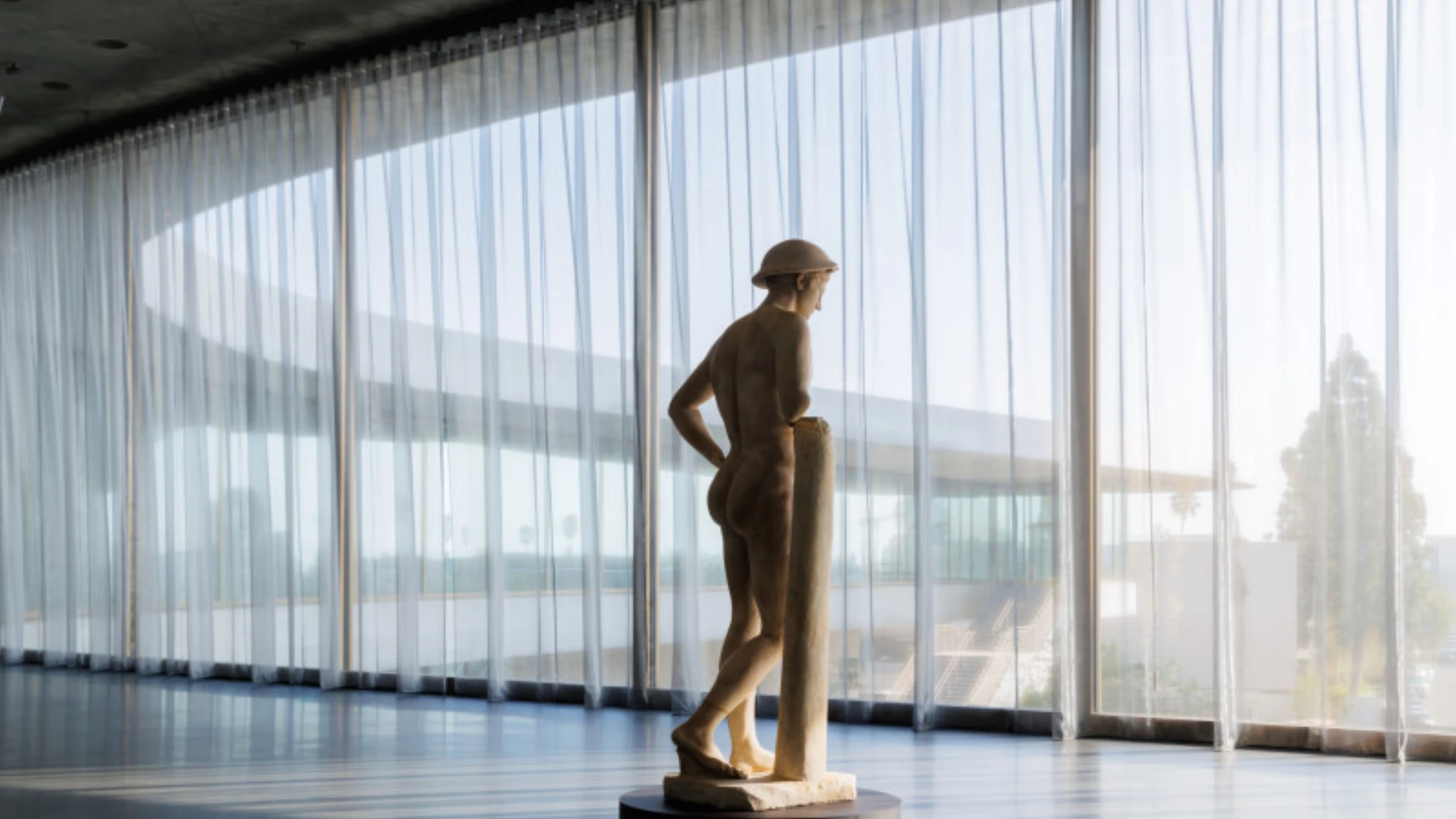
LACMA’s David Geffen Galleries Open, Marking a High-Stakes Reset for the Museum’s Public Identity
After years of scrutiny, LACMA’s new Peter Zumthor-designed galleries are opening with a collection display strategy that tests whether architecture can carry a full institutional repositioning.
The opening of the new David Geffen Galleries at LACMA closes one chapter of architectural speculation and opens a far more consequential one: programming. Designed by Peter Zumthor and elevated across Wilshire Boulevard, the building has been discussed for years as form, symbol, and budget line. Now that visitors can enter, the conversation shifts to whether the museum’s presentation strategy can justify the scale of institutional investment and public attention attached to the project.
Early descriptions of the interior emphasize movement and permeability. The galleries oscillate between bright circulation zones and darker rooms, while long perimeter windows keep the city visually present. This matters because architecture here is being asked to do curatorial work, not merely hold it. The layout encourages a non-linear encounter with objects and periods, aligning with LACMA’s stated preference for cross-temporal adjacency over strict chronological segmentation.
That display philosophy is ambitious and risky. Integrated presentations can challenge disciplinary silos and produce surprising art-historical pairings, but they can also dissolve context if curatorial framing is too light. LACMA’s leadership, under director Michael Govan, has repeatedly positioned the museum as a place where global histories are re-read through proximity and movement rather than national or period taxonomies. The new galleries effectively convert that thesis into architecture, making curatorial clarity the make-or-break variable.
The public environment around the building reinforces the stakes. The site already includes highly legible anchors such as Chris Burden’s Urban Light, and the expanded campus now folds additional outdoor sculpture and circulation into the visitor pathway. Institutional experience in Los Angeles has always been partly urban choreography, and the Geffen opening extends that pattern by linking internal viewing routes with externally visible civic space.
For trustees and peer institutions, the project will be measured less by opening-week attendance than by medium-term indicators: repeat visitation, educational uptake, donor confidence, and acquisition velocity tied to the new display model. LACMA has framed this build as a long-cycle investment in how a major encyclopedic museum can function in the twenty-first century. The burden of proof is therefore longitudinal. A single strong season is not enough; the model must sustain critical and public confidence through programming turnover.
For artists and curators, the opportunity is significant if the institution keeps experimentation live after the launch window. New architecture often arrives with a temporary tolerance for formal risk, then drifts back toward conservative display routines once operational pressure sets in. If LACMA avoids that cycle, the Geffen galleries could become an active laboratory for rethinking object relations across geography and era, not simply a celebrated shell.
The opening has already produced polarized visual and political readings, which is unsurprising for a project of this scale. What is clearer now is that the building has achieved its first institutional function: it has made curatorial intention impossible to keep abstract. From this point forward, every installation choice becomes legible as policy. In that sense, LACMA’s reset is underway, and the museum now has to prove that its architectural wager can deliver durable intellectual value, not only spectacle.