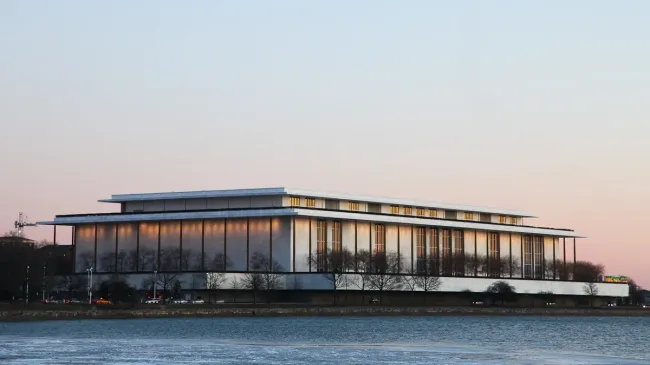
Kennedy Center Board Votes to Reinscribe Trump's Name on Facade
Trump-chaired board votes to inscribe the president's name on the Kennedy Center facade despite court rulings and federal law prohibiting new memorials
Board Approves Trump Inscription Despite Federal Law
The board of the John F. Kennedy Center for the Performing Arts has voted to inscribe President Donald Trump's name on the building's marble facade, approving the phrase "Restored and Renovated by President Donald J. Trump" immediately below the Kennedy Center name. The move represents the latest attempt by the Trump-allied board to carry out the president's wishes, despite repeated court rulings aimed at preventing them from doing so, as reported by Artforum. The vote represents a remarkable collision between cultural stewardship and political self-promotion at one of America's most significant arts institutions.
The decision comes after US District Judge Christopher R. Cooper ruled in May 2025 that Trump's name, which had been appended to the facade in December 2025 following an earlier board vote, had to come off. Cooper determined that only Congress has the authority to rename a monument, citing federal law stipulating that "no additional memorials or plaques in the nature of memorials shall be designated or installed in the public areas." The administration dragged its feet on the removal, obscuring Trump's name with a large tarp instead of removing it, prompting Cooper to order an explanation for its continued presence on the building.
Legal Endaround Through Partial Closure
In a parallel move, the board approved a plan to shutter most of the Kennedy Center complex for renovations, attempting to circumvent an earlier court ruling that blocked full closure. The board voted to close only the main building, leaving a nearby annex known as the Reach open with limited programming. The plan includes moving the 3,000-pound bronze bust of John F. Kennedy that has long greeted visitors at the main building to the Reach, allowing the board to technically meet the legal requirement that the center remain a memorial to the late president.
The Trump-chaired board had unanimously voted in March 2025 to close the entire Kennedy Center for a major restoration. Judge Cooper temporarily blocked that plan on the grounds that the trustees did not have "sufficient information" to make such a decision, which he further noted had been "ill-informed and seemingly preordained." The board's latest strategy of partial closure appears designed to thread the needle between Cooper's ruling and the administration's renovation ambitions.
Board Member Celebrates, Another Objects
Kennedy Center board member Paolo Zampolli, a onetime modeling agent and longtime Trump supporter, told reporters that the board felt adding Trump's name would increase tourist traffic to the center. Zampolli said he hopes the inscription will appear "as big as it can get," framing the decision as a branding opportunity rather than a stewardship responsibility. The statement underscores the degree to which commercial logic has infiltrated the governance of what was conceived as a public cultural trust.
Democratic Congresswoman Joyce Beatty, who sits on the board, offered a sharply different assessment. "This latest development is a transparent effort to circumvent the court's ruling and flies in the face of the statutes that Congress passed," Beatty told the BBC. "I will continue to fight for this treasured national monument." Her objection highlights the partisan divide on the board and the broader question of whether cultural institutions should serve as vehicles for presidential legacy-making.
Cultural Implications for a National Institution
The Kennedy Center has long served as Washington's premier cultural venue, hosting the National Symphony Orchestra, the Washington National Opera, and a wide range of performing arts programming that attracts millions of visitors annually. The board's decisions raise fundamental questions about the independence of cultural institutions from political interference, and whether a sitting president can reshape a congressionally designated memorial to serve personal branding objectives. The Kennedy Center was established by Congress in 1958 as a living memorial to President John F. Kennedy, with a mandate to present the finest performing arts to the American public.
The White House issued a statement claiming that "under President Trump's bold leadership, the Kennedy Center is on its way to becoming the finest cultural institution anywhere in the world." Critics note that the renovation plan, while presented as an upgrade, effectively displaces programming and transforms a public arts venue into a monument to a living president, a departure from the center's founding mandate. Arts organizations across the country have watched the Kennedy Center saga with growing alarm, concerned that the precedent could extend to other federally supported cultural institutions.
What Comes Next
Legal challenges to the board's latest votes are likely. Judge Cooper's earlier rulings established that the board cannot act without sufficient information and that congressional authority supersedes board decisions when it comes to memorials. The question now is whether the revised approach, closing only the main building and framing Trump's name as a renovation credit rather than a memorial, will survive judicial scrutiny. Legal experts have noted that the semantic distinction between a memorial inscription and a renovation credit is thin, and courts may not look kindly on what appears to be an overt attempt to relabel a prohibited action to evade judicial review.
For the arts community, the stakes extend beyond one building. The Kennedy Center precedent could open doors for other cultural institutions to be repurposed as political branding vehicles, eroding the boundary between public arts funding and partisan self-promotion. The National Endowment for the Arts, the Smithsonian Institution, and other federally supported cultural bodies could face similar pressures if the board's approach goes unchallenged. Arts advocates have pointed out that the Kennedy Center's founding legislation explicitly designates it as a living memorial to President Kennedy, not a venue for incumbent self-promotion, and that the board's actions fundamentally misread the institution's purpose.
The renovation plan itself has drawn criticism from arts professionals who question whether shutting down the main building serves artistic or political ends. The Kennedy Center's main halls host the National Symphony Orchestra's concert season, the Washington National Opera's productions, and hundreds of other performances annually. Displacing this programming for an indefinite renovation period, particularly when the Reach annex lacks comparable acoustic and staging infrastructure, suggests that the board prioritizes structural modifications over the artistic mission the center was built to serve. Musicians and performers have expressed concern that the displacement could lead to permanent cancellations of major productions, with companies unable to maintain their seasons in a reduced venue.
The controversy also raises questions about the role of the Kennedy Center board itself. Traditionally, the board has included bipartisan representation from Congress, prominent cultural figures, and presidential appointees confirmed by the Senate. Under the current administration, the board's composition has shifted heavily toward Trump allies and political donors, with several long-standing cultural representatives removed and replaced by individuals with limited arts management experience. This shift in board composition has enabled decisions that would have been unthinkable under previous boards, where artistic mission and institutional independence were understood as inviolable principles.
As the legal battle continues, the performing arts world watches closely to see whether a congressional memorial to a fallen president can be transformed into a monument to a living one, and what that transformation means for the future of cultural independence in America. Several arts organizations have already begun exploring alternative venues in Washington, concerned that the Kennedy Center may not return to its original mission under the current board's stewardship. The outcome of this dispute could reshape the relationship between government and the arts for decades to come, establishing either a precedent for political control of cultural institutions or a judicial boundary that protects them from partisan capture. The case also raises broader questions about the role of presidential appointees on cultural boards, and whether the tradition of stacking such boards with political allies serves the public interest or undermines the institutions those boards are meant to protect. Previous administrations have typically maintained a balance between political appointees and cultural professionals on the Kennedy Center board, understanding that the institution's credibility depends on its perceived independence from partisan politics. The current board's willingness to act as a vehicle for presidential branding represents a break from that tradition that could have lasting consequences for how cultural institutions are governed in the United States. The Kennedy Center dispute also fits into a broader pattern of presidential involvement in cultural affairs under the current administration, including proposals to eliminate funding for the National Endowment for the Arts and the National Endowment for the Humanities, and attempts to reshape the leadership of the Smithsonian Institution. Taken together, these actions suggest a systematic effort to bring cultural institutions under direct presidential control, a posture that runs counter to the arm's-length principle that has governed American cultural policy since the establishment of the NEA in 1965. The courts may ultimately determine whether that principle survives this administration, or whether it becomes another casualty of the ongoing erosion of institutional independence For the Kennedy Center, the question is not whether its marble facade can accommodate another name, but whether its institutional soul can survive the systematic conversion of a cultural memorial into a political trophy. The answer will shape American cultural governance and the relationship between politics and the arts for generations to come, long after the current controversy has faded from the headlines.