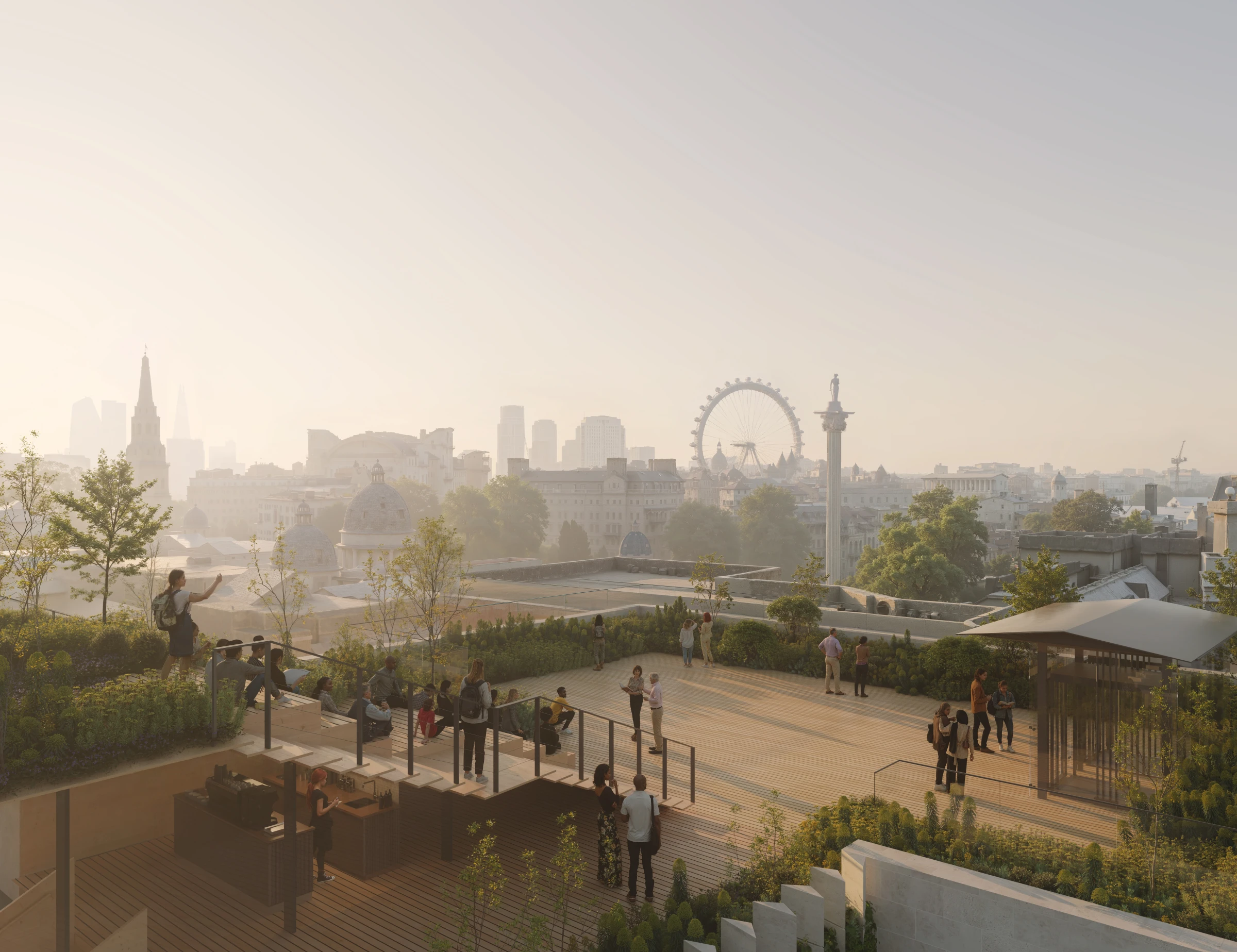
Kengo Kuma Wins National Gallery’s £750M Expansion, Resetting London’s Museum Building Race
London’s National Gallery selected Kengo Kuma and Associates for Project Domani, a £750 million extension that could reshape curatorial circulation and institutional competition through the 2030s.
The National Gallery in London has chosen Kengo Kuma and Associates to design Project Domani, a major £750 million expansion that will add a new wing to one of Europe’s most visited painting institutions. The decision, announced by the National Gallery, came after a competition that reportedly drew sixty-four architecture firms. In practical terms, this is not just another capital project. It is a long-horizon operational bet on how viewers move through collections, how curators build narratives across old and new spaces, and how a bicentenary museum competes for global attention in the next decade.
Project Domani extends beyond a façade refresh. The plan includes building over adjacent land that currently hosts St. Vincent House and nearby commercial uses, with an opening targeted for the early 2030s. The institution says the expansion will increase hanging space by more than 15 percent, an important number for a museum where programming pressure is constant and audience demand is structurally high. More wall space means more choices, but also more responsibility, because every added square meter requires staffing, climate control, conservation planning, and a coherent curatorial purpose.
Director Gabriele Finaldi’s public endorsement of Kuma’s handling of light and materials is revealing. The long argument around museum architecture has shifted from icon-building to experience-building. Visitors no longer accept circulation bottlenecks, dead transitional corridors, or galleries that perform well in photographs but poorly for looking. If Kuma, working with UK firms BDP and MICA, delivers a wing that solves flow while preserving the collection’s pedagogical clarity, the project could become a template for older national museums facing similar retrofit pressures.
The move also lands in a wider building cycle. The National Gallery recently completed an £85 million renewal of the Sainsbury Wing, timed to its 200th anniversary. Together, the Sainsbury upgrade and Project Domani suggest a two-stage strategy: first modernize existing infrastructure, then materially expand capacity. For lenders, donors, and trustees across the sector, this sequencing matters because it spreads risk while preserving momentum. It also signals that prestige institutions are still willing to spend at scale even as operating costs remain volatile.
There is, however, a harder question underneath the celebration. Additional space does not automatically produce better exhibitions. It can just as easily produce programming inflation, where institutions feel compelled to fill calendars at unsustainable velocity. The National Gallery’s challenge now is governance, not only architecture. It will need to define what the new wing is for, which audiences it is meant to serve, and what kinds of scholarship and display become possible only because this expansion exists.
For London’s museum ecosystem, the appointment sharpens competition. When one flagship institution expands by this magnitude, peers are pressured to answer with their own capital campaigns, curatorial repositioning, or visitor-experience upgrades. In that sense, Project Domani is a city-level signal as much as a museum project. The competition is no longer simply about blockbuster loans or social media visibility. It is about who can build durable, legible institutions that still feel intellectually urgent in the 2030s.
There is another reason this commission matters internationally. Kuma’s practice already has major museum and civic references, including projects connected to the V&A Dundee. For trustees elsewhere, the National Gallery decision will be read as a signal about what kind of architecture is now rewarded by legacy institutions: less monumentality for its own sake, more daylight control, material tactility, and flexible program logistics. The project now moves from competition narrative to delivery discipline, where contracts, phasing, and collection-safe construction sequencing will decide whether the ambition actually reaches the wall.