Hong Kong’s Cheng-Lan Foundation Opens With a Global Majority Mandate
A new independent foundation in Hong Kong launches with Cian Dayrit’s first solo show in the city and a cross-border residency strategy linking Asia and Europe.
Hong Kong has gained a new private cultural actor with public ambitions. The Cheng-Lan Foundation, founded by Brian Yue, opened this week with a clear thesis: global contemporary art will continue to misrepresent itself unless institutions materially shift who gets exhibited, commissioned, and written into history. The foundation’s first move is not a neutral opening program, it is a statement of intent built around artists and curators from communities that major Western institutions still describe as emerging while depending on them for renewal.
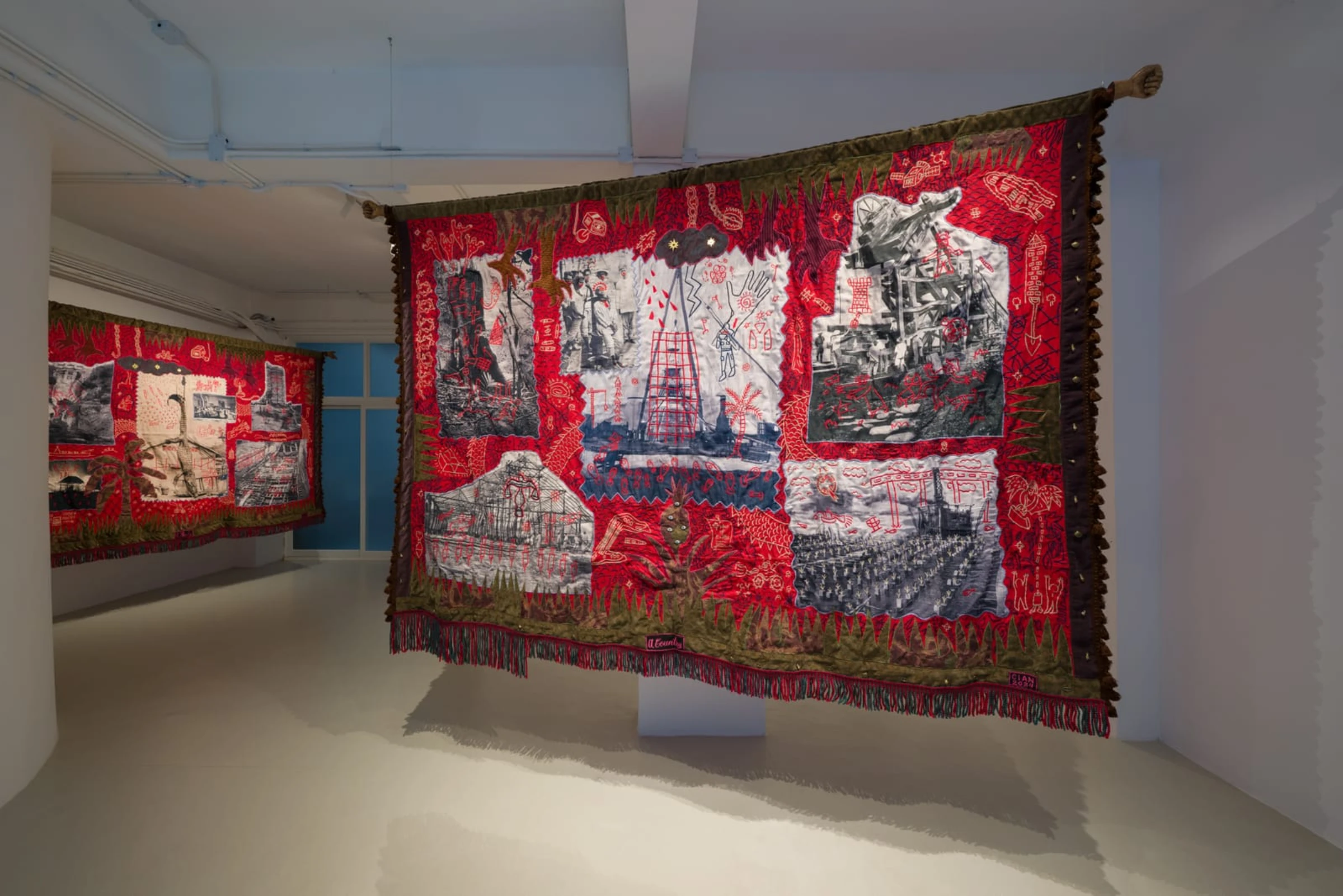
The inaugural exhibition, A Country, A Body, presents Manila-based artist Cian Dayrit in his first solo presentation in Hong Kong. Dayrit’s practice is known for what he calls counter-cartography, a method that reads maps, extraction zones, and military borders as instruments of power rather than objective records. In the opening installation, textiles, stitched surfaces, and layered iconography present land as a contested archive, not a passive backdrop. The show establishes the foundation’s tone early: historical argument first, decorative consensus second.
Yue’s institutional framing is also legible in the project’s structure. Before establishing a physical base in Hong Kong, he launched a scholarship pathway linked to Central Saint Martins at the University of the Arts London. That sequence matters. The foundation did not begin as a local vanity project with a fast branding cycle. It started with professional development, then expanded into exhibitions, commissions, and long-term collection building. The model positions Hong Kong as an operating base, not a symbolic address.
Its first residency track reinforces that approach. Cheng-Lan is piloting partnerships with Para Site in Hong Kong and Delfina Foundation in London, effectively using residency infrastructure to build circulation rather than one-off visibility. For artists, that can mean studio time, commissioning pathways, and curatorial relationships that survive beyond a fair week. For curators, it offers room to test concepts that often fail to fit legacy institutional calendars driven by donor certainty.
The timing is strategic. Hong Kong’s art week has become both a marketplace and a legitimacy theater where many organizations chase attention without changing governance or acquisition logic. Cheng-Lan’s language of the global majority will be tested by its program continuity, publication record, and collecting choices over the next three years. The real question is not whether the term resonates, it is whether the foundation can convert rhetoric into durable institutional behavior: which artists are collected, which publics are addressed, and which collaborations persist when market pressure shifts.
Still, the launch signals a meaningful development in the city’s ecology. A number of independent spaces opening around the same period have framed themselves as alternatives to conventional commercial pipelines. Cheng-Lan’s distinction, at least in this first phase, is that it links curatorial argument to a funding and commissioning mechanism. If that mechanism remains active, the foundation could become a useful intermediary between artists, public institutions, and private patrons seeking work that exceeds trend cycles.
For collectors and museum professionals watching Hong Kong this season, Cheng-Lan is worth tracking less as a new address and more as a policy experiment in miniature. It is attempting to build a collection and program around translocal histories, diasporic practice, and institutional partnership at once. If it succeeds, it will offer a replicable framework for other mid-sized foundations that want public relevance without pretending to be museums.