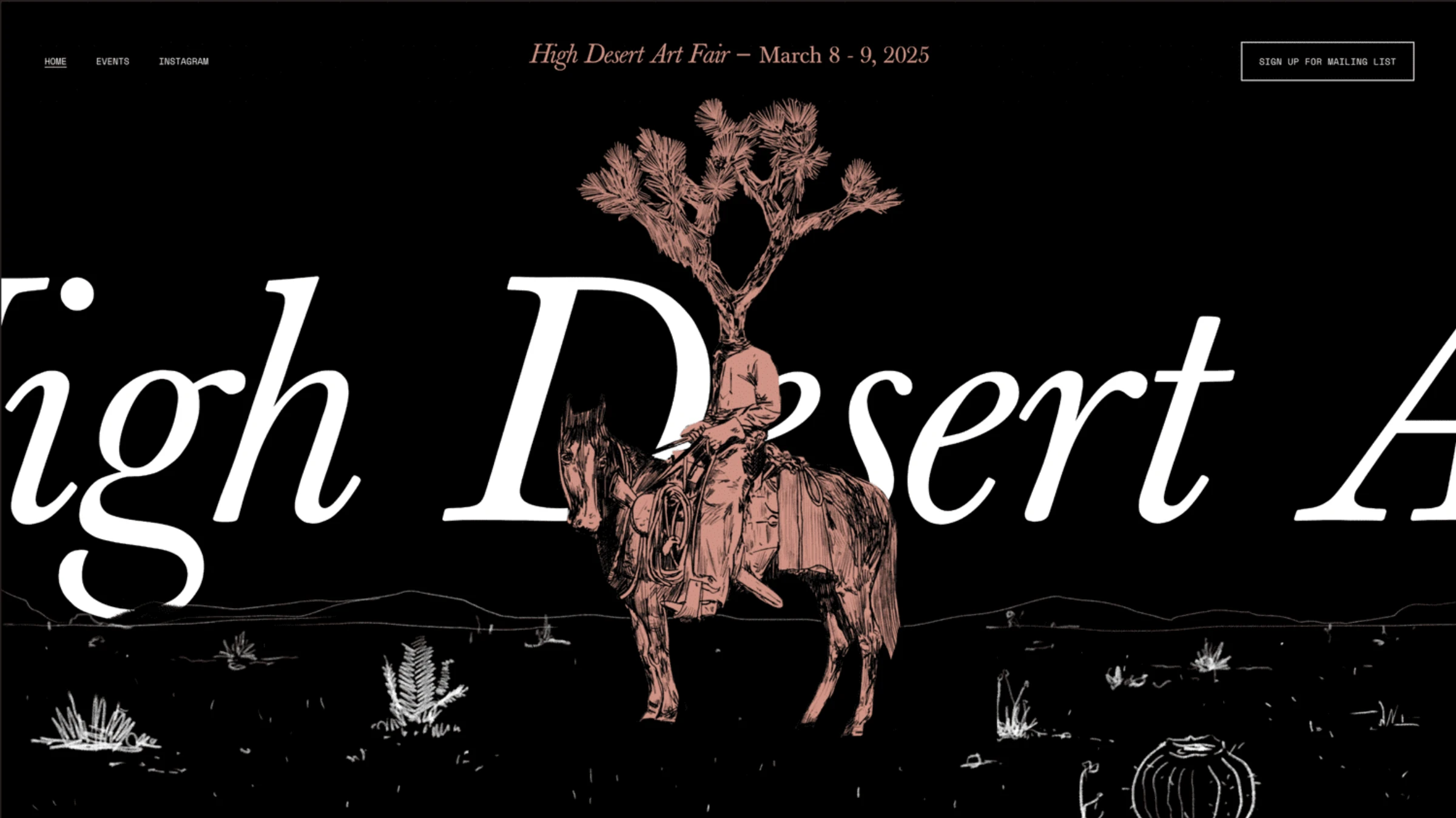
High Desert Art Fair Tests a Lower-Cost Alternative to the Global Fair Circuit
In California’s Pioneertown, the High Desert Art Fair drew around 4,000 visitors and positioned motel-room booths as a credible market model for galleries priced out of major fairs.
The High Desert Art Fair in Pioneertown, California, is no longer operating as a quirky side event. Its latest edition has become a serious proof of concept for a market structure that many mid-sized galleries have been demanding: lower booth costs, local social density, and less dependency on the rotating convention-center economy. Hosted at the High Desert Art Fair site around the historic Pioneertown Motel complex, the event reportedly brought in around 4,000 visitors, a major jump from last year.
The basic economics are straightforward. Room pricing around $3,500 dramatically undercuts the cost of participating in major international fairs, where rent, transport, staffing, and hospitality can force galleries to chase a narrow class of immediate-sale inventory. That pressure often discourages risk in both curation and pricing. By reducing fixed costs, the Pioneertown format lets exhibitors present younger programmes, regional material, or work that needs conversation before acquisition.
The location, linked to the wider Joshua Tree National Park cultural orbit, is not incidental branding. Destination fairs now compete on experience as much as inventory. Collectors increasingly bundle travel, studio visits, local hospitality, and social programming into their acquisition calendar. For smaller events, this can offset the visibility disadvantage against global mega-fairs by creating concentrated face-to-face networks over a shorter weekend cycle.
Still, the model has constraints. Destination energy can quickly become extraction when local housing and infrastructure are already under pressure. The fair’s inclusion of community-linked fundraising and artist-run participation suggests organisers understand that risk, but one weekend of solidarity messaging does not automatically rebalance long-term real-estate dynamics in the desert region.
What matters for the trade is whether this model remains repeatable after novelty fades. A one-off attendance spike is easy. Sustaining collector return, gallery confidence, and meaningful sales quality over multiple editions is the real test. It will depend on programming discipline, transparent cost structure, and continued integration with local institutions rather than pure tourism positioning.
Market timing helps. Dealers and advisors have spent two years warning about fair fatigue in London, Paris, Hong Kong, and New York cycles that now feel expensive and increasingly homogenous. Alternative fairs can succeed if they deliver three things consistently: targeted buyers, manageable overhead, and identity that is not copy-pasted from existing circuits.
The High Desert edition also shows how programming beyond booths can drive conversion. Artist talks, off-site tours, and local nightlife are often dismissed as ambient extras, yet they are part of how collectors move from browsing to conviction. In this edition, organisers and participants appear to have used that social architecture intentionally, with repeated contact points and smaller-scale interactions across the weekend.
For galleries, the lesson is practical rather than ideological. If participation costs stay rational and buyer quality holds, secondary fairs like this can become core revenue infrastructure, not occasional experiments. For collectors, the takeaway is similar: these formats increasingly surface work before it is standardized by the major circuit.
In a market still recalibrating after inflation, travel volatility, and shrinking margins, Pioneertown is not a replacement for the global fair calendar. It is a warning to it. If legacy fairs keep raising costs while narrowing opportunity, more galleries will keep shifting attention to places where the math works and the audience still arrives curious.