AI Breakthrough Deciphers Carbonized Herculaneum Scroll
International research team uses particle accelerators and AI to virtually unwrap ancient Stoic text from Vesuvius eruption
The Digital Resurrection of Lost Wisdom
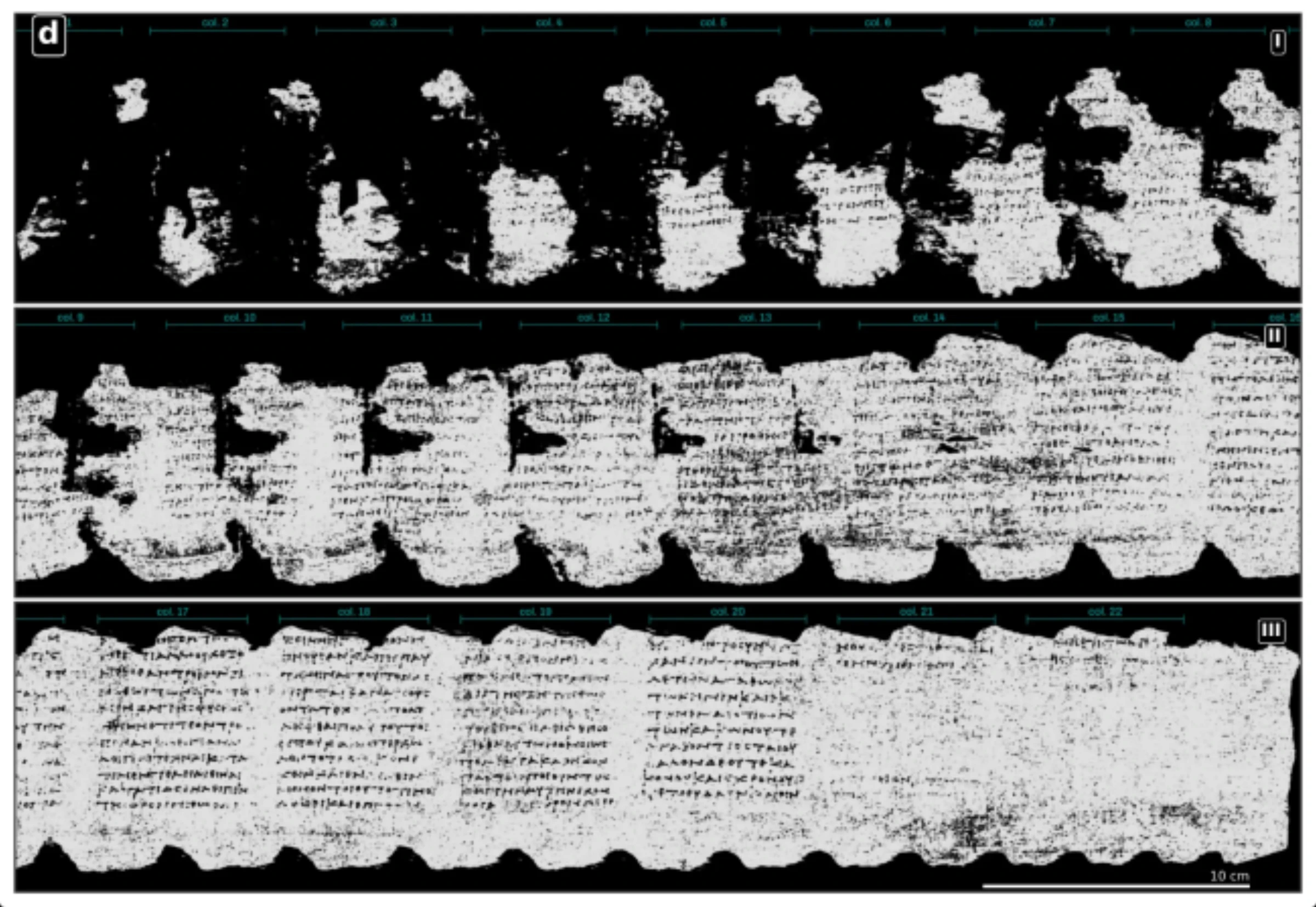
In a milestone for both archaeology and computer science, an international research team has successfully deciphered the full text of a carbonized scroll from the ancient Roman town of Herculaneum. The town, along with the famed Villa of the Papyri library, was buried under an avalanche of volcanic refuse during the eruption of Mount Vesuvius in 79 AD. For centuries, these scrolls remained essentially unreadable, resembling charcoal lumps that would crumble into dust if physically unwrapped. The breakthrough, achieved through a combination of artificial intelligence and high-energy physics, allows for the first time a complete virtual reading of the scroll known as PHerc. 1667.
The process involved a sophisticated pipeline of technology, including the use of a particle accelerator and a synchrotron to map the ink on the fragile papyrus. This imaging was then processed by AI models trained to recognize the subtle variations in texture and color that indicate writing. The result is a transformational shift in papyrology; what was once a readability score of zero in the 1980s has now become a clear, sustained argument across multiple columns of Greek text. This is not just the recovery of a document, but the recovery of a lost voice from the classical world. This marriage of tech and antiquity is similar to other AI-driven recoveries we have documented.
The use of a synchrotron–a massive circular accelerator that produces intense X-ray beams–allows the team to peer through the carbonized layers of the scroll without touching them. By detecting the chemical signature of the ink, the AI can essentially "peel back" the charred skin of the papyrus in a virtual space. This non-invasive technique is the only way to ensure that the fragile artifacts are not destroyed in the process of discovery. The marriage of high-energy physics and machine learning has turned the most stubborn archaeological puzzles into a solvable problem of data processing, a feat that has been extensively covered by Artforum.
Stoicism and the Ethics of Human Behavior
Preliminary analysis of the text suggests that PHerc. 1667 is a philosophical treatise focusing on ethics, the arts, and human behavior. The content strongly indicates that it is a Stoic text, possibly authored by the philosopher Chrysippus or perhaps Epicurus. Stoicism, with its emphasis on virtue, rationality, and the endurance of hardship, was a dominant school of thought in the Hellenistic and Roman eras. The recovery of a new text from this tradition provides invaluable data for historians and philosophers seeking to understand the nuances of ancient ethical debates.
The discovery is particularly poignant given the nature of the scroll's preservation. The very disaster that erased Herculaneum from the map for two millennia–the eruption of Vesuvius–is what carbonized the papyrus and preserved the ink. The tension between destruction and preservation is palpable here; the volcano acted as a brutal archivist. By virtually unwrapping the scroll, researchers are not only reading a text but are engaging with the physical remnants of a catastrophe, bridging the gap between a dormant, carbonized object and a living philosophical discourse.
The text of PHerc. 1667 offers a rare glimpse into the intellectual life of the late Republic and early Empire. If the scroll is indeed a work by Chrysippus, it represents the recovery of one of the most influential thinkers of the ancient world, whose work was largely lost during the Middle Ages. The detailed discussions on ethics and human behavior found within these pages are not just historical curiosities; they are foundational texts that shaped the Western concept of morality and civic duty. The rediscovery of these arguments allows modern scholars to re-evaluate the evolution of Stoicism in a way that was previously impossible, a development that ARTnews describes as a paradigm shift in classical studies.
The Vesuvius Challenge and the Democratization of Discovery
This achievement is the culmination of a unique, open-source approach to science. Professor Brent Seales of the University of Kentucky co-founded the Vesuvius Challenge – a competition that offers large financial prizes to computer scientists and engineers who can develop better ways to read the scrolls. This model has accelerated progress by inviting a global community of AI specialists to tackle a problem that traditional archaeology could not solve. In October 2023, a 21-year-old researcher, Luke Farritor, won $40,000 for uncovering the first word in an unopened scroll, proving that the best solutions often come from outside the established academic hierarchy.
The Vesuvius Challenge has turned the process of decipherment into a public event, moving the research from the closed doors of laboratories to a transparent, competitive arena. This democratization of discovery has not only sped up the reading of PHerc. 1667 but has created a repeatable, systematic approach that can be applied to the rest of the library. The goal is no longer just to read a few fragments, but to achieve a digital reunification of the entire Herculaneum collection, effectively rebuilding a lost library in virtual space.
The open-source nature of the challenge has led to an explosion of innovation in the field of AI-enhanced papyrology. By sharing the raw imaging data with the public, the team has allowed thousands of developers to experiment with different algorithms for ink detection. This collaborative effort has produced results that far exceed what a single academic team could have achieved in a decade. It is a new model for archaeological research, where the gatekeepers of knowledge are replaced by a global network of problem-solvers, each bringing a unique perspective to the challenge of reading the unreadable.
Toward a Total Recovery of the Villa of the Papyri
The successful reading of PHerc. 1667 is the proof of concept that has changed the trajectory of the project. As Professor Seales stated during a press conference at Naples’ Biblioteca Nazionale di Napoli Vittorio Emanuele III, it is now only a matter of time until all the scrolls are read. This prospect is staggering; the Villa of the Papyri contains hundreds of scrolls that could potentially rewrite our understanding of ancient philosophy, literature, and Roman administration. The scale of the potential recovery is comparable to finding a new wing of the Library of Alexandria.
Looking forward, the integration of AI and synchrotron imaging will likely become the standard for all carbonized papyri. The implications extend beyond Herculaneum, offering hope for other damaged ancient texts across the Mediterranean. The transition from a readability score of zero to a full text marks the end of the "dark age" for these documents. As we move toward a total recovery, the world prepares to engage with a set of texts that have been silent for two thousand years, proving that while time and nature can destroy the medium, technology can eventually recover the message.
The potential for discovery is limited only by the number of scrolls remaining in the volcanic ash. If the team can maintain the current pace of virtual unwrapping, we may see a sudden influx of new classical texts entering the canon. This would not just be a victory for archaeology, but a shock to the system of classical studies. The recovery of the Herculaneum library will force scholars to revise their theories on the spread of philosophy and the social structure of the early Roman Empire. We are on the cusp of a digital renaissance, where the lost libraries of the past are being rebuilt in the cloud, one pixel at a time.
Ultimately, this breakthrough reminds us that the boundaries of human knowledge are often just technical limitations. The carbonized scrolls were not lost; they were merely waiting for the right tool to unlock them. The success of the Vesuvius Challenge proves that the future of the humanities lies in its intersection with the hard sciences. As we move from PHerc. 1667 to the remaining scrolls, we are not just recovering text, but we are expanding the capacity of human memory. The ghost of the Villa of the Papyri is finally speaking, and the world is listening. This convergence of high-energy physics and classical philology is a blueprint for the future of the humanities, demonstrating that the most profound insights often come from the most unlikely technical intersections.
The recovery of the scrolls also prompts a necessary conversation about the nature of the archive. In a world of digital abundance, the sudden reappearance of a physical, carbonized archive from two millennia ago is a reminder of the precariousness of human record-keeping. The virtual reconstruction of the library is not just a technical feat, but a philosophical statement on the endurance of thought. It suggests that as long as the material trace exists, no idea is ever truly lost, only waiting for the technology to match the ambition of the discovery. As the team prepares to tackle the next batch of scrolls, the world waits to see which other forgotten voices will be summoned from the ash.