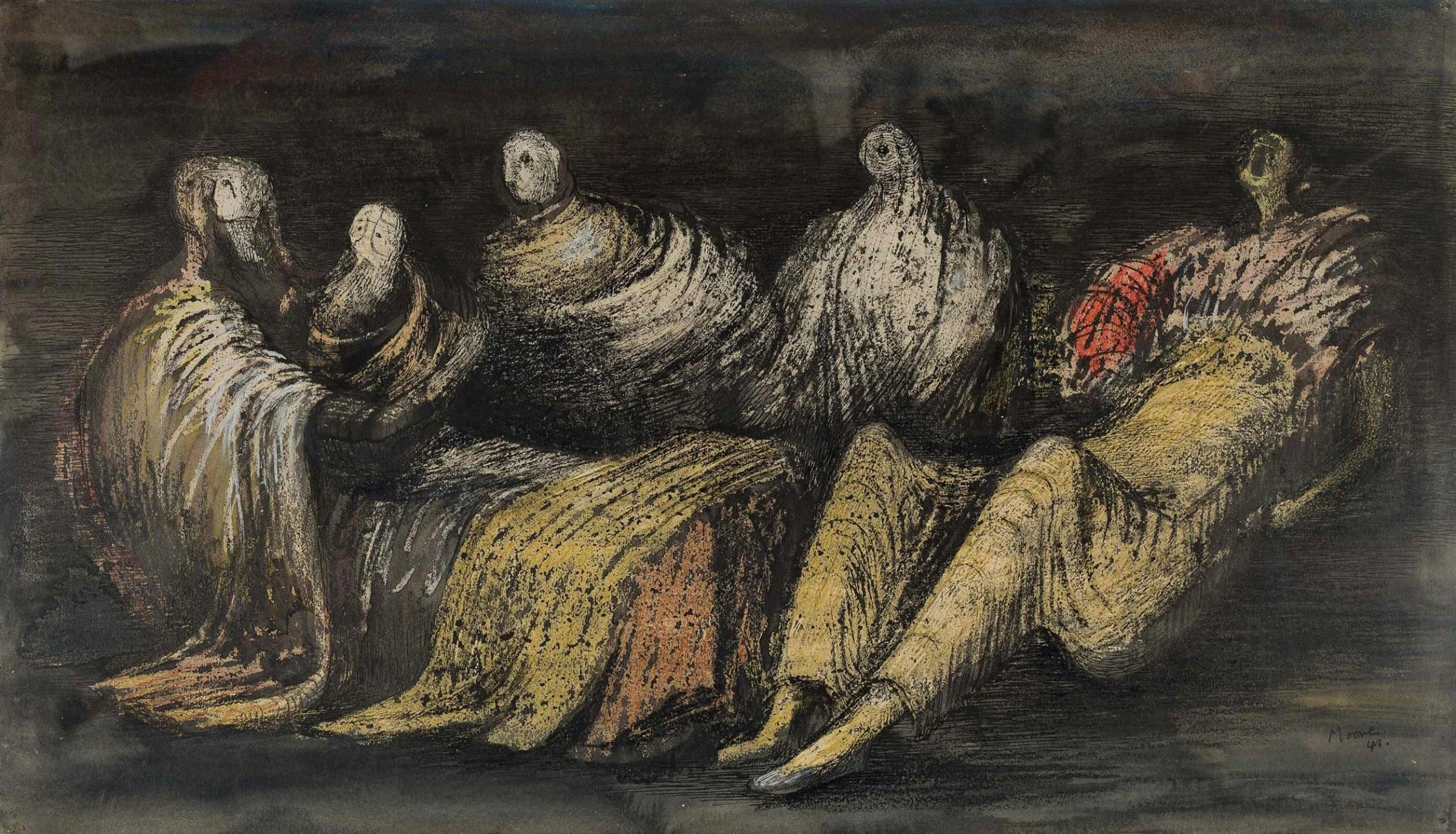
Henry Moore Foundation Reopens Sheep Field Barn With Landmark Shelter Drawings Exhibition
At Perry Green, a major redevelopment of Sheep Field Barn reintroduces Moore’s wartime Shelter Drawings in a museum setting built around conservation, education, and long-cycle public access.
Henry Moore Foundation is reopening Sheep Field Barn at Henry Moore Studios & Gardens with The Shelter Drawings 1940-1941, a focused presentation of one of the most consequential bodies of work in twentieth-century British art. The redevelopment combines gallery upgrade, education facilities, and environmental retrofit, with the exhibition opening April 1 as the estate resumes full visitor season programming.
The curatorial argument is direct: the Shelter Drawings are not side material to Moore’s sculpture practice, they are central to understanding his method under conditions of social emergency. Produced in 1940 and 1941 after Moore observed Londoners sheltering in Underground stations during the Blitz, the series transformed sketchbook observation into psychologically dense scenes of collective vulnerability, endurance, and civic proximity. The Foundation notes that over 300 works were created in this concentrated period, with around 30 included in the opening display.
Architecturally, the barn project extends an existing structure while reducing perceived mass through roofline and cladding adjustments, creating better visitor circulation and improved learning spaces without severing the site from its agricultural context. That operational choice matters because Perry Green is not simply a historic house destination. It is an active archive-and-landscape ecosystem where studios, maquettes, monumental outdoor works, and documentary holdings are meant to be read together.
For institutions, the reopening is a useful model in retrofit logic. Rather than build a detached flagship, the Foundation has invested in upgrading a working structure with clear programming utility. The result is a venue that can hold both rotating exhibitions and sustained education output, including school and workshop activity that ties directly to how Moore gathered material from everyday forms and surroundings. In an era when funding pressure often pushes organizations toward short-term spectacle, this is a slower and more durable strategy.
For collectors and scholars, the timing is strong. As postwar narratives are reassessed through conflict history, migration studies, and social memory frameworks, the Shelter Drawings have renewed interpretive value. They carry formal interest, but also institutional relevance for questions about how artists witness crisis without collapsing into illustration. That combination keeps the series active in both exhibitions and research, rather than fixed as canonized wartime imagery.
There is also a practical conservation dimension. Works on paper demand controlled conditions, and reopening with this material signals confidence in upgraded display and handling standards. Foundations managing artist estates increasingly face a dual mandate: protect fragile archives while broadening public access in ways that are financially sustainable. The Sheep Field Barn redevelopment addresses that mandate through infrastructure, not rhetoric.
The broader public program strengthens the signal. In addition to the barn exhibition, the Foundation’s season includes major outdoor and thematic presentations, extending Moore coverage beyond specialist audiences and into mixed visitor cohorts. This matters for long-horizon relevance. Artist legacy institutions that depend on one audience segment eventually contract; institutions that build layered access points, scholarship, schools, general visitors, and international tourists, preserve both impact and funding resilience.
The reopening ultimately frames Moore less as a static monument of British modernism and more as an artist whose work remains usable for current questions about conflict, community, and cultural stewardship. If the Foundation sustains this balance between scholarship, access, and operational discipline, Sheep Field Barn will function as more than a renovated venue. It will become a template for how single-artist institutions can modernize without flattening historical complexity.