Henry Moore Foundation Reopens Sheep Field Barn, Reframing Perry Green as a Working Education Site
A £5 million redevelopment at Henry Moore Studios & Gardens reopens Sheep Field Barn with expanded galleries and new learning studios, repositioning the site around process, pedagogy, and long-horizon public engagement.
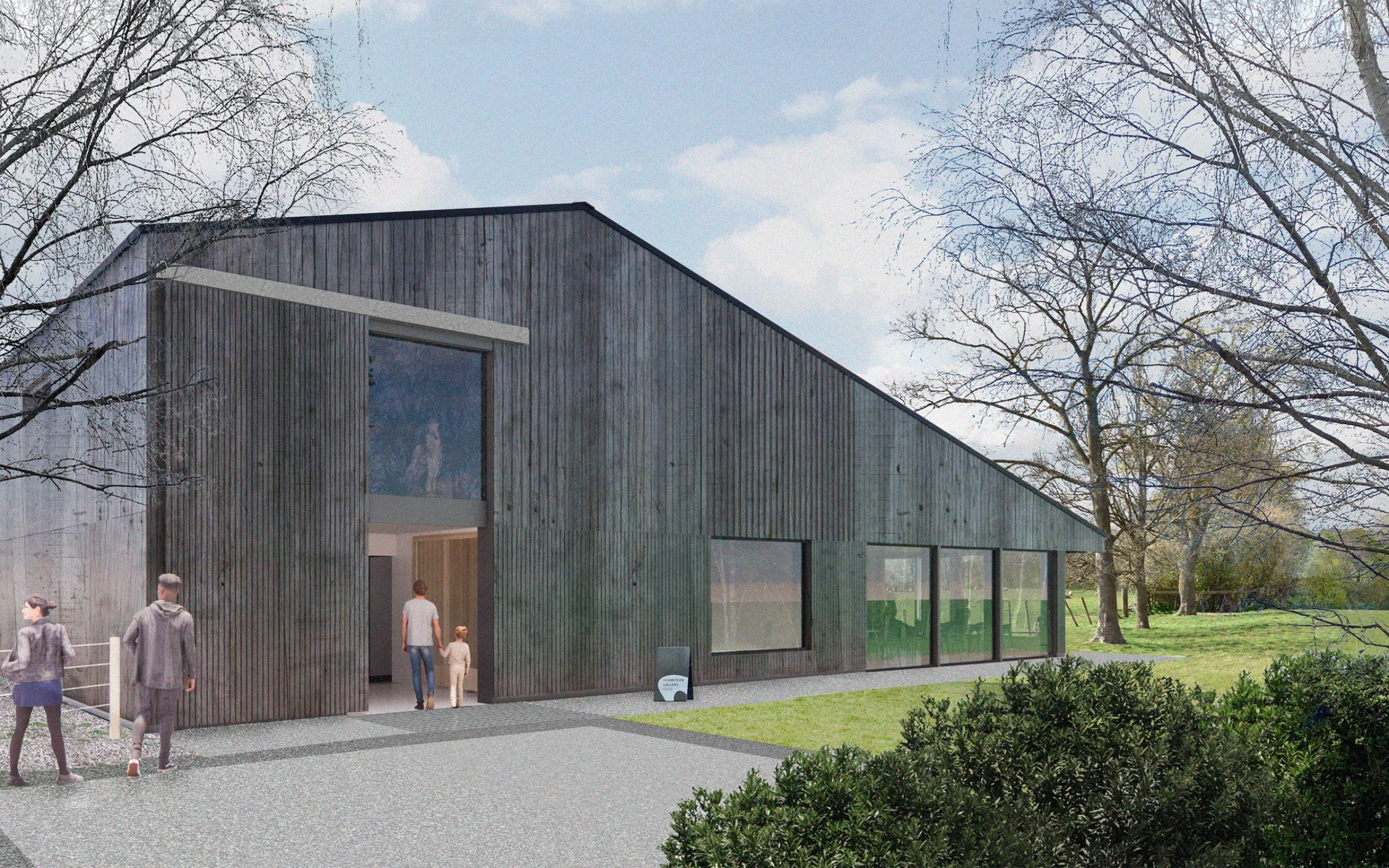
The Henry Moore Foundation’s reopening of Sheep Field Barn on 1 April is more than a facilities upgrade, it is a curatorial repositioning of Perry Green as an active pedagogical campus rather than a static heritage destination. After a £5 million redevelopment, the former farm building now carries expanded exhibition functions and purpose-built learning studios, with architecture and programming aligned to a single thesis: Moore’s legacy is inseparable from making, not just viewing.
That distinction matters. Many artist estate sites drift toward preservation-only interpretation, where biography hardens into period display and audience engagement becomes passive. At Perry Green, the new configuration argues for the opposite. The redesigned galleries present Moore’s life and work in tighter relation to his methods, research habits, and teaching commitments, while the new studio infrastructure creates operational space for workshops, schools programming, and practical experimentation. This is a decision about institutional identity as much as visitor experience.
Architecturally, the project led by DSDHA combines retrofit and extension, doubling the building footprint and shifting circulation toward a more porous learning environment. The materials strategy, from timber structure to low-carbon systems, is consistent with the foundation’s public sustainability commitments, but the stronger point is functional: studio, exhibition, and landscape interfaces are now designed to work together. The site no longer asks visitors to separate looking from doing.
The reopened program also corrects a long-standing interpretive gap. Despite Moore’s centrality in twentieth-century sculpture, permanent on-site framing of his career has been surprisingly thin relative to the depth of holdings in the Henry Moore Foundation archive and collections. The new installation draws from those holdings to map formal evolution, international commissions, and recurring thematic concerns, with stronger archival integration than previous displays. For scholars and curators, that shift should make Perry Green more useful as a research destination, not only a public sculpture garden.
The launch exhibition devoted to the Shelter Drawings is strategically well chosen. These works remain among Moore’s most emotionally direct responses to collective crisis, and they connect biography, wartime witnessing, and technical experimentation in one body of material. Positioning them at reopening frames the new barn as a place where social history and studio practice are read together. It is also a curatorial signal that the foundation intends to cycle focused thematic shows rather than rely solely on canonical highlights.
There is a broader UK institutional context here. Regional and peri-urban art sites increasingly need to justify capital expenditure through demonstrable educational utility and year-round programming range. Sheep Field Barn now has the infrastructure to meet that demand: more flexible galleries, dedicated teaching spaces, and better accessibility for mixed audiences from school groups to specialist cohorts. If the programming team can sustain cadence, the venue should become a stronger node in national sculpture education networks.
The timing with Henry Moore: Monumental Nature at Kew Gardens is not incidental. It creates a two-site narrative in which public-facing large-scale sculpture in London is paired with process-rich interpretation at Perry Green. That is smart audience architecture: one site amplifies visibility, the other deepens understanding. For the foundation, it also broadens the funnel between casual cultural tourism and long-term engagement with archive, research, and sculpture pedagogy.
Critically, the reopening reframes what an artist foundation can deliver in 2026. Instead of choosing between conservation and participation, this model insists on both. The legacy assets remain intact, but the institutional proposition is contemporary: active learning spaces, inclusive program formats, and a curatorial frame that treats education as core practice, not outreach add-on. In a sector where legacy houses often struggle to speak to present audiences, Sheep Field Barn looks like a serious operational answer.
If there is a risk, it is executional. Infrastructure can only do so much without sustained staffing, commissioning discipline, and editorial clarity across exhibitions and public programs. The foundation has acknowledged that by building coordinator capacity alongside the capital project. Over the next twelve to eighteen months, the measure of success will be whether the barn functions as a continuous site of making and inquiry, not simply an improved venue. The opening suggests the institution understands that standard and is willing to be judged against it.