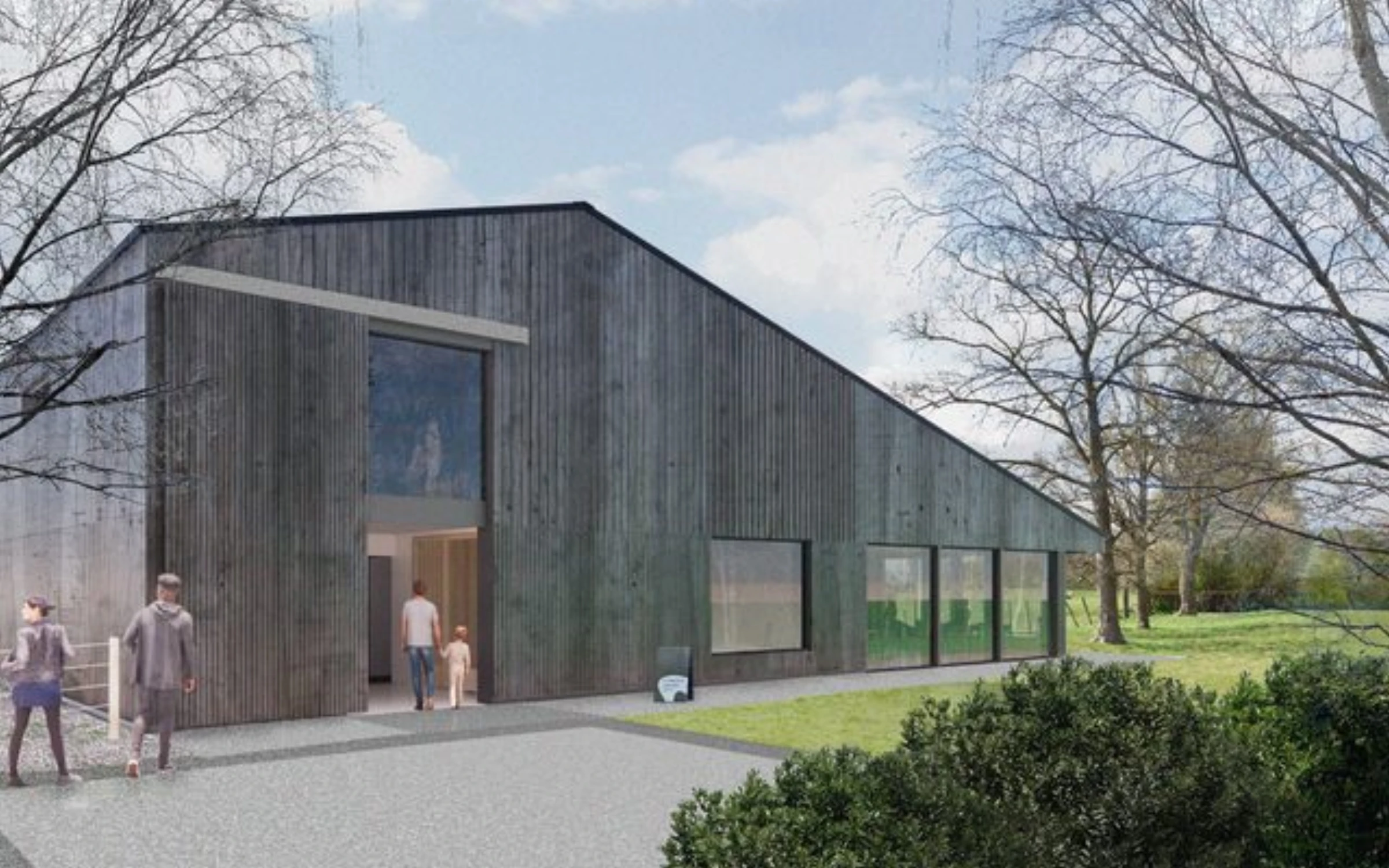
Henry Moore Foundation Reopens Sheep Field Barn as New Exhibition and Learning Hub
A £5m redevelopment at Henry Moore Studios & Gardens has reopened Sheep Field Barn with new galleries and studios, reframing Moore’s legacy around process, education, and public access.
The Henry Moore Foundation has reopened Sheep Field Barn at Perry Green after a £5m redevelopment, turning a former farm structure into a combined exhibition venue and education complex. For a site often treated as a monument to a single canonical sculptor, the reopening marks a deliberate shift in emphasis: from static legacy display toward active public learning, studio practice, and historically grounded interpretation.
The project sits within Henry Moore Studios & Gardens, where the artist lived and worked for four decades after moving from London during the Blitz. Moore’s relationship to Perry Green has always been central to his mythology, but the new galleries are trying to widen that frame. The stated curatorial focus is not only Moore’s finished bronzes, but his processes, research habits, and role as teacher and advocate for sculpture as a civic art form.
Architecturally, the barn has already lived multiple lives. Originally a steel-frame agricultural building, it was first adapted in the late 1990s, and has now been substantially reworked by DSDHA. The reopening includes a permanent interpretive display and temporary galleries, beginning with a focused presentation of Moore’s Shelter Drawings. That opening choice is strategic. The drawings, produced after witnessing Londoners sheltering underground during wartime bombing, connect Moore’s formal language to social crisis rather than to postwar monumentality alone.
The institutional context matters as much as the architecture. The foundation controls major holdings and archives, and can therefore shape not just what is shown, but how twentieth-century British sculpture is narrated across generations of visitors. By adding purpose-built learning studios and appointing dedicated engagement staff, the organisation is effectively betting that Moore’s long-term relevance depends on direct participation, not reverential distance.
This approach aligns with broader pressures on artist foundations. Across Europe and North America, legacy institutions are being pushed to justify public value beyond stewardship and occasional scholarship. Education, access, and programme utility now sit alongside conservation and collection care as primary performance metrics. In that environment, spaces that support making, school groups, and interdisciplinary programming are not add-ons. They are governance strategy.
The timing also intersects with a wider Moore visibility cycle, including the major outdoor presentation at Kew Gardens. Together, the two initiatives create a dual platform: one emphasising monumental public encounter, the other emphasising studio thought and archival depth. For curators and educators, that pairing offers a more useful model of Moore than the single-image canon of reclining figure plus landscape.
There are still open questions. Can the new educational infrastructure sustain year-round demand beyond launch momentum? Will the temporary exhibition programme maintain intellectual sharpness once the centenary-adjacent visibility cycle cools? And can a foundation-led site keep critical distance while presenting the artist it exists to preserve? Those are the real tests of whether this reopening is structural or cosmetic.
For now, the strongest outcome is methodological. Sheep Field Barn has been repositioned as a working civic interface between archive, object, and public practice. If that model holds, it could become one of the more convincing examples of how artist-house institutions can move from memorial culture into live cultural infrastructure.