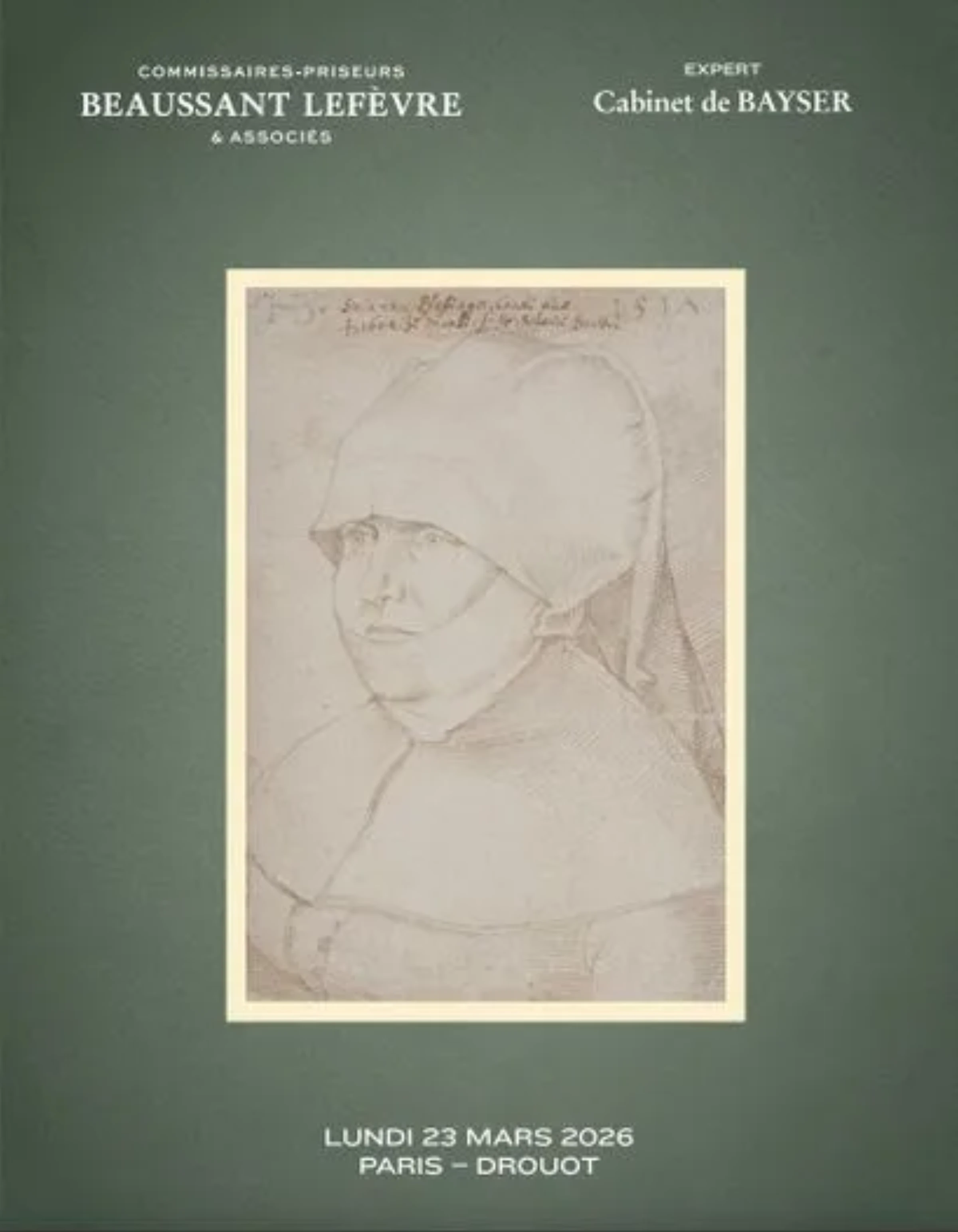
France Blocks Export of Newly Attributed Hans Baldung Silverpoint
France has classified a newly attributed 1517 Hans Baldung drawing as a national treasure, halting export for 30 months before a planned Drouot sale.
The French culture ministry has blocked the export of a newly identified drawing by Hans Baldung Grien, days before its planned sale at Drouot in Paris. The work, a silverpoint Portrait of Susanna Pfeffinger dated 1517, was expected to be one of the year’s most closely watched Old Master drawings at auction, with a pre-sale estimate of €1.5 million to €3 million. Instead, France has designated it a national treasure, triggering a 30-month export bar and fundamentally changing both the timeline and economics of the transaction.
The drawing is small in scale, roughly 15.7 by 10.4 centimeters, but materially and historically dense. It is executed in silverpoint on prepared paper and carries Baldung’s monogram and date. The sitter is identified as Susanna Pfeffinger, linked to Strasbourg, where Baldung built much of his mature career. Specialists consulted around the discovery have argued that the sheet’s handling and provenance make it an exceptional survival, and potentially the only silverpoint portrait by Baldung still in private hands at the time of attribution.
For market observers, the ministry’s intervention is not surprising in principle but significant in timing. The work reportedly entered formal export-license review in late 2025, and the refusal arrived just ahead of sale day. In practical terms, that means the lot cannot proceed in ordinary international-market conditions. The auction house has suspended the sale and the consignors are now likely to negotiate with prospective French buyers, including institutions or institution-backed private actors able to assemble funding within the export-hold window.
This is where policy meets market structure. Export bars are often described as protective measures, but they also reconfigure negotiating leverage. Sellers lose open competition from global bidders, while local buyers gain time and, in many cases, price-setting power. For museums, this can be a rare strategic opening. For estates and families consigning rediscovered material, it can feel like a hard correction of expected value. Both readings are true at once, which is why these cases remain politically sensitive even when they are legally straightforward.
The case also highlights how attribution redistributes value rapidly. By reports tied to the sale, the drawing remained in the same family network for centuries and was only recently recognized as a Baldung. Once authenticated by leading specialists in Old Master drawings, it moved from inherited object to museum-grade asset in one step. That transition has become more common as private archives and estates are reassessed with tighter technical study and stronger comparative databases. Each successful reattribution raises the stakes for export review and national retention claims.
For curators, the medium itself adds urgency. Baldung drawings are scarce, and silverpoint works by him are scarcer still. French public collections currently hold no comparable silverpoint portrait by the artist. If a French institution secures the sheet, the acquisition would not simply add another Northern Renaissance work. It would close a specific gap in medium, chronology, and regional context. If no acquisition is completed within the hold period, the work could eventually re-enter international circulation, potentially at a price shaped as much by the legal history as by connoisseurship.
Primary materials include the lot page and sale notice from Beaussant Lefèvre, venue context from Hôtel Drouot, and curatorial comparanda held by the Staatliche Kunsthalle Karlsruhe.