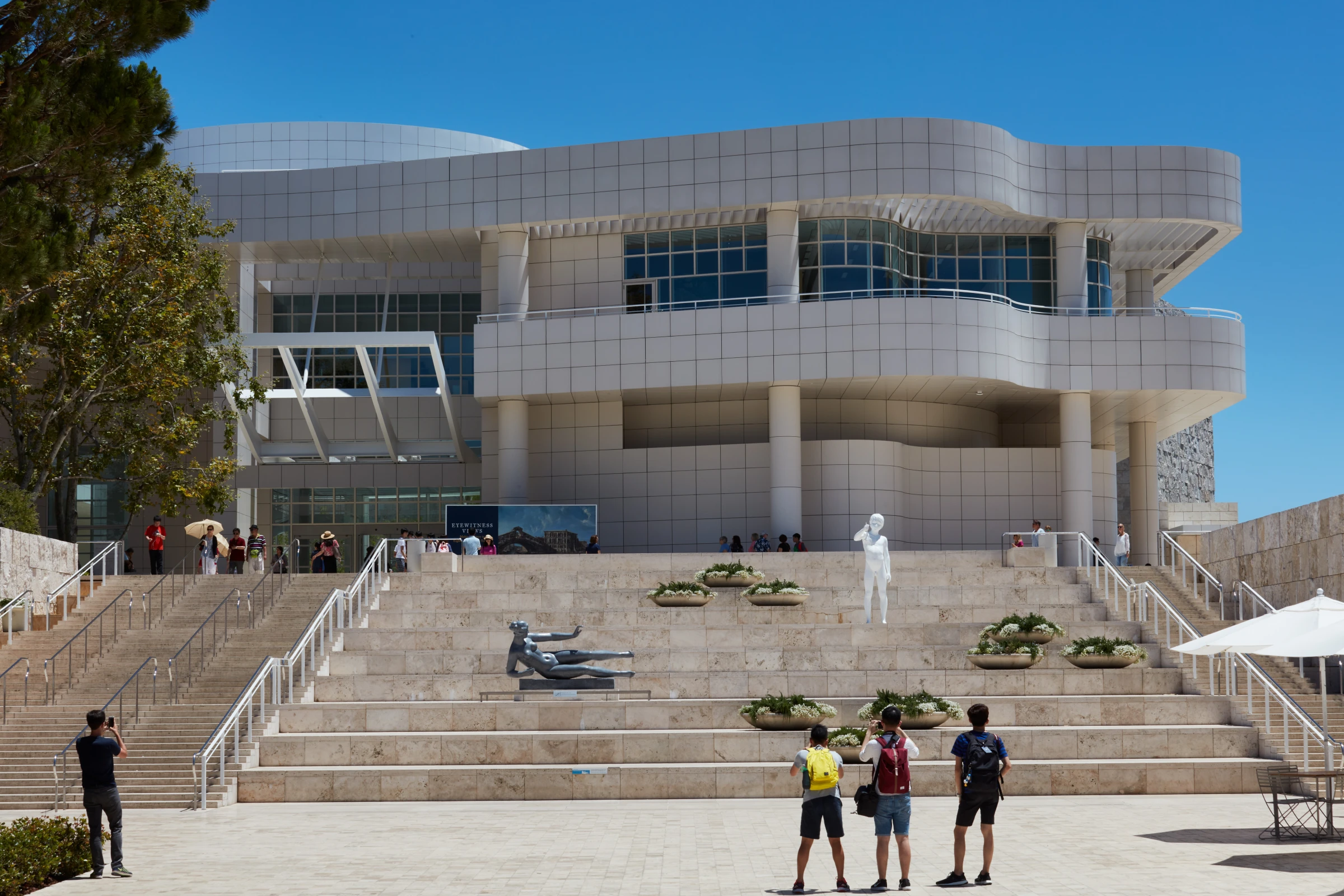
Getty Center Sets 2027 Closure Window for Major Modernization Ahead of Los Angeles Olympics
The Getty Center will close from March 2027 to spring 2028 for its first major overhaul since opening, with transit capacity, galleries, and visitor systems slated for upgrades.
The Getty Center will close on 15 March 2027 for about one year, reopening in spring 2028, according to institutional reporting and public statements. The timeline places the relaunch directly ahead of the Los Angeles Olympic cycle, when cultural traffic in the city is expected to intensify. In practical terms, the closure marks the first full-scale modernization of the hilltop campus since it opened in 1997.
Although closure announcements are often framed as maintenance, the Getty package appears more strategic. Planned work reportedly includes gallery updates, visitor welcome areas, transit improvements for the tram system, and infrastructure upgrades such as connectivity and environmental systems. Together, these are not cosmetic fixes. They are throughput and reliability investments designed for higher visitor volume and longer-term operational resilience.
The institutional communication line is consistent with this framing. The J. Paul Getty Trust has described the next phase as an expansion of access and campus performance, and visitors are already being directed to planning materials linked from the Getty visitor platform. For museum operators, that reflects a broader shift in sector priorities. Public-facing success is increasingly judged by friction reduction, predictable entry systems, digital reliability, and climate control quality, in addition to exhibitions and scholarship.
During closure, the Getty Villa is expected to remain open and absorb part of the institution's audience demand. That strategy protects public continuity but also creates curatorial and logistical pressures. Collection displays must be adapted to a different architectural context, while marketing has to reset public expectations so the Villa is read as an active destination, not simply a temporary substitute for the Center.
For Los Angeles, the decision is a reminder that major cultural infrastructure now competes in the same planning horizon as sports mega-events, transit policy, and tourism economics. Museums that delay systems upgrades risk being penalized precisely when international attention is highest. By taking the hit of a full closure earlier, Getty is trading short-term attendance loss for a stronger position during a period of exceptional citywide demand.
The project also raises an old but unresolved question in museum planning, whether campus identity can be preserved while operations are substantially retooled. Getty's architecture is part of its brand, and modernization can trigger anxiety about experiential dilution. The challenge will be to increase capacity and service quality without flattening the spatial character that made the site distinctive.
If execution holds, the 2028 reopening could become a case study for how legacy institutions prepare for peak-demand cycles without abandoning long-range stewardship standards. If it slips, the closure will read as an avoidable disruption in a city that already faces infrastructure strain. Either way, Getty's timetable has reset expectations for how proactively major museums should plan when urban, cultural, and global calendars converge.
From an operations perspective, the closure period is also an opportunity to reset maintenance cycles that are difficult to execute under full visitor load. Mechanical systems, wayfinding infrastructure, and accessibility pathways can be upgraded with less compromise when the site is not processing daily crowds. The key risk is reopening execution, because deferred testing can create bottlenecks if commissioning timelines slip.
For lenders and partner institutions, early clarity on gallery sequencing and reopening milestones will matter as much as architectural updates. Major loans are scheduled years in advance, and confidence in project delivery affects willingness to commit high-value works. Getty will likely need to communicate detailed reopening phasing to keep external partnerships stable during the transition window.