Gabrielle Goliath Takes Her Cancelled South African Pavilion Into Venice Anyway
After South Africa pulled her Venice Biennale project, Gabrielle Goliath is mounting Elegy independently in Venice, turning a state cancellation into a direct test of artistic freedom and institutional legitimacy.
Gabrielle Goliath will stage Elegy in Venice this spring despite the South African government’s decision to cancel her national pavilion project, and that reversal by way of persistence makes the story more serious than a procedural biennial dispute. According to The Art Newspaper, Goliath’s installation will run independently at Chiesa di Sant’Antonin in Castello from 5 May to 31 July, close to the official South African pavilion that will now stand empty. What was framed by the state as a cancellation has become a public demonstration of how little cultural authority an official pavilion holds once its moral legitimacy collapses.
Last year Goliath had been selected to represent South Africa at the 2026 Venice Biennale with a new iteration of her long-running Elegy cycle, a body of work that has for years centered on femicide and the murder of LGBTQI+ people in South Africa. The new version widened that mourning structure to address the Ovaherero and Nama genocide in Namibia and the killing of the Palestinian poet Hiba Abu Nada in an Israeli airstrike in 2023. Culture minister Gayton McKenzie reportedly objected to the Gaza-related component, calling it divisive. When Goliath refused to revise the work, he terminated the project.
The official justification matters less now than the precedent the move tried to establish. Goliath and curator Ingrid Masondo challenged the cancellation in South Africa’s High Court and lost at first instance, but the appeal continues. Their decision to keep fighting, even after finding a new venue, is what turns this episode from an isolated funding dispute into a constitutional question. As Goliath told The Art Newspaper, the issue is whether ministerial power can decide whose lives may be mourned and what kinds of political imagination public art is permitted to carry. That is not a niche Venice argument. It is a textbook struggle over state interference in cultural expression.
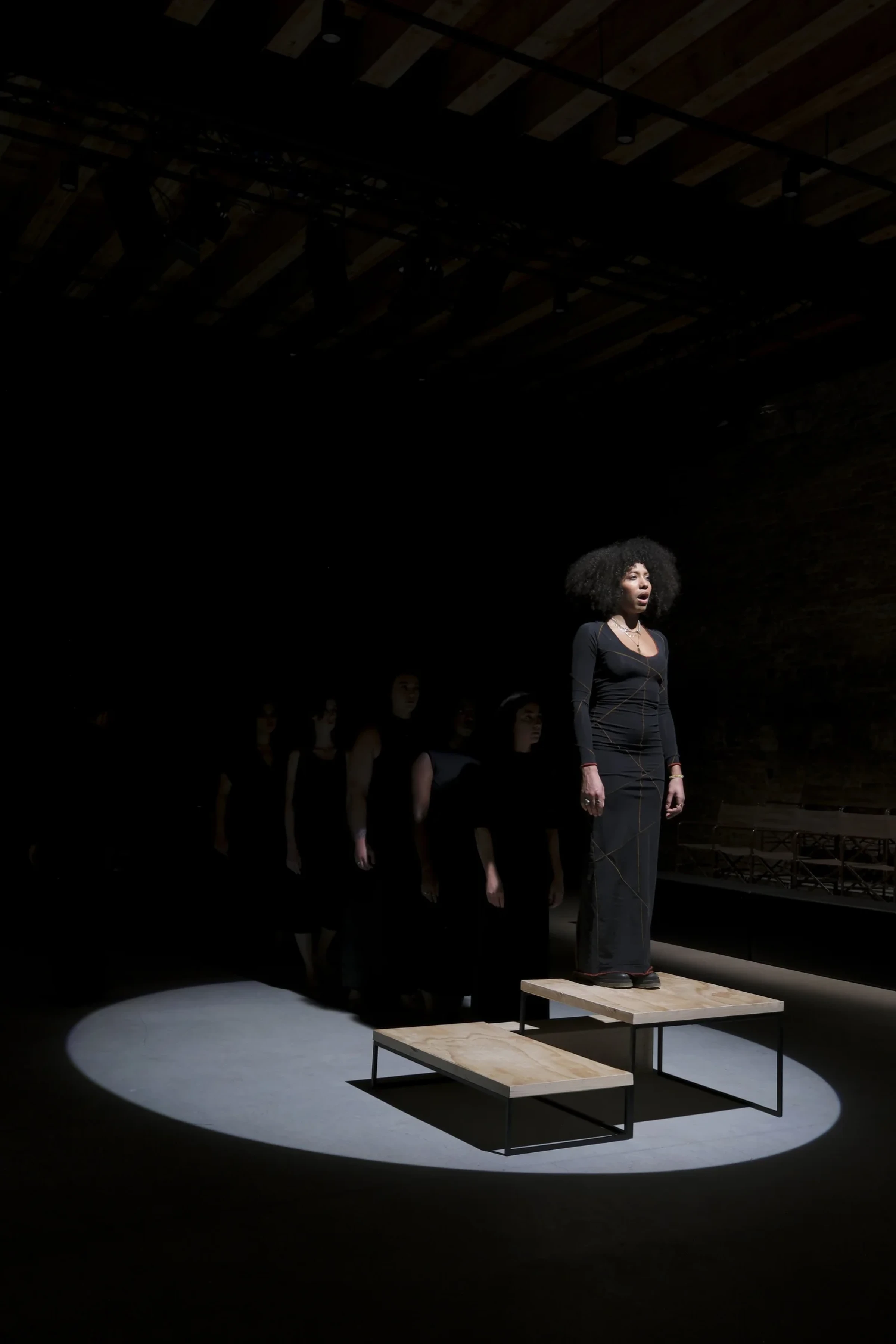
The work itself was never built for discretion. On Goliath’s project page, Elegy is framed as a durational act of collective lament, often staged through sustained vocal performance in which one singer holds a note until another steps in to continue it. The structure is simple, but it accumulates force through substitution, fatigue, and communal breath. In this context, that form becomes almost too apt. The South African state withdrew its support, and others stepped forward to carry the note.
That transfer of support should trouble any culture ministry that still wants to speak the language of representation. Once a national pavilion artist can reroute a cancelled project into the biennial city itself, the state loses its monopoly on symbolic placement. The relocation to Chiesa di Sant’Antonin makes that displacement visible in architectural terms as well as political ones. What remains visible is the emptiness of the official gesture. A vacant pavilion in Venice is not administrative tidiness. It is a material sign of censorship, avoidance, or both.
There is also a deeper geopolitical tension here. Biennials routinely speak the language of internationalism while leaning on national-pavilion structures that are inherently political, often opaque, and easily manipulated by ministries. Goliath’s case exposes the contradiction cleanly. The system says artists represent nations, but nations reserve the right to disavow artists once the content exceeds what the state finds convenient. By moving the work outside the pavilion while remaining inside Venice’s biennial ecology, Goliath has exposed how contingent official representation really is.
For curators and funders, the lesson is blunt. If institutions want to claim that art can hold grief, conflict, and historical asymmetry without being reduced to propaganda, they have to defend artists when governments retreat. Otherwise the rhetoric of artistic freedom remains decorative. Goliath’s independent Venice presentation will matter partly because of the work itself, but also because it documents a refusal. The state attempted silence; the project answered with relocation, community, and duration.
That makes Elegy more than a cancelled pavilion with an afterlife. It is now a case study in how artists can survive state abandonment without softening the work that caused the rupture in the first place. South Africa may have vacated its pavilion, but it has not escaped the comparison that empty room will invite.