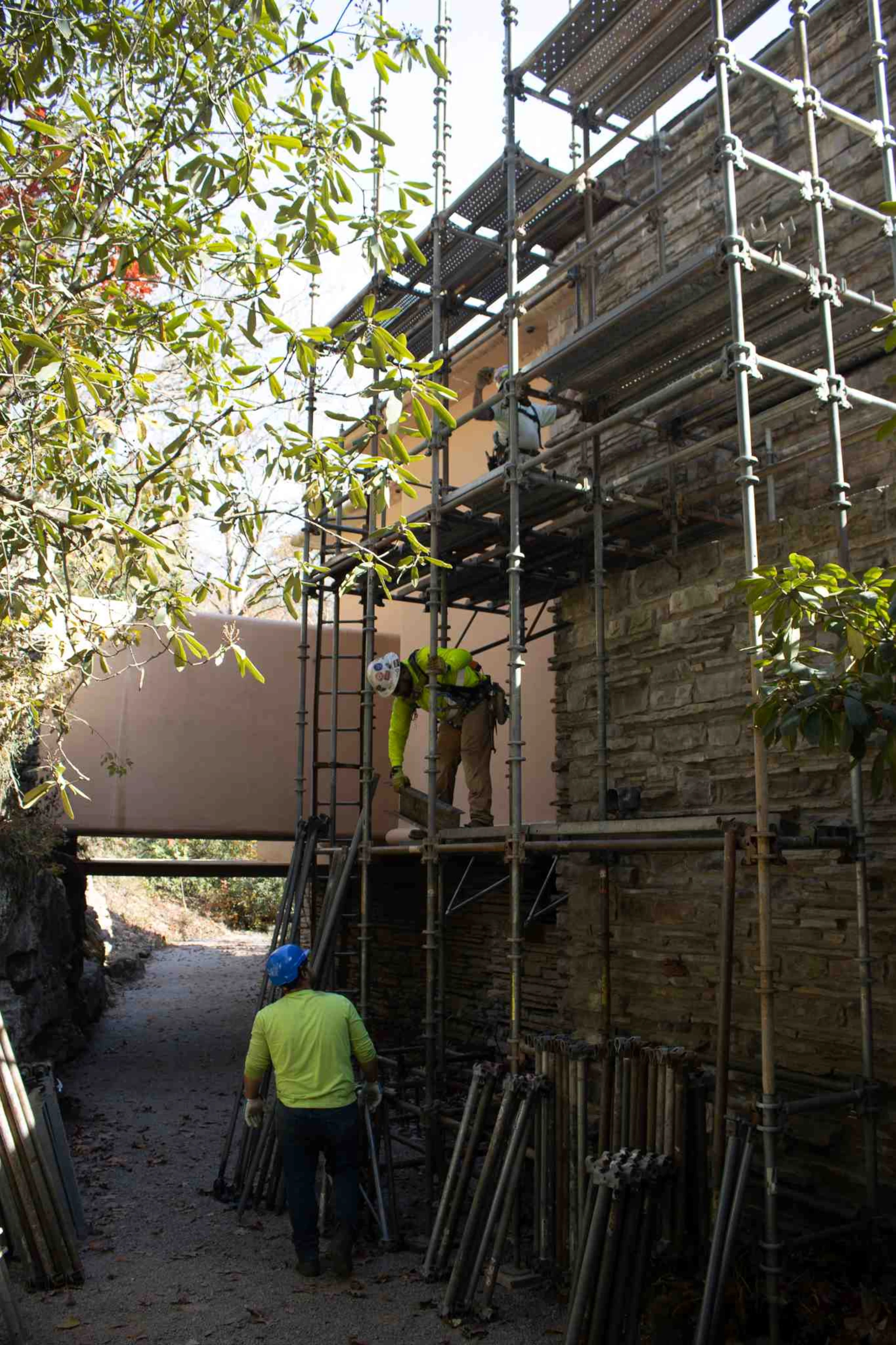
Fallingwater Completes Major Preservation Cycle, Including New Waterproof Roof System
A multi-year, $7 million preservation campaign at Frank Lloyd Wright’s Fallingwater has completed core waterproofing and envelope repairs central to the site’s long-term survival.
The completion of a major preservation cycle at Fallingwater is a reminder that modern architectural icons survive only through continuous technical intervention. The three-year, roughly $7 million campaign addressed moisture infiltration, degraded finishes, and vulnerable joints, culminating in installation of a new waterproof roof system. For a structure designed as a radical fusion of architecture and landscape, where water is both concept and physical force, waterproofing is not maintenance trivia. It is the core condition of survival.
Frank Lloyd Wright’s 1935 design for Edgar J. Kaufmann’s family retreat has always imposed unusual conservation challenges. The house’s projecting terraces, complex concrete geometry, and direct relationship to Bear Run create exposure patterns that conventional domestic preservation models do not fully cover. As conservation teams have noted repeatedly, design brilliance and material stress are inseparable at Fallingwater. The same formal decisions that made the building canonical also demand unusually intensive long-horizon care.
The recent works reportedly included roof membrane replacement, flashing repairs, masonry and stone-envelope interventions, and attention to steel-framed openings. On paper, these sound like standard envelope tasks. In practice, each intervention has to be staged around strict historic integrity requirements, specialized access constraints, visitor operations, and climate windows that can narrow quickly in western Pennsylvania. The logistics are as decisive as the craftsmanship.
The stewardship framework also matters. Fallingwater is owned and operated by the Western Pennsylvania Conservancy, and its preservation work sits inside a larger program often communicated under the World Heritage Preserved initiative. Since the site’s inscription within UNESCO’s “The 20th-Century Architecture of Frank Lloyd Wright” grouping, the expectation for preservation rigor has intensified. Global recognition raises institutional profile, but it also hardens accountability standards around documentation, technical choices, and deferred-maintenance planning.
For architecture institutions and museum-scale house museums, the larger lesson is financial and operational. Complex modern sites cannot be protected with intermittent patching cycles tied only to annual budget comfort. They require capital planning that treats water management, structural interfaces, and environmental control as recurring obligations with fixed cadence. Otherwise, conservation costs compound and emergency work becomes the default mode.
There is also a public interpretation dimension. Fallingwater has increasingly framed active restoration as part of the visitor experience, explaining scaffolding phases, restricted zones, and why specific repairs are unavoidable. That transparency model helps convert temporary disruption into institutional literacy. Audiences begin to understand that preservation is not backstage administration but a central part of cultural stewardship.
The finished roof and envelope phase does not mean an endpoint. At sites like Fallingwater, completion usually means transition to the next monitored cycle, with new diagnostics, targeted repairs, and periodic material replacement. Preservation success is measured less by dramatic unveilings than by disciplined continuity, evidence that the building can remain both visitable and authentic without drifting into facsimile.
In that sense, the current milestone is significant not because it resolves all risk, but because it demonstrates institutional willingness to fund, stage, and communicate difficult technical work before failure becomes catastrophic. For one of the most studied houses of the 20th century, that is the metric that matters: keeping the building legible as architecture while keeping it physically intact enough to outlast the next generation of weather, tourism pressure, and material fatigue.